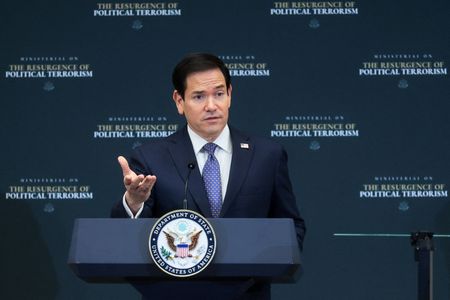

U.S. Secretary of State Marco Rubio is set to travel to Manila this Sunday for a series of high-level diplomatic meetings involving Asia-Pacific nations, where he is widely expected to sit down with his Chinese counterpart to help prepare a possible September summit between President Donald Trump and Chinese leader Xi Jinping.
Russian Foreign Minister Sergei Lavrov is also anticipated to be in Manila next week, joining gatherings that will include Chinese Foreign Minister Wang Yi as well as top diplomats from Japan, Australia, Canada, and Britain. The meetings are organized around the 11-member Association of Southeast Asian Nations, known as ASEAN.
The diplomatic activity unfolds against a backdrop of worldwide uncertainty, with the Iran war disrupting international trade and placing economic strain on countries throughout Asia.
The U.S. State Department confirmed that Rubio will attend three major forums: the ASEAN Post-Ministerial Conference, the East Asia Summit Foreign Ministers’ Meeting, and the ASEAN Regional Forum Foreign Ministers’ Meeting. His trip is scheduled to run through next Thursday, during which he will also hold meetings with senior officials from Indo-Pacific nations.
A State Department statement outlined the purpose of the visit, saying: “The Secretary’s visit advances a clear U.S. priority: a free and open Indo-Pacific that delivers safety, security, and prosperity for the region and for the American people.” The statement added that Rubio would work to strengthen the U.S. relationship with the Philippines during the trip.
While neither the U.S. nor China has officially confirmed a bilateral meeting between Rubio and Wang Yi on the sidelines of the forum, such an encounter is broadly expected, as representatives from both countries have met in similar settings before.
Analysts say that if the two top diplomats do meet, the conversation will likely center on organizing a second Trump-Xi summit this year. The two leaders last met in May, and Trump has indicated that Xi plans to visit the United States at the end of September.
Relations between Washington and Beijing have become somewhat more stable under a temporary trade truce the two sides reached in October, but significant disagreements persist. Many analysts describe the overall relationship as caught in a new form of Cold War.
Beyond the Trump-Xi summit preparations, the forum is expected to tackle tensions in the South China Sea, where multiple regional nations dispute territorial claims. The meetings also follow ASEAN foreign ministers’ informal talks last week with Myanmar’s foreign minister — the first direct face-to-face exchange since a 2021 coup prompted ASEAN to exclude Myanmar’s leaders from its sessions.
The gatherings take place shortly after the 10th anniversary of a 2016 international ruling that struck down the legal foundation of China’s broad South China Sea territorial claims — a decision Beijing continues to reject.
Philippine Foreign Affairs spokesperson Dominic Xavier Imperial said both ASEAN and China remain committed to negotiating a “substantive and effective” code of conduct for the waterway, expressing confidence that meaningful progress could be made this year.
Harrison Pretat, a maritime security expert at Washington’s Center for Strategic and International Studies think tank, anticipates that Rubio will voice U.S. concerns about China’s conduct in the South China Sea, but in a restrained manner given the Trump administration’s broader agenda with Beijing. “He will also not want that to completely derail his talks with Wang Yi,” Pretat said, “so I would expect a calibrated approach rather than an attempt to really hammer Beijing. I think China will likewise want to state their position and move on to other things — but there is always room to be surprised.”
Another Southeast Asia expert at the same think tank, Andreyka Natalegawa, said scam operations based in Southeast Asia are also likely to come up during the meetings. The Trump administration has characterized these fraud centers as costing American citizens billions of dollars annually.