
BUCHAREST, Romania — An unlikely political alliance between Romania’s main leftist party and a hard-right opposition group filed paperwork Tuesday aimed at removing the country’s center-right prime minister from office.
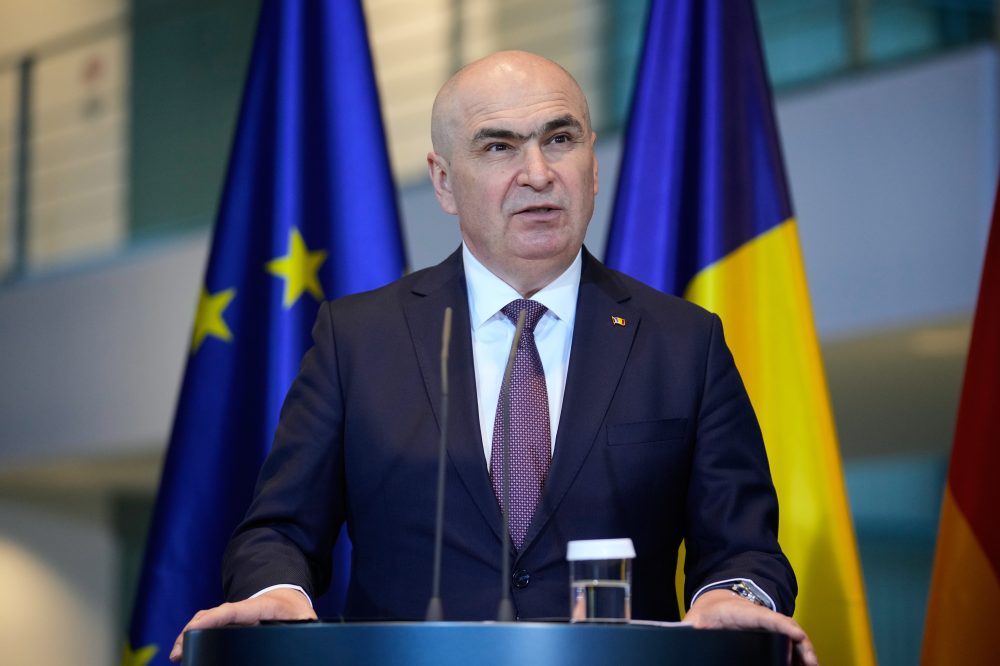
The Social Democratic Party, known as PSD and Romania’s biggest political force, teamed up with the opposition Alliance for the Unity of Romanians to present their no-confidence motion to Parliament. Their target is liberal Prime Minister Ilie Bolojan of the center-right National Liberal Party, whose pro-European coalition took power less than 12 months ago.
According to PSD officials, they have gathered sufficient backing for their effort to oust Bolojan. Alliance leader George Simion announced at Tuesday’s press briefing that their motion carries 251 signatures and predicted it would succeed “without any problems.”
Parliamentary voting on the no-confidence measure is expected to occur next week.
This political maneuvering comes after PSD abandoned the governing coalition last week, stripping Bolojan of his parliamentary majority and pushing the EU member nation into another governmental crisis.
The country has endured extended political upheaval since presidential elections were canceled in December 2024, while also wrestling with one of the European Union’s largest budget shortfalls, rising inflation, and a technical recession.
PSD President Sorin Grindeanu acknowledged Monday that “there are many things that divide us … but there is a common goal, that of voting for this motion and toppling the Bolojan government.”
“I want to be very clear, it is a parliamentary initiative, it is an initiative that currently has support beyond political color,” Grindeanu stated, noting that the far-right nationalist S.O.S. Romania party and additional right-wing factions have endorsed their effort.
Last June’s governing coalition had committed to prioritizing budget deficit reduction. However, PSD frequently clashed with Bolojan regarding various austerity policies, including increased taxes, frozen public sector salaries and pensions, and reductions in government spending and administrative positions.
In Tuesday’s statement, PSD accused Bolojan of having “failed to implement any genuine reform” during his 10-month tenure and argued Romania requires leadership “capable of collaboration.”
“In the complicated geopolitical context we find ourselves in, Romania urgently needs coherent leadership, without blockages and without political arrogance, which can ensure good administration and economic recovery,” their statement declared.
Should Bolojan’s removal succeed, PSD would become essential for establishing a pro-European parliamentary majority, though the party has previously rejected governing alongside AUR.
Siegfried Muresan, a Romanian European Parliament member from Bolojan’s National Liberal Party, defended the prime minister’s fiscal reform implementation according to coalition agreements.
Bolojan remains “serious about consolidating the budget, reforming the country, and respecting the commitments,” Muresan explained to the Associated Press. “The Socialist Party has now decided all of a sudden not to continue supporting this prime minister, to oppose the reforms and the measures which they all agree to in the coalition.”
Bucharest political analyst Cristian Andrei predicts Romania will probably encounter “a long crisis” following the vote, which “breaks the pro-European coalition and offers the populist party, AUR, a place at the mainstream table.”
“For PSD it’s a power play and a way to get back in touch with and to signal to its former voter base that has migrated toward populist parties,” he explained. “PSD wants to be great again, to regain the status of the party in charge. AUR gains a respectability aura and it shows a strong position in the Parliament, at the same time with PSD moving towards populism at speed.”
Under the original power-sharing arrangement, the prime ministerial role was scheduled to transfer from Bolojan to a PSD leader in 2027, with general elections planned for 2028.