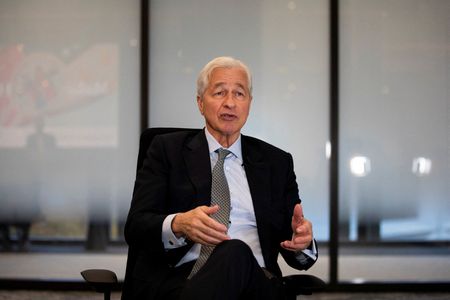

The head of the country’s largest bank is taking aim at federal regulators, accusing them of manipulating the numbers when it comes to how much money big banks must keep on hand to cover potential losses.
JPMorgan Chase CEO Jamie Dimon made the remarks Tuesday during a quarterly earnings call, escalating his ongoing criticism of proposed capital rules that he says unfairly single out his bank and other large, diversified financial institutions — while giving an advantage to major Wall Street trading firms.
“They should not do the numbers in a false way to make the number higher,” Dimon said. “The number should be the number. If they think we should have more capital, they should ask us… I’m not happy to have these numbers falsely done.”
Dimon has argued that the proposed changes to how banks calculate required financial reserves are “unfair” and hit broad-based banks harder than their competitors. JPMorgan has previously stated it would face roughly a 4% increase in capital requirements under the new proposals, while rival institutions would see an average reduction of about 4.8%.
The Federal Reserve is leading the rulemaking effort alongside two other federal banking regulators. A Fed spokesperson did not respond to a request for comment on Dimon’s criticism.
The proposals were unveiled in March and are considered significantly more favorable to the banking industry than an earlier 2023 draft put forward under Democratic regulatory leadership — a version that stalled amid industry opposition and the change in presidential administration. Still, Dimon has been one of the loudest voices against the current proposals, particularly regarding how a special capital surcharge applied to the nation’s largest and most systemically important banks is calculated.
On Tuesday, Dimon again called on the Fed to update the surcharge’s formula to fully account for economic growth since the central bank first imposed it in 2015. Doing so, he argued, would reduce how large banks appear relative to the broader economy on paper, thereby lowering the resulting charge.
The Fed has also proposed reducing the weight given to banks’ reliance on short-term wholesale funding in that surcharge calculation — a change that is expected to benefit firms that rely heavily on such funding, as opposed to banks with large customer deposit bases.
JPMorgan Chief Financial Officer Jeremy Barnum echoed those concerns on the same call, warning that the current direction of the rules could hurt everyday Americans.
“I don’t understand why you would want that as a policy outcome, because it is disproportionately damaging the ability of banks to serve Main Street,” Barnum said. “If that’s not what they want, then they shouldn’t let it happen by accident.”
Despite the regulatory friction, JPMorgan reported record profits for the second quarter, fueled by a surge in investment banking fees — the highest since 2021 — driven by a wave of major IPOs and corporate deal activity, along with strong performance from its trading operations during a period of market volatility.
Fed Vice Chair for Supervision Michelle Bowman has indicated she hopes to have the rule-writing process completed before the end of this year. The agencies are working to finalize several capital-related proposals, including rules governing how banks weigh different types of risk and the surcharge applied to the country’s most critical financial institutions.