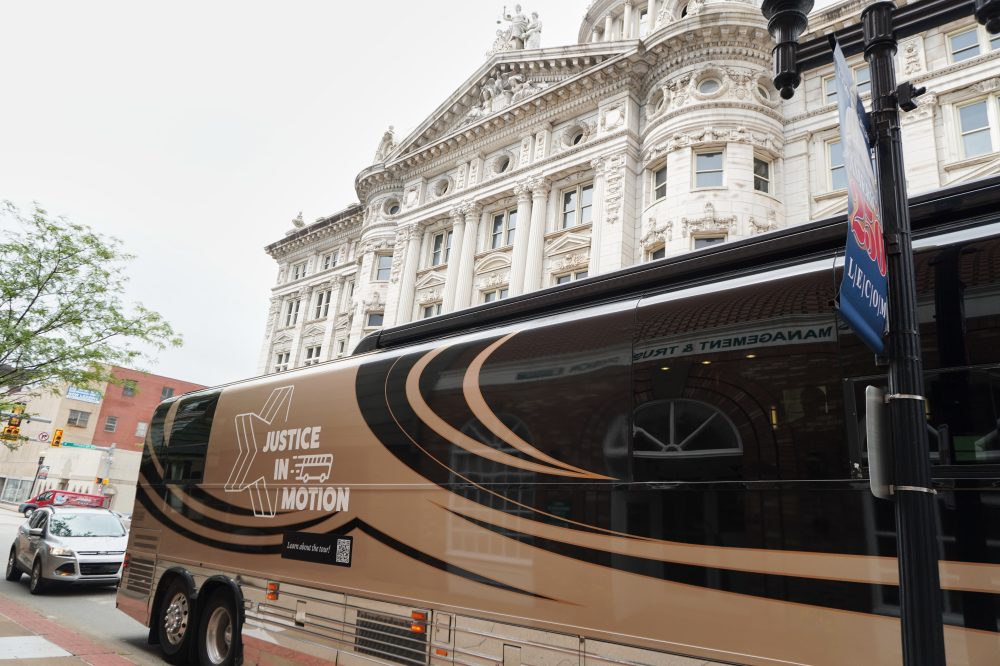

A bus loaded with retired judges rolled through the American Rust Belt this week, stopping in small towns and major cities alike to deliver an urgent message: the rule of law in the United States is in serious jeopardy.
The four-day tour — called “Justice in Motion” — wrapped up Friday with a stop at a library in Grosse Pointe, a well-to-do suburb just outside Detroit. It marked the final destination of an unusual journey that took the judges through corn fields, coal towns, and urban centers across Ohio and Pennsylvania.
The timing was deliberate. Organizers chose the nation’s 250th anniversary as the backdrop for what they described as a dire warning about American democracy and the independence of its courts.
“Looking back in history, we have teetered,” said former Ohio Supreme Court Justice Michael Donnelly. “This is a moment where we can decide to reinstill those beliefs that we are a country of laws and not of men.”
The tour represents a significant break from the traditionally quiet and guarded nature of the judicial branch. Federal judges, in particular, typically confine their public remarks to the courtroom and their written rulings. But that long-standing restraint has been eroding.
President Donald Trump has repeatedly questioned the fairness of the judicial system and called a district judge who ruled against one of his immigration policies “crooked.” He has also suggested, without providing any evidence, that Supreme Court justices who struck down his tariffs were acting in the interests of foreign powers. Meanwhile, the administration has openly defied orders from U.S. district courts and pushed an expansive interpretation of executive authority.
More federal judges have recently come forward to report receiving death threats and offensive messages, though they have stopped short of blaming Trump or any specific officials. U.S. Supreme Court Chief Justice John Roberts addressed the situation in March, warning that personal attacks on federal judges were dangerous and needed to stop. That rare public statement came just two days after Trump’s “crooked” judge comment, though Roberts did not name anyone directly.
According to the U.S. Marshals Service, threats against federal judges reached 564 during the government fiscal year ending in September — up from 509 the previous year.
“I don’t want to say we have moved into an era of lawlessness, but it sometimes feels that way,” said former U.S. District Court Judge Victoria Roberts, who joined the tour at its Michigan stop.
Former federal judge Timothy Lewis, also on the tour, said his worries about the politicization of the courts reached a breaking point about a decade ago, when Senate Republicans blocked President Barack Obama’s nomination of Merrick Garland to the Supreme Court. Lewis, who served seven years on the 3rd U.S. Circuit Court of Appeals, now believes the rule of law faces an “existential threat” from the steady erosion of democratic norms.
“I have fundamental concerns about where we are headed as a nation,” Lewis said.
The tour kicked off Tuesday in Greensburg, a western Pennsylvania town that was once a center of the coal industry. Judges chatted with patrons at a local coffee shop before speaking at the historic Westmoreland County Courthouse. The group then traveled to Washington, Pennsylvania — a town of about 13,000 people where roughly 15% of the population is Black, and which served as both a stop on the Underground Railroad and a regional hub for the Civil Rights Movement.
On Wednesday, the bus headed west to Columbus, Ohio, and then to Wooster in Amish country, with a stop at a Cracker Barrel along the way. Thursday brought events in Cleveland before the group circled north around Lake Erie into Michigan.
The tour was organized by two nonpartisan advocacy groups — the Democracy Rising Collaborative and Keep Our Republic — who drew inspiration from a similar effort in Poland in 2021. After that country’s ruling party seized control of key judicial institutions, independent Polish judges traveled to towns across the country to educate citizens about the constitution and the rule of law.
About 30 judges are participating in the U.S. tour, including two former federal judges and one current federal judge. Of the federal judges, one was nominated by a Democrat and the other two by Republicans. The state judges, some still serving on the bench, come from both parties. They have been joined by former Pennsylvania Gov. Tom Corbett, former Ohio attorneys general, and several lawyers.
Former Ohio Supreme Court Chief Justice Maureen O’Connor said judges who stay silent risk allowing “voices of misinformation” to define the public’s understanding of the judiciary. She pointed to a letter she still keeps from years ago, in which the writer accused her — a Republican — of betraying her party when she repeatedly struck down Republican-drawn legislative maps as illegal gerrymanders.
“There was just a basic misunderstanding of what my role was as a judge,” O’Connor said.
Donnelly put it plainly when describing what is ultimately at stake: “The lifeblood of the judiciary is public confidence. If you lose that, it’s very difficult to get it back.”