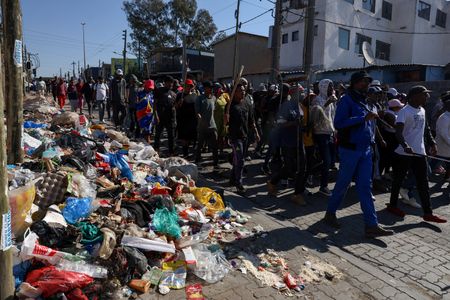

JOHANNESBURG — Anger over joblessness, crime, and years of sluggish economic growth has been driving a wave of anti-migrant protests across South Africa. But economists are sounding the alarm: pushing out foreign workers could actually harm the very businesses and job markets that protest organizers claim they want to defend.
Anti-migrant feelings have been growing sharply in recent months, reaching a peak with a nationwide demonstration on June 30. While the protests were mostly peaceful, the threat of violence has been enough to send thousands of African migrants packing and leaving South Africa behind.
Their exit, economists say, threatens to leave serious gaps in industries that have depended heavily on foreign labor — including construction, farming, delivery services, and small neighborhood shops — while also weakening the country’s large informal economy.
Mpho Lenoke, a lecturer at North-West University, explained that migrants tend to fill roles that are hard to staff. “Migrants typically find work in sectors where vacancies are difficult to fill, including farming, construction, hospitality, retail, transport and the informal sector,” Lenoke said.
United Nations figures show that approximately 2.6 million migrants were living in South Africa as of 2024, making up roughly 5% of the total population. Although current data on their economic impact is limited, estimates from the OECD and ILO based on 2010 modeling put migrants’ contribution to the country’s GDP at around 9%.
Lenoke also noted the broader benefits migrants bring. “Many foreign nationals are starting businesses that employ South Africans and bring competition, which is good for consumers,” she said. “International experience suggests that restrictions on migrant labour often have unintended economic consequences.”
The protests have already caused visible disruptions in parts of the retail world. Foreign-owned spaza shops — informal convenience stores typically run out of garages, makeshift stalls, or shipping containers — play a significant role in South Africa’s informal economy, supporting wholesalers, property owners, and local workers alike.
Sixty60, the grocery delivery service operated by Shoprite Group, Africa’s largest food retailer, experienced service disruptions during the most recent wave of protests. According to company figures, fewer than one in four of its delivery drivers held South African citizenship.
The anti-migrant movement has been gaining strength for years as South Africa has struggled with weak economic performance. The World Bank lowered its 2026 growth forecast for the country to 1.0% in June, down from a previous estimate of 1.4%. Meanwhile, Statistics South Africa reported an unemployment rate of nearly one-third during the first quarter of the year, leaving 8.1 million people out of work.
Those difficult conditions have stoked resentment toward migrants. However, a study conducted by the International Labour Organization using labor force survey data found that when immigrant participation in the workforce rises, job opportunities for South African-born workers tend to increase as well.
Beyond the labor market, protests themselves can damage the economy through looting and forced business closures, according to Susanna Deetlefs of ACLED. “Supply chains are disrupted, jobs are lost, and access to goods and services is curtailed when tensions escalate,” she said.
So far, investors have not panicked, but they are taking note of the growing unrest as a new risk factor. “It is a significant social problem in South Africa that investors keep hearing about, but they actually haven’t seen an actual real-life impact of it,” said Kaan Nazli, an emerging markets debt portfolio manager at Neuberger Berman. “Now, with these protests, this is a risk.”
The consequences stretch well beyond South Africa’s borders. According to ILO data, South Africa is the region’s primary source of remittances and its largest host of working-age migrants. A joint report from FinMark Trust and the South African Reserve Bank found that money sent out of the country more than tripled between 2016 and 2024, reaching over 19 billion rand — approximately $1.16 billion — in 2024.
Nearly 90% of those transfers to southern Africa went to Lesotho, Malawi, Mozambique, and Zimbabwe, with Zimbabwe alone receiving more than 60% of the total amount.