
MIAMI (AP) — Ashleigh Hallam spends her days teaching English to non-native speakers at a library in Indiana. These days, soccer is returning the favor — giving her an unexpected introduction to Spanish.
For Hallam, watching this World Cup on a Spanish-language channel just makes sense.
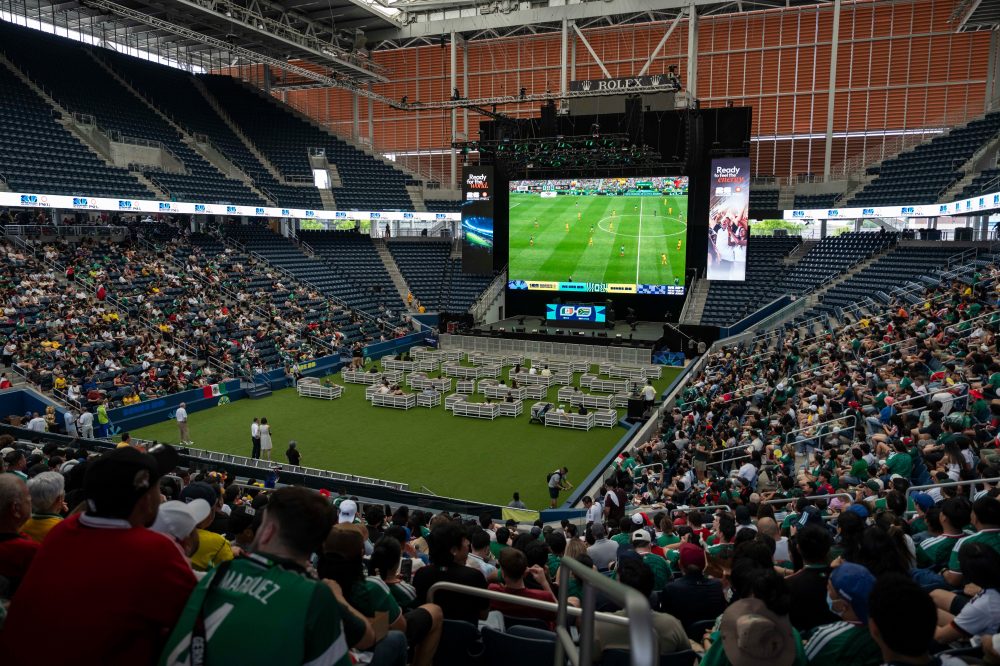
She’s part of a surprisingly large group of English-speaking Americans who have been tuning into World Cup matches on Telemundo — despite having limited or zero understanding of what the commentators are actually saying.
“I can’t really understand everything they’re saying on Telemundo because they’re speaking in Spanish,” Hallam said. “But you understand what’s going on.”
The numbers tell an interesting story. U.S. Census data shows that approximately 20% of the American population is Hispanic, yet Telemundo, citing Nielsen ratings, says that close to half of all World Cup viewers in the country have watched at least a portion of the tournament in Spanish. Every match has been available in English through Fox or FS1, in Spanish on Telemundo or Universo, and through streaming platforms like Fox One or Peacock.
Viewers who spoke with The Associated Press gave several reasons for making the switch: the thrill of beloved announcer Andrés Cantor’s iconic “¡goooooool!” call; the fact that Telemundo keeps the camera on the field during hydration breaks instead of cutting to commercials like Fox does; a general sense that the Spanish broadcasts are simply more fun to watch; and for some, a financial reason — Peacock, which carries Telemundo, costs less than Fox One.
Jackson Braunius, originally from Michigan, watched a U.S. match from a barstool at a steakhouse in Miami Lakes, Florida. He admitted his Spanish vocabulary is almost nonexistent — “I know ‘cerveza,’” he said, tapping his beer — but said watching on Telemundo didn’t bother him at all.
“I figured out the science here,” Braunius said. “When they’re not talking too loud, nothing is happening. When they get loud, there’s a chance. When they get real loud, it’s probably going to be a goal.”
Comedian Trevor Noah has been hosting World Cup watch parties on YouTube and made the move to Spanish-language broadcasts himself, largely because of the commercial break issue.
“We’re seeing the players on the pitch discussing what’s happening. You see which coach is more stressed. Some players are tapping each other on the back. This is part of the game,” Noah said during one of his YouTube streams. “I feel like when you cut to ads, you lose this — you lose the stress, you lose the joy, the anticipation. So, shout out again, Telemundo: Really, really amazing coverage.”
Telemundo has acknowledged the wave of praise, publicly thanking English-speaking viewers — and Noah personally — for the kind words about its coverage.
Meanwhile, there appear to be plenty of viewers to go around. The tournament’s strong performance could spark a competitive bidding situation for the 2030 World Cup rights, with reports indicating that English-language and Spanish-language broadcast rights may be bundled together in that deal — something that was not the case for this tournament.
Fox Sports reported that the Belgium-U.S. match on Monday night peaked at around 41 million viewers at one point, calling it the “most-watched soccer telecast in U.S. history.” Combined viewership between Fox, which averaged 33 million, and Telemundo, which drew an estimated 12 million, put the average at no fewer than 45 million — making it the most-watched U.S. broadcast event since the Super Bowl. For comparison, the most recent Super Bowl drew an average audience of roughly 125 million, according to Nielsen data.
William Kennedy of Miami is married to a Colombian woman whose first language is Spanish. He says he only knows enough Spanish to order food at a restaurant, yet he frequently finds himself watching World Cup matches on Telemundo.
When Colombia was playing, the Kennedy household was definitely on Telemundo. Even after Colombia was eliminated in a penalty shootout against Switzerland, Kennedy said he still tends to drift toward Telemundo.
“When the American commentators are doing the game, I don’t know what game they’re watching. I just don’t,” Kennedy said. “I’d rather get the excitement in Spanish because essentially what happens is they’re talking, and then they’re talking really, really fast, and then they’re getting loud and your brain is just like, ‘Oh, something’s happening — even if I don’t know what’s happening.’”
Hallam said the World Cup has actually strengthened her connection with her Spanish-speaking students. She only became a serious soccer fan a few years ago when her daughter wanted to join a recreational league for elementary school-aged kids. The league needed coaches, so Hallam literally checked out a “coaching for dummies” book and taught herself the sport from scratch.
She went on to coach her daughter all the way through high school. Now she’s a devoted soccer fan and a devoted Telemundo viewer — and she plans to keep watching Spanish-language broadcasts long after the World Cup wraps up.
“It’s just very comforting,” Hallam said. “We’ve really enjoyed it and I hope we get to continue. The next World Cup, we’re going to watch it just like this.”