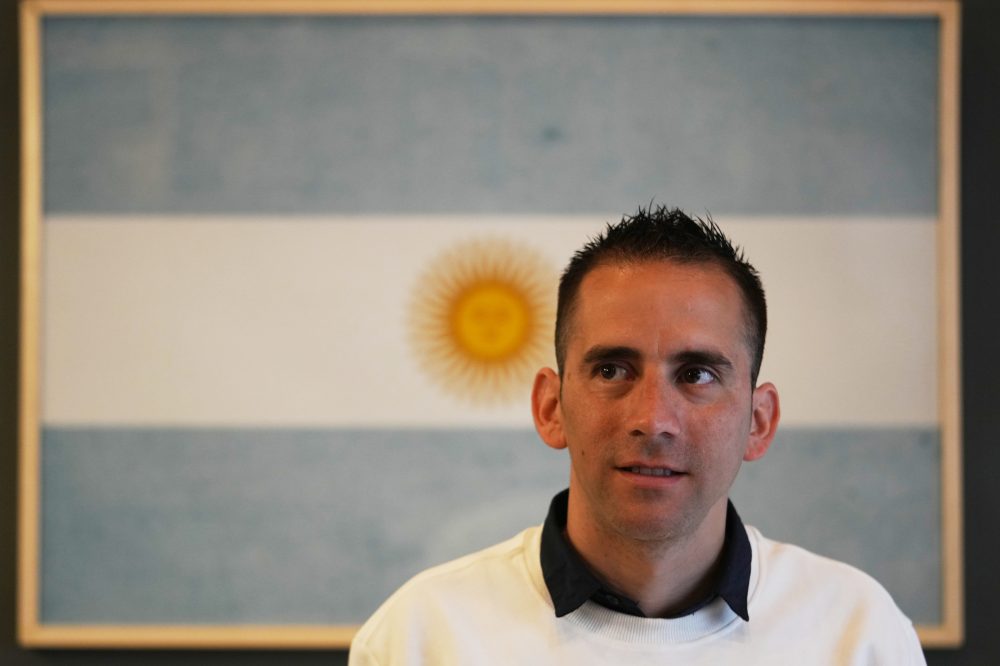

BUENOS AIRES, Argentina — A man from Argentina who was held in Venezuelan custody for 448 days issued an appeal Friday for global leaders to intensify efforts pressuring the administration of interim Venezuelan President Delcy Rodríguez to free other detainees.
Nahuel Gallo, age 35, gained his freedom on March 1 following his arrest on spy-related charges leveled by the administration of former President Nicolás Maduro, who has since been removed from power.
“I think we’re still imprisoned until our fellow inmates are freed,” Gallo told The Associated Press.
Throughout his nearly 15-month incarceration, Gallo reported suffering physical assaults, inadequate healthcare, and relentless mental torment while confined at Rodeo I facility.
Since assuming the role of acting president following Maduro’s January apprehension by U.S. forces, Rodríguez has pledged democratic changes, and Venezuelan officials have previously rejected accounts of prison mistreatment. However, opposition voices maintain that hundreds continue to be held on political grounds.
According to Gallo, these ongoing imprisonments demonstrate that Venezuela’s oppressive apparatus continues to function.
During a Thursday meeting in Buenos Aires with U.S. Ambassador to Argentina Peter Lamelas, the diplomat issued a statement declaring that “the Maduro regime in Venezuela used the arbitrary detention of foreign citizens as a tool of political repression.”
Earlier this week, National Assembly President Jorge Rodríguez — who is the interim president’s brother — revealed intentions to free 300 prisoners, including some whom human rights organizations view as politically motivated cases.
Gallo’s arrest occurred on Dec. 8, 2024, during his attempt to cross into Venezuela for a visit with his Venezuelan partner, María Alexandra Gómez García, and their child, who was under 2 years old at the time.
While passing through border control, Venezuelan officials examined his mobile device and discovered WhatsApp messages between him and his partner discussing Venezuela’s political and economic circumstances.
“You’re criticizing my president,” Gallo recalled officers telling him.
He was subsequently taken to the General Directorate of Military Counterintelligence, where he reported being restrained, struck, and kicked during questioning sessions.
Following this, he was placed in a truck where agents persisted with interrogation after discovering contacts connected to Argentine legal institutions on his phone.
“You are a spy. You work for the government,” he recalled them saying while threatening to throw him from the vehicle, pressing a gun against his head and pointing a Taser at him.
Almost three weeks following his detention, then-Venezuelan Attorney General Tarek William Saab charged Gallo with engaging in “terrorist actions” against Venezuela.
Throughout his nearly 15-month stay at Rodeo I, Gallo reported having zero communication with Argentine representatives and receiving no updates about potential release discussions.
Gallo painted a picture of brutal circumstances within the facility. Healthcare was severely restricted. Prisoners received only brief daily periods for bathing, laundering, and restroom use. Guards regularly deployed pepper spray against inmates.
His foreign status prohibited him from receiving visitors. His first conversation with his wife occurred only after a full year behind bars and following his decision to begin a hunger strike.
The experiences that continue to trouble him most involve witnessing guards assault prisoners in adjacent cells.
“I think the greatest torture is seeing something being done to someone else and not being able to do anything,” Gallo said.
He currently utilizes social media platforms to expose Venezuelan prison conditions and campaign for those who remain incarcerated.
“The person who’s still inside is waiting for the one who got out to do something,” he said.
Gallo continues to recall the words his fellow prisoners shared as he departed Rodeo I: “Gallo, don’t forget about us.”