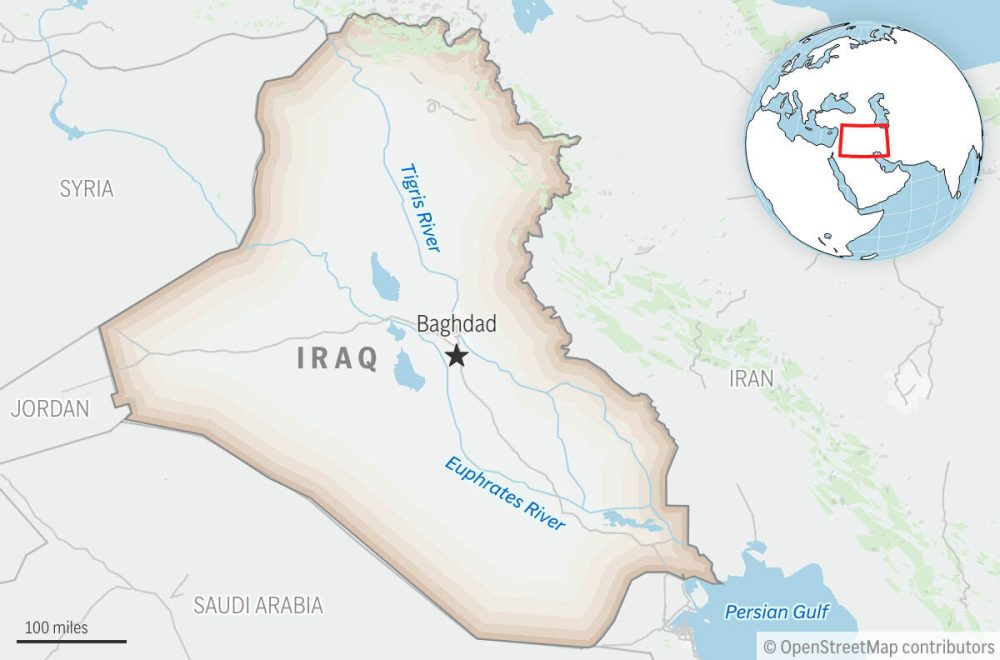

BAGHDAD (AP) — Regional tensions are rising as Gulf Arab nations have thrown their support behind Kuwait in a renewed territorial disagreement with Iraq concerning their shared maritime boundaries in the Persian Gulf.
The conflict escalated after Baghdad recently provided the United Nations with maps and coordinates outlining what it considers Iraqi territorial waters — boundaries that Kuwait argues violate its sovereign territory.
While diplomatic ties between the two nations have strengthened following the removal of Saddam Hussein in 2003 — who launched an invasion of Kuwait in 1990 — disagreements over water boundaries continue to create ongoing tensions.
According to Kuwait’s foreign ministry, Iraq’s territorial claims violate Kuwaiti sovereignty by incorporating areas that belong to Kuwait, specifically the Fasht al-Qaid and Fasht al-Aij shoals, into Iraqi territory.
Several of Kuwait’s regional allies have expressed support for its position, with Qatar, the United Arab Emirates, and Oman releasing solidarity statements. Saudi Arabia expressed “serious concerns” regarding Iraq’s maritime map, stating it also intrudes upon a jointly administered Saudi-Kuwaiti area.
In response, Iraqi Foreign Minister Fuad Hussein stated Monday that Kuwait had “deposited its maps with the United Nations in 2014, without consulting Iraq at the time.”
Hussein emphasized that Iraq remains dedicated to “the provisions of international law and … to regulating its maritime rights within the established legal frameworks, thereby contributing to the strengthening of stability and cooperation in the region.”
Back in 2019, Iraq filed a formal complaint with the UN, claiming Kuwait was implementing a “policy of fait accompli by creating a new situation that changes the geography of the region” following construction of a port facility on the Fasht al-Aij shoal.
The two countries have maintained a long-standing disagreement over Khor Abdullah, a narrow channel shared between Iraq and Kuwait that flows into the Persian Gulf.
While both nations signed an accord in 2012 governing navigation through the waterway, two Iraqi legislators challenged the agreement in 2023, claiming it violated Iraq’s sovereignty and lacked proper parliamentary approval. Iraq’s Federal Supreme Court later invalidated the agreement.