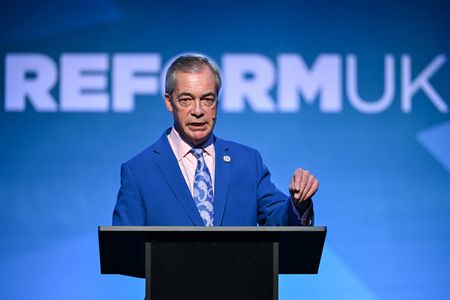

Nigel Farage’s Reform UK political movement continues to dominate British polling data ahead of upcoming local elections in May and the next national election scheduled by 2029, surpassing both the ruling Labour government and Conservative opposition with a controversial policy agenda.
The populist party has unveiled a comprehensive platform centered around strict border enforcement, economic restructuring, and cultural nationalism.
BORDER ENFORCEMENT AND MASS REMOVALS
Under the leadership of former Goldman Sachs executive Zia Yusuf, who oversees domestic policy, Reform UK proposes launching a comprehensive five-year initiative called “Operation Restoring Justice” designed to locate, detain and remove undocumented immigrants while discouraging future arrivals through rapid enforcement.
The party intends to establish Secure Immigration Removal Centres within 18 months, creating capacity to remove up to 24,000 undocumented individuals monthly. Reform UK estimates it could remove as many as 600,000 asylum seekers, including families with children, during its first term in office.
Reform UK also plans to withdraw from the European Convention on Human Rights, claiming the Strasbourg-based tribunal prevents Britain from conducting removals. The party would eliminate the Human Rights Act 1998, which incorporates ECHR protections into British law, replacing it with domestic legislation.
The party, which frequently characterizes unauthorized immigration as an “invasion,” proposes establishing a new Deportation Command modeled after U.S. Immigration and Customs Enforcement.
Simultaneously, Reform UK would attract wealthy foreign investors through a “Britannia investor visa” program, offering 10-year residency permits for £250,000 ($334,000) with exemptions from UK taxation on international earnings.
FISCAL RESTRUCTURING AND JOB CUTS
Former Conservative minister Robert Jenrick leads Reform UK’s economic policy development, proposing a restructured financial framework governed by “strict fiscal rules” to control mounting national debt through targeted spending reductions.
The party would terminate benefit payments to foreign nationals, increase immigration health charges, and limit foreign aid expenditures.
Additional savings would come from eliminating 68,500 government positions, reducing welfare distributions, and shifting new public employees from guaranteed pension benefits to contribution-based retirement plans.
While respecting Bank of England autonomy, Reform UK would seek greater business representation on monetary policy committees. The party would delay tax reductions until achieving “fiscal headroom necessary” but promises cuts when financially feasible.
ENERGY EXPANSION AND CLIMATE POLICY REVERSAL
Richard Tice, a former property developer directing business, trade and energy policy, advocates maximizing domestic oil and gas production while rapidly expanding nuclear power generation.
Reform UK would eliminate net-zero carbon targets and zero-emission vehicle requirements. The party supports “buying British” policies for government procurement and would impose “tight quotas and significant tariffs” to prevent Chinese electric vehicle market dominance.
Reform UK opposes Labour’s 2025 Employment Rights Bill, arguing the legislation destroys youth employment by increasing business costs through expanded sick pay, parental leave, and restrictions on dismissal practices.
HOSPITALITY SECTOR SUPPORT
Under the slogan “save our pubs,” Reform UK proposes reducing hospitality VAT to 10% and eliminating employer National Insurance increases. The party would cut beer duty by 10% and gradually eliminate business rates for all public houses.
EDUCATIONAL NATIONALISM AND VOCATIONAL TRAINING
Former Conservative Home Secretary Suella Braverman oversees education policy, advocating for a “patriotic, balanced curriculum” to foster British pride while opposing “woke ideology.” The party supports stricter school discipline and prohibiting social and gender transitioning for students.
At the university level, Braverman wants to redirect young people away from “Mickey Mouse courses” by establishing a target for 50% of youth to enter trades, addressing shortages in nursing, construction and caregiving. She has not identified which academic programs Reform UK considers inadequate.
As equalities policy director, Braverman would eliminate diversity, equity and inclusion requirements, claiming they promote left-wing ideology, and would repeal the Equality Act of 2010, which strengthened anti-discrimination protections. The party would also abolish the government equalities minister position.
CRYPTOCURRENCY ADVANCEMENT
Reform UK proposes introducing a Cryptoassets and Digital Finance Bill to encourage cryptocurrency adoption, including reduced capital gains taxation on digital assets and establishing a bitcoin reserve fund at the Bank of England.