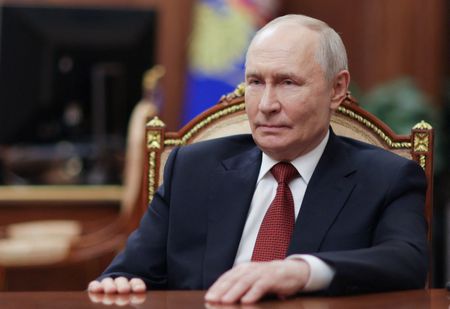

Russian President Vladimir Putin announced Sunday that Russia has no intention of slowing its military push to seize full control of four Ukrainian regions, dismissing a recent Ukrainian proposal aimed at reducing the intensity of the ongoing conflict, now in its fifth year.
Speaking in an interview with Russian state television, Putin said Russia also needs to rapidly expand its air defense capabilities in response to a growing wave of Ukrainian drone strikes targeting the country’s oil sector. He maintained that Russia is handling the fuel supply disruptions caused by those attacks.
Earlier that same day, Putin acknowledged at a Kremlin meeting with government ministers and senior officials that the drone strikes had caused fuel shortages in several Russian regions — but insisted the situation was under control.
During the television interview, Putin addressed a Ukrainian proposal calling for both sides to stop launching long-range strikes as a possible step toward peace. He dismissed the idea, saying Moscow viewed it as nothing more than a tactic to ease military pressure on Ukrainian forces along the 1,250-kilometer (775-mile) front line.
“It is clear why this proposal is being made, because our counter-strikes deep into Ukrainian territory are much stronger, have greater impact and are, frankly, more destructive,” Putin said.
“Given their catastrophic shortage of personnel, the Ukrainian Armed Forces apparently believe this could be their salvation. But saving the Kyiv regime is not part of our plans,” he added.
A spokesperson for Ukrainian President Volodymyr Zelenskiy did not respond to a request for comment on Putin’s statements, as the request was submitted during late-night hours in Ukraine.
Earlier this month, Zelenskiy sent Putin an open letter requesting a direct, face-to-face meeting — an invitation the Russian leader has turned down.
Putin framed Ukraine’s ongoing strikes as an attempt to pull Russian forces away from their core military goals, saying the attacks were “aimed at diverting our attention and forces from achieving the main objectives – the complete liberation of Donbas and Novorossiya.” That phrase refers to the Donbas region as well as the neighboring regions of Zaporizhzhia and Kherson.
Putin has consistently demanded that Ukraine give up its remaining positions in the Donetsk region of Donbas as a fundamental condition for any peace agreement. Seven months after launching its 2022 invasion, Russia formally annexed all four regions — Donetsk, Luhansk, Kherson, and Zaporizhzhia — though it only partially controls the latter two.
On the subject of Ukraine’s drone campaign, Putin said the top priority is to “quickly and significantly ramp up production of those air defence systems that are most needed.”
He also downplayed the impact of the strikes, saying: “All the strikes, wherever they hit our infrastructure, absolutely do not affect the situation on the front, on the line of combat contact.”
Putin said Russia is anticipating a renewed round of U.S.-led diplomatic efforts to end the war, including a planned return visit to Moscow by U.S. envoys Steve Witkoff and Jared Kushner — but only after the “hot phase” of the U.S.-Israeli conflict with Iran has concluded.
He also appeared to align with remarks made last week by U.S. Secretary of State Marco Rubio, who said no formal agreement came out of Putin’s talks in Alaska with U.S. President Donald Trump, though American proposals were discussed.
“Nobody signed anything, but we talked about certain possibilities for ending the conflict in Ukraine,” Putin said, adding that the U.S. side had asked Russia for compromises as part of those discussions.
Putin also suggested that Belarusian President Alexander Lukashenko — with whom he held two days of talks this week — could play a role in facilitating peace negotiations. He made no mention of Ukraine’s claims that Russia is trying to draw Belarus more deeply into the conflict. While Belarus allowed Russian forces to use its territory during the February 2022 invasion, Lukashenko has pledged not to send Belarusian troops into combat.