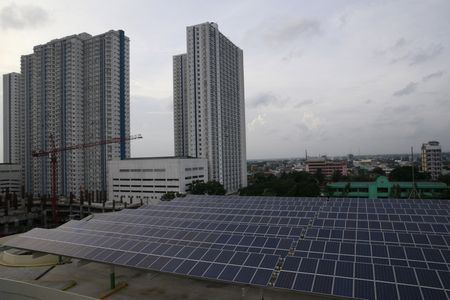

Residents across the Philippines are racing to put solar panels on their rooftops as electricity bills climb to painful levels, pushing the island nation to the top of the global rankings for solar panel imports.
The country’s leading power distributor, Meralco, has raised electricity rates by 10% since a conflict broke out in the Middle East in late February. For a typical household using around 200 kilowatt-hours per month — roughly the amount consumed by three people — electricity now eats up about 12% of monthly income.
Unlike most of its neighbors in Southeast Asia, the Philippines offers almost no government subsidies for power, leaving residents with some of the highest residential electricity rates in the region. Only Singapore has comparable prices, but Singaporeans have nearly 13 times the purchasing power of the average Filipino.
Adrian Sabatera, a 39-year-old software engineer, had considered going solar for years but held off due to the cost. As panel prices dropped and electricity bills kept climbing, he finally made the move — spending 570,000 pesos (about $9,300) on a system for the Manila home he shares with three others.
“I wouldn’t be shocked if a third of the middle-class population eventually finds their way to this setup,” Sabatera said.
The surge in rooftop solar installations has driven $407 million worth of panel imports in the three-month period ending in May — a 145% jump compared to the same period a year ago, according to trade figures from China, which supplies the bulk of the world’s solar panels. Even when overall Chinese panel exports fell 13% in May following the removal of a tax rebate, shipments to the Philippines actually grew by nearly a third.
While the Netherlands technically ranks as a larger market on paper, analysts note that it functions primarily as a transshipment hub rather than an end consumer.
INQUIRIES FLOODING IN
Philergy German Solar, a Manila-based installation company, reported receiving more than two-and-a-half times as many customer inquiries in the first five months of this year compared to the same stretch last year. At peak times, the company was handling as many as 3,000 inquiries in a single day, according to managing partner Jochen Staudter.
Staudter noted that customers are making up their minds “much faster than before” and predicted that “demand will continue to be driven by high electricity prices.”
According to Alnie Demoral, an analyst at energy think tank Ember, distributed solar capacity in the Philippines could nearly triple to 3,500 megawatts within two years — matching the country’s existing large-scale solar infrastructure. Loan repayment periods are also shrinking, from four years down to about 3.1 years, making the investment more attractive.
Currently, solar power accounts for less than 4% of the country’s total electricity consumption, according to government figures.
OBSTACLES REMAIN
A weakening currency has made the electricity crisis worse, since the Philippines depends heavily on imported coal and natural gas to generate power. That dependency has contributed to rising inflation and slower economic growth.
Manila entrepreneur Jason Porciuncula installed a 12-kilowatt solar system with battery storage back in January. When power prices hit record levels in May, his monthly electricity bill fell to just one-fifth of what he paid last summer — when bills reached 21,000 pesos.
Still, the industry faces real growing pains. Brenda Valerio, the Philippines director at New Energy Nexus, said installations are struggling to keep pace with demand due to hoarding of components, unpredictable equipment costs, and insufficient quality control.
Government loans for solar installations are available up to 500,000 pesos at a below-market interest rate of 5%, but private-sector employees are excluded from the program.
The biggest barrier remains the steep upfront cost, which typically exceeds the average annual household income of 353,200 pesos.
“The opportunity is real, but the upfront cost is often too high for a household or business, no matter how quick the payback time is,” Ember’s Demoral said.
(Exchange rate: $1 = 61.29 Philippine pesos)