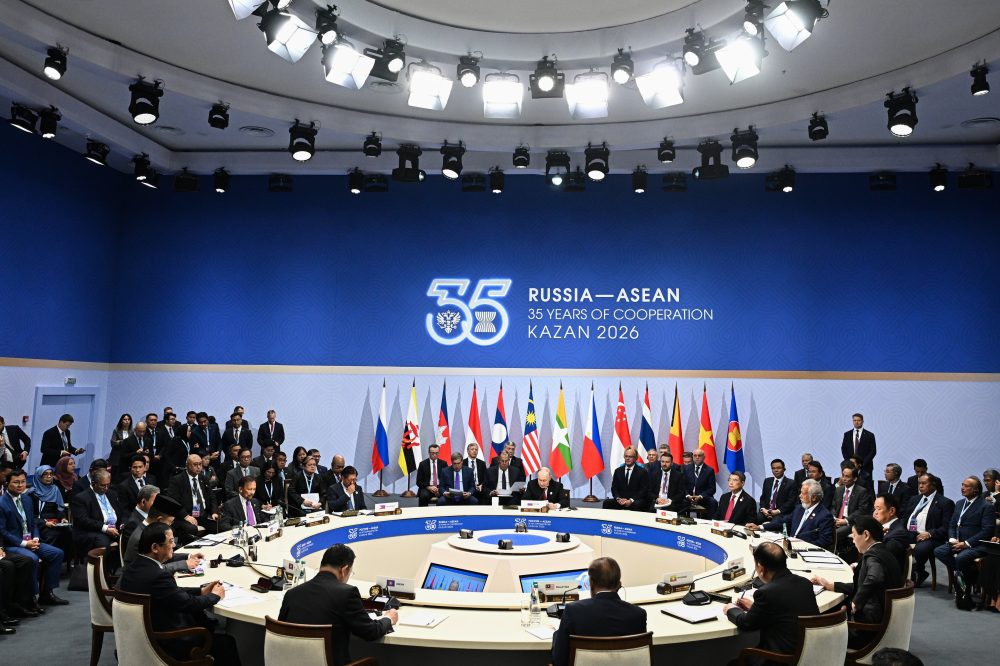

MOSCOW (AP) — Russian President Vladimir Putin on Thursday praised his country’s relationship with the Association of Southeast Asian Nations as he hosted a gathering in Kazan designed to deepen economic and political cooperation with the regional bloc.
Leaders attending the Kazan summit agreed to further build upon the “strategic partnership” between Russia and ASEAN member nations, which include Brunei, Cambodia, Indonesia, Laos, Malaysia, Myanmar, the Philippines, Singapore, Thailand, East Timor, and Vietnam.
“It is a strategic partnership that serves as an essential stabilizing factor in the Asia-Pacific amidst geopolitical turbulence, contributing to the formation of a balanced security architecture and equitable mutually beneficial cooperation,” Putin said during the summit, which celebrated the 35th anniversary of Russia-ASEAN relations.
The summit’s agenda covered an exchange of views on global and regional matters, a review of progress in Russia-ASEAN relations, and discussions about future areas of cooperation.
Putin pointed out that Russia and ASEAN have “expanded the scope of practical cooperation in such areas as combating new security challenges and threats, as well as trade and investment, energy, agriculture, digitalization, science and technology, tourism, and humanitarian contacts.”
A declaration signed by summit participants reaffirmed a shared commitment to a “just multipolar world as guided by international law and the principles of the U.N. Charter to promote mutual benefit and respect for all states.”
The leaders described the Kazan summit as a “significant milestone” in Russia-ASEAN relations and pledged to maintain high-level contact between Russia and the bloc in order to advance their “strategic partnership.”
In addition to the main summit sessions, Putin held one-on-one meetings with several ASEAN leaders. The summit was co-chaired by Putin and Philippine President Ferdinand Marcos Jr., whose nation currently holds the association’s rotating presidency.
ASEAN’s membership is diverse in its global alignments — some countries, including the Philippines, are considered close to the United States, while others maintain strong trade and security relationships with China and Russia.
Several ASEAN members, including the Philippines, Indonesia, Thailand, and Vietnam, have either purchased Russian crude oil or signaled interest in doing so after global fuel prices surged in the aftermath of the war in Iran.