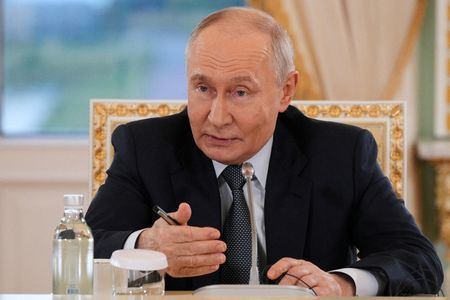

Russian President Vladimir Putin dismissed the possibility of meeting with Ukraine’s leader on Friday, after receiving an open letter suggesting direct negotiations to end the conflict that has now entered its fifth year.
The Ukrainian president’s letter, distributed to multiple nations including the United States, claimed that most Russians have become weary of ongoing missile and drone strikes, rising inflation, and fuel shortages, making them ready for peace.
The letter also warned that prolonging the conflict might jeopardize Putin’s leadership, noting that historical patterns show change typically follows when Russia becomes exhausted.
During remarks at an annual economic conference where wealthy Russian business leaders voiced concerns about elevated interest rates and economic decline caused by the war, Putin questioned the sincerity of the peace overture.
“This letter contains some rather rude remarks. Was it a way to create the conditions for a face-to-face meeting or a way not to set up a face-to-face meeting? I think it was the latter,” said Putin.
When asked about the possibility of meeting with the Ukrainian leader, whom the 73-year-old Russian president deliberately avoided naming and referred to only as “the letter’s author,” Putin responded directly:
“I don’t see the point in meeting; the only point is for the Ukrainian side to halt the advance of our armed forces. But we need agreements – not for six months, not for three months, but for the long term.
“Let the experts get to work and come up with some solutions. After that, we can meet…,” the Russian leader said.
Russian military commentators have also criticized the Ukrainian letter as a calculated publicity campaign intended to fuel internal Russian dissent rather than genuinely pursue peace.
During a Thursday session with international journalists, Putin maintained his uncompromising position regarding the conflict and stated that Russian forces continue making daily battlefield gains. However, he acknowledged that U.S. President Donald Trump’s peace initiatives might halt the fighting if Kyiv demonstrates willingness to make concessions. Each side blames the other for refusing to negotiate.
The war has evolved into a prolonged battle of attrition across eastern Ukraine, resulting in substantial casualties for both armies. Despite Russia’s significant military and territorial advantages over Ukraine, Moscow controls approximately one-fifth of Ukrainian land more than four years after Putin’s decision to deploy tens of thousands of soldiers.
International sanctions combined with Ukrainian aerial attacks on Russia’s energy facilities and strategic installations have increasingly strained the country’s economic situation, bolstering arguments from business and political leaders who favor negotiating a peace settlement.
Ukraine maintains it will not retreat from its remaining positions in the eastern Donbas area and refuses to acknowledge Russian control over seized Ukrainian territories.
Russian forces launched another massive assault this week, firing hundreds of drones and dozens of missiles at Ukrainian population centers, including Kyiv, resulting in dozens of civilian deaths. Ukraine has intensified its own attacks within Russian borders, targeting oil refineries among other facilities.