
A legendary Associated Press photographer whose award-winning image documented a pivotal moment in America’s civil rights struggle has passed away at 86 years old.
Jack Thornell died Thursday at a Metairie, Louisiana hospital due to kidney disease complications, according to his son Jay Thornell, who confirmed the death on Friday.
During his four-decade tenure with the Associated Press from 1964 through 2004, Thornell captured images of politicians, natural catastrophes, and criminal investigations. However, his career became defined by documenting the fight for racial equality, beginning on his very first day at the AP’s New Orleans office when he covered school integration along Mississippi’s Gulf Coast.
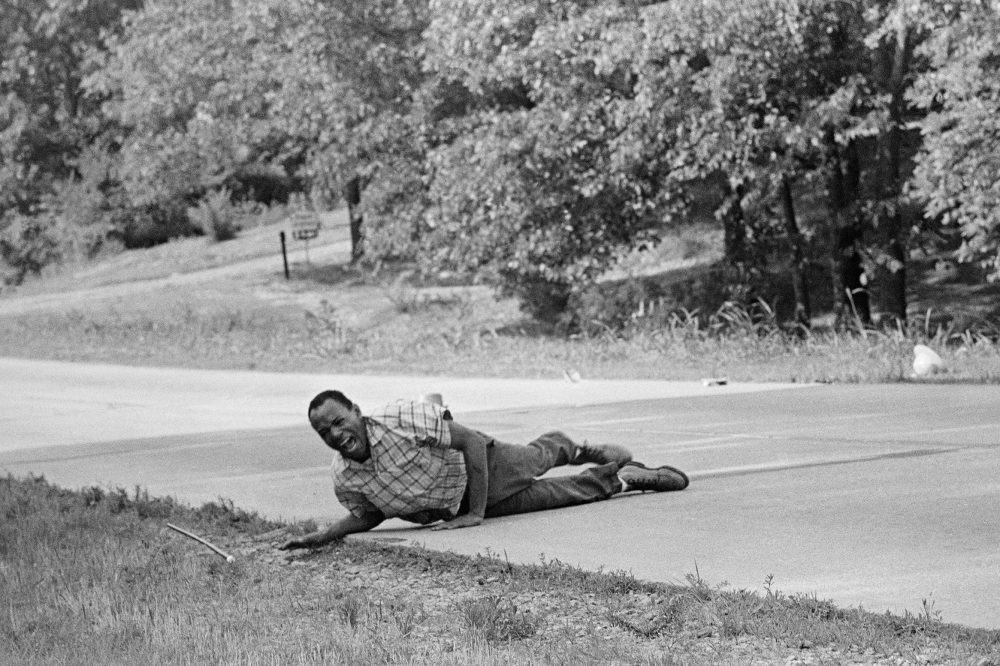
Thornell’s most famous photograph came in June 1966 when he was just 26 years old and assigned to document a civil rights demonstration. James Meredith, who had broken racial barriers by enrolling at the University of Mississippi four years earlier, was leading his “March Against Fear” to encourage African American voter registration throughout the state.
While Meredith walked along U.S. Highway 51 near Hernando, Mississippi, Thornell and a competing photographer waited in their roadside vehicle when gunshots suddenly erupted, sending both men into action.
The resulting photographs became powerful symbols of the violent opposition to integration. One image showed Meredith writhing in pain as he crawled toward the highway’s shoulder. The Pulitzer Prize-winning shot, which Thornell initially didn’t realize he had taken, depicted Meredith on the ground at the road’s edge with outstretched arms and palms pressed against the asphalt. His head was turned toward his attacker, who could be seen among the roadside vegetation at the photograph’s far left.
Meredith survived his injuries after hospitalization. The gunman, Aubrey James Norvell, was caught immediately, entered a guilty plea, and completed 18 months of his five-year sentence.
Thornell initially worried he might lose his job, believing his competitor had better images of the shooter. Instead of termination, he received the 1967 Pulitzer Prize after developing his film and examining the negatives more carefully.
His civil rights documentation extended beyond the Meredith shooting. In 1964, Thornell photographed the charred remains of a station wagon in Neshoba County, Mississippi, that had belonged to civil rights activists Michael Schwerner, James Chaney, and Andrew Goodman. The three men’s bodies were discovered weeks later buried in an earthen dam after Ku Klux Klan members kidnapped and murdered them. Thornell also quickly photographed the local sheriff’s arrest by federal agents on conspiracy charges related to their deaths, capturing the shot while retreating from a sheriff supporter who threatened him with a blade.
In 1966, Thornell documented the violence surrounding school integration efforts in Grenada, Mississippi. One photograph showed an African American man protecting his ears while moving away from an explosive device thrown by hostile white protesters.
Throughout his career, Thornell photographed Dr. Martin Luther King Jr. on multiple occasions, including during the 1965 Selma-to-Montgomery march in Alabama and demonstrations supporting Memphis sanitation workers in 1968, just one week before King’s assassination in that city.
Although Thornell had returned to New Orleans before King’s murder, he was later sent to Atlanta to photograph the King family viewing the body at Spelman College’s Sisters Chapel.
He arrived late for that assignment and described in a 2018 interview how he rushed past another photographer and climbed onto a pew, stepping from bench to bench to reach the casket for his shot.
“I was shaken when I left there. I had my eyes on the floor because I knew everyone was looking at me for my despicable behavior,” Thornell said during the interview at his Kenner, Louisiana residence. “But I didn’t leave without the picture.”
In 1977, when King’s killer James Earl Ray broke out of a Tennessee prison, Thornell was present to photograph Ray’s recapture, showing him dirty and exhausted.
Born and raised in Vicksburg, Mississippi, Thornell’s photography career began through an Army mix-up in the late 1950s, according to a 1967 AP World corporate magazine story.
“The U.S. Army had decided to make a radio repairman of him. But at Fort Monmouth, his name got mixed up with that of a camera bug who wanted to attend photographic school. So Thornell, who didn’t know an aperture from a back focus, took the short course in picture-taking while the camera bug learned to fix radios.”
Following his military service, Thornell joined the Jackson (Miss.) Daily News before the AP hired him for their New Orleans bureau.
Working during the South’s most turbulent period, Thornell remembered experiencing fear amid the violence and threats. However, he faced an even greater concern than physical danger.
“The greatest fear for me was coming back without the photograph,” he explained. “The things that were happening there, you just kind of dealt with it and tried to photograph what was happening, because that was your bread and butter, that was your career. And your success depended on how well you did that day. Because tomorrow there’s always another newspaper coming out.”
Thornell leaves behind his son Jay, daughter Candy Gros, and one granddaughter.