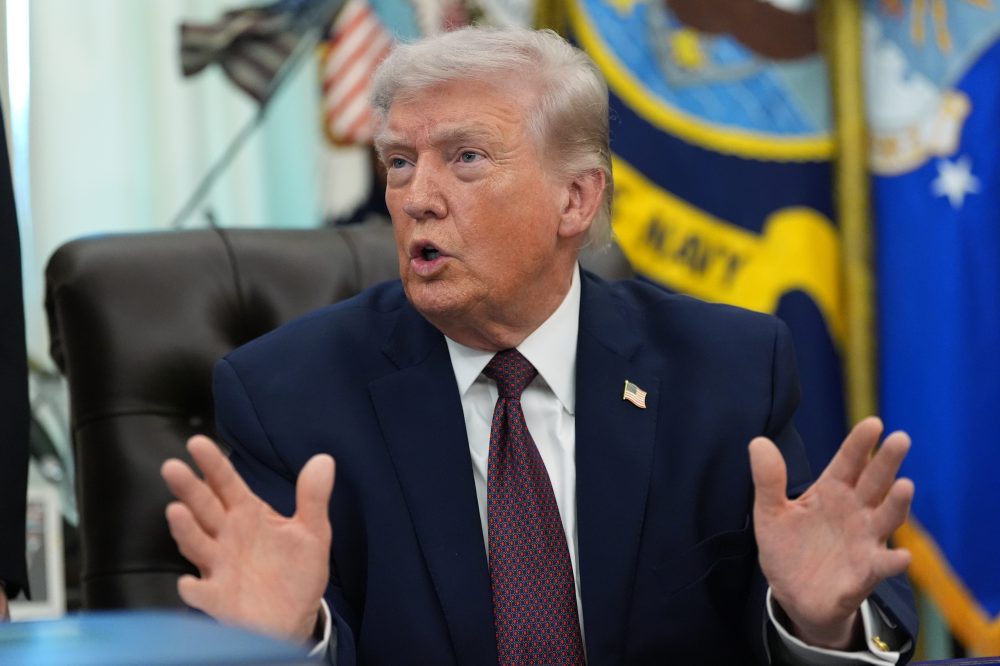

WASHINGTON — President Donald Trump issued an executive order Tuesday establishing a federal database of eligible voters across all states, a directive that legal experts anticipate will face immediate court challenges as the administration pushes for tighter voting restrictions before upcoming midterm elections.
The directive instructs the Department of Homeland Security to collaborate with the Social Security Administration in developing verified voter rolls for every state, the White House announced. Additionally, the order attempts to prohibit the U.S. Postal Service from delivering absentee ballots to individuals not appearing on each state’s authorized voter registry, though experts question whether the president possesses authority over postal operations.
The executive order also mandates that voting ballots include secure envelopes featuring unique tracking barcodes, according to the document initially disclosed by the Daily Caller.
“The cheating on mail-in voting is legendary. It’s horrible what’s going on,” Trump stated while signing the directive, reiterating his unsubstantiated claims regarding mail-in ballot fraud. “I think this will help a lot with elections.”
Legal challenges are anticipated following Tuesday’s action as the president continues efforts to influence state-administered elections.
Trump’s initial election-related executive order from March 2025 attempted comprehensive reforms to election procedures nationwide, including mandating documentary citizenship proof for federal voter registration and requiring mailed ballots to arrive at election offices by Election Day. Courts have largely halted these provisions following lawsuits from voting advocacy organizations and Democratic state attorneys general, who contend the measures represent unconstitutional federal overreach that would prevent many citizens from voting.
During a February podcast interview with a conservative host, Trump expressed his desire to “take over” elections in Democratic-controlled regions, citing fraud allegations that multiple audits, investigations and judicial proceedings have disproven.
David Becker, a former Justice Department attorney who directs the Center for Election Innovation and Research, said Tuesday’s voting directive demonstrates Trump hasn’t absorbed lessons from his earlier unsuccessful attempts to control elections.
“The Constitution is very clear — the president has no power over elections in the states,” Becker explained. “This will be blocked as soon as lawyers can get to the courthouse.”
Becker noted that the U.S. Postal Service operates under a board of governors, preventing presidential control over mail delivery decisions.
“If Trump signs an unconstitutional Executive Order to take over voting, we will sue,” declared Marc Elias, a voting rights attorney and Democracy Docket founder, in a social media statement. “I don’t bluff and I usually win.”
American elections operate through a decentralized system rather than federal administration. Thousands of local jurisdictions manage voting processes, from small townships to large urban counties serving more voters than entire states. The Constitution’s Elections Clause grants Congress authority to “make or alter” election rules for federal positions but establishes no presidential power over election management.
The Trump administration has initiated what it characterizes as a comprehensive effort targeting alleged voter fraud, which has been the focus of false statements from Trump and supporters for years. The Justice Department has spent months requesting detailed voter registration records from states as part of what officials describe as election security efforts, filing lawsuits when state officials decline to provide the information.
FBI agents seized ballots in January from a Georgia county election office that has featured prominently in right-wing conspiracy theories surrounding Trump’s 2020 election defeat. Attorney General Pam Bondi recently appointed Daniel Bishop, the chief federal prosecutor for North Carolina’s Middle District, as a “special attorney” authorized to investigate and prosecute nationwide cases “relating to the integrity of federal elections,” according to the appointment document.
The Department of Homeland Security’s SAVE system for confirming citizenship and immigration status has faced criticism from voting rights organizations over flawed outcomes from unreliable databases and privacy issues. States can perform bulk SAVE searches using Social Security numbers, but most states don’t collect complete Social Security numbers during voter registration, the Brennan Center for Justice reports. While the Trump administration updated the system last year, legal challenges continue alleging that SAVE dependence creates citizenship verification errors affecting qualified voters.
The president frequently criticizes mail-in voting, claiming the practice involves widespread fraud while urging lawmakers to approve comprehensive election legislation restricting it. Trump’s fraud allegations lack foundation; a 2025 Brookings Institution study determined mail voting fraud occurred in just 0.000043% of total mail ballots cast, approximately four instances per 10 million mail ballots.
Trump has personally utilized mail ballots, including last week in local Florida elections. White House officials state Trump opposes universal mail-in voting rather than individual voters who require alternative voting methods for circumstances like travel or military service.