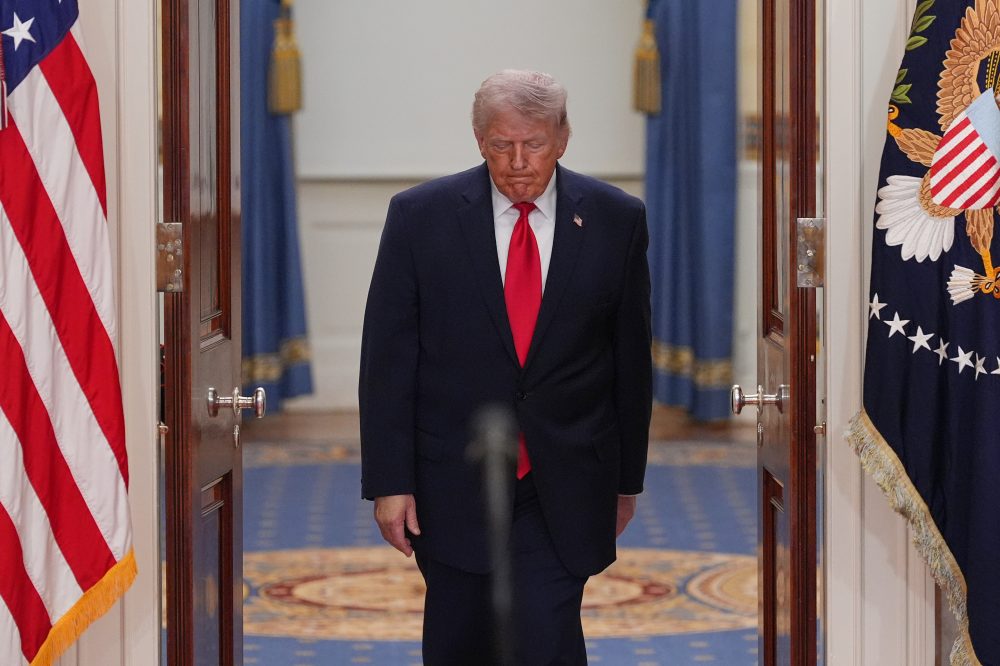

TEL AVIV, Israel — U.S. military forces entered their second day of searching for an American pilot downed in a remote Iranian region, as President Donald Trump renewed his ultimatum to Tehran on Saturday with a stark warning about his Monday deadline for reopening the Strait of Hormuz: “Time is running out.”
Iran identified the downed American aircraft as an F-15E Strike Eagle, one of two planes attacked on Friday. Tehran has offered a bounty for anyone who captures the “enemy pilot.” Iranian military leadership claimed on Saturday that they also brought down two U.S. Black Hawk helicopters on Friday, though The Associated Press could not confirm this independently.
The conflict, which has now entered its sixth week, started with coordinated U.S.-Israeli military strikes on February 28 and has resulted in thousands of casualties, disrupted international markets, blocked critical shipping lanes, and driven up fuel costs. The hostilities continue to escalate as Iran launches retaliatory strikes throughout the region.
“We will continue to crush them,” declared Israeli Prime Minister Benjamin Netanyahu on Saturday. Israel’s armed forces verified they targeted a petrochemical facility in Mahshahr, which Netanyahu claimed finances the ongoing conflict. Iranian state media reported five fatalities from the strike, according to a provincial security official.
During a Wednesday national speech, Trump claimed the U.S. had “beaten and completely decimated Iran.” However, on Saturday, what appeared to be an Iranian drone struck Oracle’s headquarters in Dubai, United Arab Emirates.
Warning of potential war crimes, international observers noted that both nations have targeted and attacked civilian infrastructure and non-military sites.
Iran’s Atomic Energy Organization reported that an air attack occurred near the Bushehr nuclear plant, resulting in one security guard’s death and damage to a support structure. Rosatom’s director announced the evacuation of 198 personnel. This marked the fourth assault on the facility.
Diplomatic Efforts Underway
Pakistan’s Foreign Ministry spokesperson Tahir Andrabi informed the AP that his nation’s ceasefire mediation efforts are “right on track.” Pakistan announced last week it would host negotiations between Washington and Tehran.
Iranian Foreign Minister Abbas Araghchi stated that Iranian representatives “have never refused to go to Islamabad.”
According to two regional officials, mediators from Pakistan, Turkey, and Egypt are working to facilitate U.S.-Iran negotiations. They reported efforts to reconcile both nations’ conditions for ending hostilities and reopening the vital Strait of Hormuz.
The potential agreement involves halting military actions to enable diplomatic resolution, according to a regional official participating in the mediation and a Gulf diplomat briefed on the discussions. Both requested anonymity due to the confidential nature of the diplomatic process.
Trump reiterated his deadline through social media: “Remember when I gave Iran ten days to MAKE A DEAL or OPEN UP THE HORMUZ STRAIT. Time is running out — 48 hours before all Hell will reign down on them.”
Search for American Airman
The rescue operation for the U.S. pilot centers on a mountainous area in Iran’s southwestern Kohgiluyeh and Boyer-Ahmad province. A broadcaster on an Iranian state television affiliate called on local residents to surrender any “enemy pilot” to authorities.
According to a Pentagon email obtained by the AP, military officials received word of “an aircraft being shot down” in the Middle East.
One U.S. crew member was successfully recovered. The Pentagon informed the U.S. House Armed Services Committee that a second service member’s condition remained unknown.
Trump informed NBC News that the incident would not impact potential negotiations with Iran.
A U.S. official, speaking anonymously about sensitive military matters, confirmed that a second U.S. Air Force combat plane went down in the Middle East on Friday. It remained unclear whether the aircraft crashed or was attacked, or if Iran played a role.
Iranian media outlets reported that Iran’s defense systems struck a U.S. A-10 attack plane, causing it to crash in the Persian Gulf.
Oracle Building Attacked
Oracle’s Dubai offices sustained damage after Iran’s Revolutionary Guard threatened the company. AP-verified footage from the UAE revealed a significant hole in the building’s southwestern section.
Dubai’s government media office described a “minor incident caused by debris from an aerial interception that fell on the facade,” reporting no injuries. Austin, Texas-based Oracle Corp. did not immediately respond to requests for comment.
The Revolutionary Guard has labeled several major U.S. technology firms as participants in “terrorist espionage” activities against Iran and declared them valid targets. Previous drone attacks have hit Amazon Web Services installations in the UAE and Bahrain.
Second Strait Threatened
Late Friday, Iran’s parliamentary speaker Mohammad Bagher Qalibaf made an indirect threat to block traffic through another crucial regional waterway, the Bab el-Mandeb.
This 32-kilometer (20-mile) wide passage connects the Red Sea to the Gulf of Aden and Indian Ocean. Over ten percent of global maritime oil shipments and twenty-five percent of container vessels travel through it.
“Which countries and companies account for the highest transit volumes through the strait?” Qalibaf posted.
The conflict has claimed more than 1,900 lives in Iran since fighting began.
In Gulf Arab nations and the occupied West Bank, casualties exceed two dozen, while Israel has reported 19 deaths and the U.S. has lost 13 service members. Lebanon has suffered over 1,400 fatalities with more than one million people displaced. Ten Israeli soldiers have perished there.