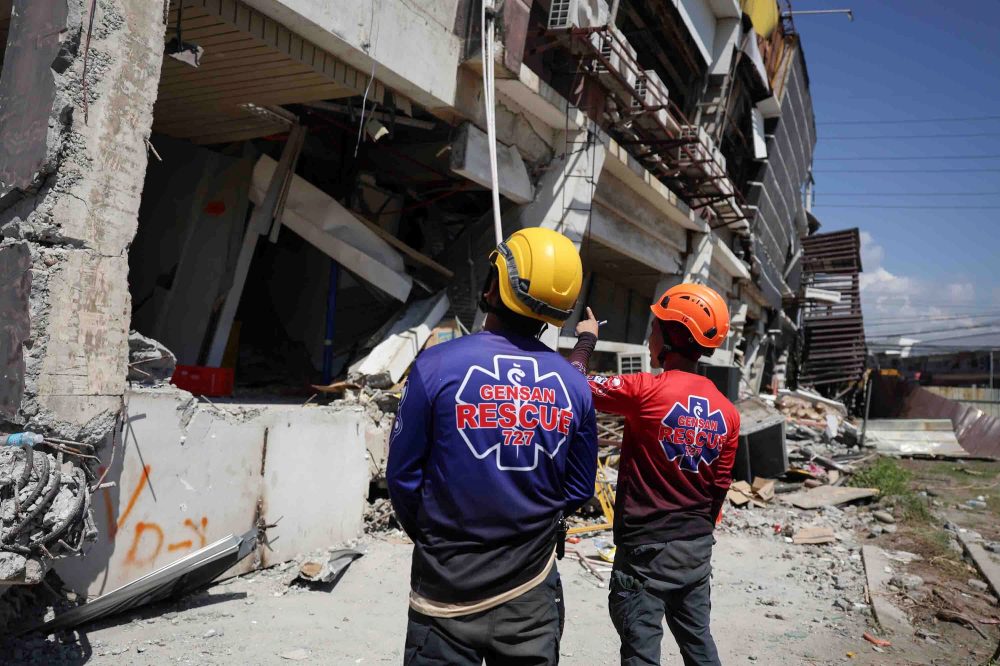

GENERAL SANTOS, Philippines — Search and rescue teams combed through damaged structures across the southern Philippines Tuesday, working to confirm no survivors remained trapped following a powerful earthquake that claimed at least 37 lives and forced over 20,000 people from their homes.
Official records show only four individuals remain unaccounted for in the southern provinces where the 7.8 magnitude tremor hit Monday morning, though the Office of Civil Defense noted that numerous collapsed and severely damaged structures require complete examination for potential survivors or victims.
The seismic event, which originated near Mindanao, the nation’s second-largest island by population, left nearly 500 people wounded and drove more than 20,000 residents to seek refuge in emergency housing facilities.
Tsunami concerns prompted many residents to evacuate their homes. Ocean waves reaching up to 1.4 meters (4.6 feet) above normal tide levels were recorded in the Philippines, though tsunami-related damage was limited to six stilt houses in a shoreline community. Lesser waves reached the coasts of Indonesia and Palau, extending as far as southern Japan.
The seismic disaster created widespread devastation, particularly affecting General Santos, a bustling port city home to more than 700,000 residents and recognized as the nation’s tuna fishing hub, where falling structures and debris claimed at least 13 lives.
Sarangani province recorded at least 18 fatalities, primarily from a mountainside collapse that buried homes in the highland community of Glan, reported Rafaelito Alejandro from the Office of Civil Defense.
Additional casualties occurred in the southern provinces of South Cotabato and Davao Occidental, as well as on Balut Island, emergency response coordinators confirmed.
Preliminary government damage reports indicate approximately 2,000 residential structures and 117 public buildings and facilities sustained damage across multiple provinces. The main airport in General Santos suspended operations, leading to the cancellation of 63 domestic flights, with exceptions made only for relief missions.
Roughly 6,000 educational facilities in earthquake-affected areas require structural evaluation before students can return to classes. The tremor occurred on the opening day of the academic year following a two-month summer recess, and many injured victims were young pupils who had assembled enthusiastically for morning flag ceremonies.
Officials have cautioned that structures showing crack damage could fail due to continuing aftershocks, some registering at dangerous intensity levels.
“We cannot force the immediate reopening of schools because we have to ensure the integrity of the buildings,” Alejandro said.
Monday’s earthquake originated beneath the ocean at a depth of 33 kilometers (20 miles), positioned roughly 32 kilometers (20 miles) southwest of Maasim town in Sarangani province.
The tremor resulted from activity within the Cotabato Trench and marked the most powerful since the same underwater geological feature generated an 8.1-magnitude earthquake that created tsunami waves on Aug. 17, 1976, explained Teresito Bacolcol, director of the Philippine Institute of Volcanology and Seismology.
That earlier disaster and resulting tsunami waves measuring 8 to 10 meters (26 to 33 feet) that overwhelmed numerous communities and provinces killed approximately 8,000 people, Bacolcol noted.
The Philippine seismological institute had planned to mark the anniversary of the 1976 earthquake and tsunami in August by placing commemorative markers to remind at-risk communities of the importance of maintaining constant preparedness, Bacolcol informed The Associated Press.
A 1990 earthquake of similar 7.8 magnitude resulted in over 1,000 deaths, injured thousands more, and caused widespread destruction across northern provinces and urban areas.
President Ferdinand Marcos Jr. dispatched senior defense and disaster management officials from Manila to coordinate search and rescue operations, oversee distribution of tens of thousands of food packages and building supplies to earthquake victims, and evaluate damage to transportation infrastructure.
The United States, maintaining a defense treaty with the Philippines, announced it was coordinating with Manila and stood prepared to assist Philippine response efforts. France, Japan and New Zealand also offered their support.
The Philippines experiences frequent earthquakes and volcanic activity due to its position along the Pacific “Ring of Fire,” a chain of seismic fault lines encircling the ocean.
The island nation also endures approximately 20 typhoons and tropical storms annually, ranking it among the world’s most disaster-vulnerable countries.