
Pope Leo XIV plans to address one of Europe’s most contentious issues by traveling to two major migration centers — Spain’s Canary Islands next week and Italy’s Lampedusa island in early July.
These isolated European territories have faced overwhelming challenges as tens of thousands of primarily African migrants arrive via some of the globe’s most dangerous sea routes. Despite declining numbers this year, particularly in the Canaries, migration remains a divisive political issue in these traditionally Catholic nations.
Catholic leaders and migrants anticipate the papal visits will redirect focus toward compassion and assistance rather than polarizing political arguments that divide both conservative and liberal factions.
“Stuck in the middle are the migrants,” said the Most Rev. José Mazuelos, the bishop of Canarias, whose diocese includes several of the islands. “So the church says, ‘Let’s give them a face, because we’re talking about people, not numbers.’”
One such person is Eslim Jallow, 27, who left Gambia with his younger brother seeking better opportunities and reached the Canary Islands in 2023. Initially facing difficulties adjusting, Jallow mastered Spanish, completed training programs, and now works as a programmer and web developer in Las Palmas de Gran Canaria.
“Perhaps the pope will change the way in which people here look at immigrants,” Jallow said. “Immigrants should be treated with dignity and respect, not ignored.”
Though not Catholic himself like most arriving migrants, he believes Leo “speaks for us, he reminds the world we are also human beings.”
Supporting migrants worldwide was central to Pope Francis’s mission. His first pastoral journey outside Rome brought him to Lampedusa in 2013, and three years later he returned from the Greek island of Lesbos with twelve Syrian Muslim refugees.
Pope Leo has maintained the Catholic Church’s commitment to advocating humane treatment of migrants internationally, including condemning mass deportations in his native United States.
“Pope Leo is signaling how important immigration is to him by doing these two trips early in his papacy,” said Michele Pistone, a Villanova University professor who leads its new center on immigration.
Leo’s Canary Islands itinerary includes a June 11 visit to Gran Canaria’s port of Arguineguín to honor thousands of migrants who perished or vanished during their journeys. The following day, he will meet with migrants at a Tenerife camp.
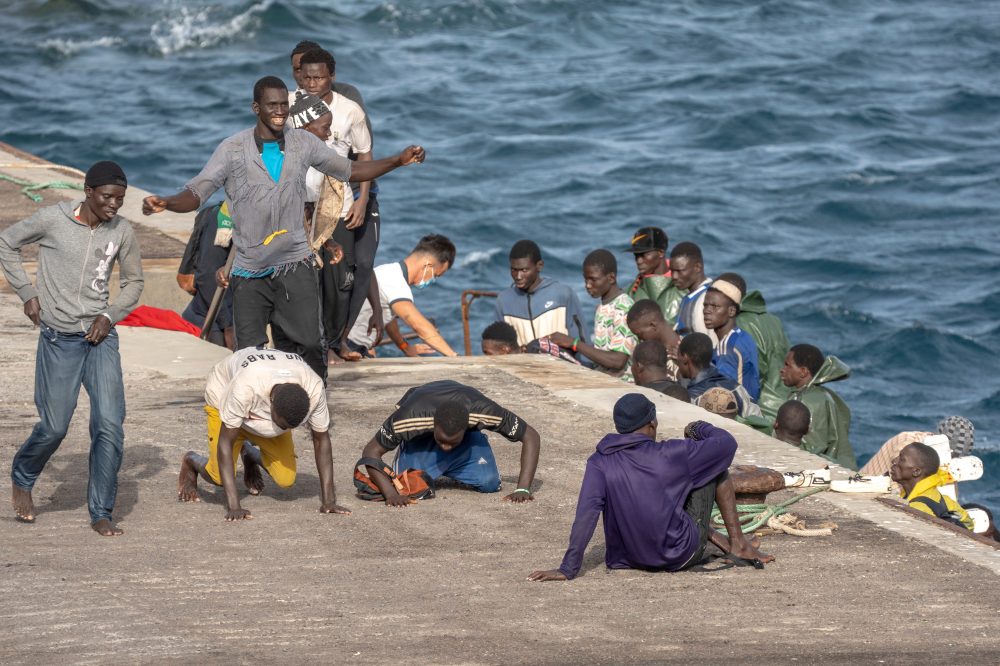
The island chain became the center of a humanitarian emergency in 2024 when nearly 47,000 migrants from North and West Africa arrived, including thousands of unaccompanied children.
Similar to Jallow, half landed on El Hierro island — almost tripling its population, according to the Most Rev. Eloy Santiago, bishop of Tenerife, whose diocese encompasses the smaller island. Resources reached critical limits despite most migrants staying only briefly.
“If a boat arrives, the couple of local doctors have to go out running to take care of them, and then the local residents who had their medical appointments can’t have them,” Santiago said.
Catholic organizations join others in assisting migrants from their first moments stepping off overcrowded, unsafe boats.
While arrivals have dropped significantly this year due partly to enhanced African coastal controls, the greatest challenge persists — supporting those who arrived as minors under state care but face homelessness at 18, typically without employment opportunities or assistance.
Jallow worries about his younger brother’s future when he becomes an adult next year. The brother has been paralyzed from the neck down following an accident shortly after arriving in the Canaries and resides in a Catholic hospital in Las Palmas.
Caya Suárez, secretary general for the Catholic charity Caritas in the Canaries, has witnessed how migrants aging out of care become extremely vulnerable.
“That’s a very bad moment, even though they’d been waiting for it with hope, because they see they are still stuck without alternatives,” she said.
Caritas assists young adults in securing housing and employment, she explained. The organization has also relocated some young migrants to Madrid, a small village in the predominantly rural Galicia region, and other mainland locations with parish support, even as other Spanish regional governments resist accepting underage migrants.
Many Canary Islands residents feel abandoned to handle an impossible situation — extending already strained resources for migrants who expected economic opportunities and European Union travel freedom but instead face homelessness while struggling to send money home and find ways to leave.
Combined with perceptions that national and European institutions view this as solely an “island problem,” the circumstances create growing frustration even among generous islanders historically accustomed to migration connections with Latin America, according to the Canaries’ bishops.
“The pope’s word can help so that in the middle of this fatigue, people can buck up again because they see they are supported,” said Santiago, who was born and ordained a priest on the islands.
Nationally, Spain’s Catholic Church has endorsed new legislation granting temporary residency permits to potentially over half a million undocumented foreigners, many from Latin America.
These individuals frequently work in hospitality, farming, and elderly care, strengthening the economy according to Prime Minister Pedro Sánchez’s socialist government — and the church.
“In the matter of immigration, the church’s position gets into a head-on collision with the position of the right,” said Pablo Simón, a political science professor at University Carlos III in Madrid.
This has created tension between the church and far-right parties like Vox in Spain, which has criticized church immigration positions despite frequently framing anti-migrant messaging in religious language.
The Rev. Fernando Redondo, who leads the migration department of the Spanish bishops’ conference, said the church’s position aligns with Christian teachings to welcome strangers. However, he noted the need for better understanding among faithful who believe migrants take jobs or exploit welfare systems.
“We have a big challenge, which is raising awareness among our faithful … that from the viewpoint of faith, to welcome a migrant person is to welcome Christ himself,” Redondo said. “Then, of course, there needs to be ways, proper social and political ways, so that migration doesn’t become a total mess.”
In the Canaries, ordinary citizens have confronted life-threatening chaos firsthand — fishermen providing water to migrants on makeshift rafts, beachgoers rushing into water to assist landing migrants, volunteers greeting them in over a dozen languages.
Yet they have also witnessed successful integration, such as in a declining mountain village that revitalized after opening a center for three dozen migrant children, creating employment and filling the school — and the local church’s annual feast day procession.
Many therefore anticipate Leo delivering a straightforward but essential message of reconciliation focusing on affected individuals rather than politics.
“The pope doesn’t support this slogan of ‘let’s go, open doors for the whole world here.’ Nobody supports that,” Mazuelos said. “When here comes a gentleman in a wooden boat after five days in the Atlantic, what are we supposed to do, kick him back? We’ve got to find a way to welcome him.”