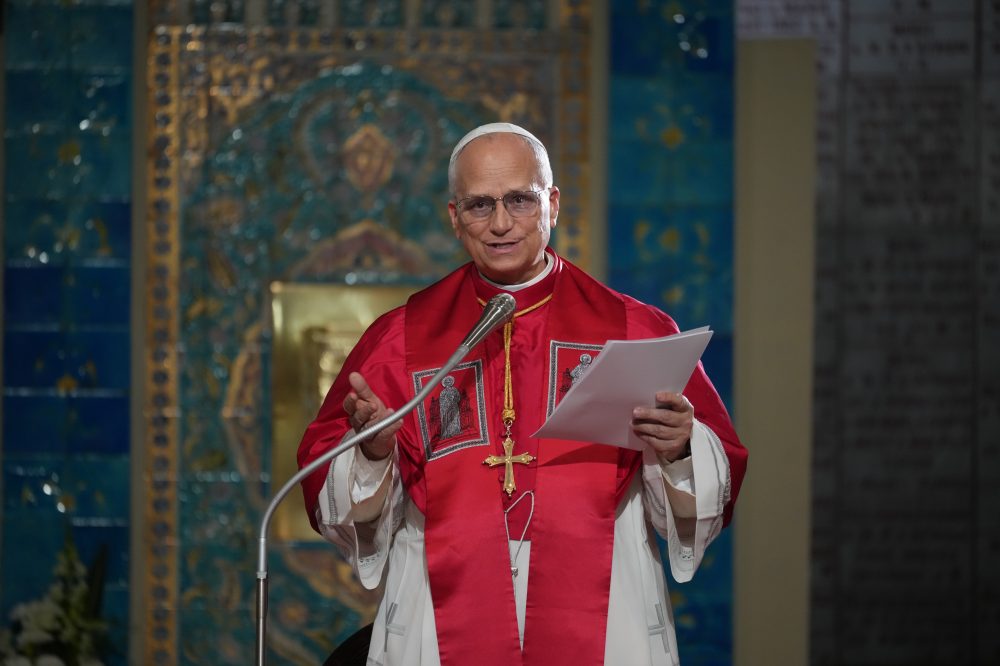

ALGIERS, Algeria (AP) — The first American pope is making history this week with an unprecedented papal journey to Algeria, where he’s paying tribute to the 5th-century Christian scholar who has shaped his entire pontificate.
Pope Leo XIV traveled to Annaba, formerly known as Hippo, on his second day in the North African nation. The pilgrimage represents a deeply personal mission for the pontiff, who has repeatedly called himself a follower of St. Augustine, the legendary theologian who lived, ministered and died in this ancient city.
The papal visit comes during a turbulent period marked by the ongoing U.S.-Israel conflict in Iran, with Leo’s peace advocacy creating tensions with U.S. President Donald Trump back home.
Since his election, Leo has consistently referenced Augustine’s teachings and declared himself “a son of St. Augustine” on the evening he became pope. For this groundbreaking trip, he’s highlighting Augustine’s role as someone who brought different communities together.
The journey also shines light on Augustine’s African heritage, which scholars say has often been overshadowed by European perspectives on his legacy. Despite spending just five years in Italy, Augustine is frequently viewed through a Western lens as one of Christianity’s greatest intellectual giants for his profound writings on truth, evil, creation and divine grace.
Augustine entered the world in 354 in Thagaste, now the Algerian town of Souk Ahras near Tunisia’s border. His mother was Berber and his father Roman, living when this region belonged to the Roman Empire. He studied and taught public speaking in Carthage, located in present-day Tunisia.
In 383, Augustine departed for Rome, then Milan, where he embraced Christianity. He soon returned home, established a monastery at Hippo, rose to bishop, and penned masterworks including “Confessions” and “The City of God.”
Catherine Conybeare, who studies Augustine at Bryn Mawr College in Pennsylvania, has written “Augustine the African,” examining the scholar from his North African viewpoint. She describes someone who saw Rome as his world’s center but felt self-conscious about his Punic-influenced Latin.
“One of the most important thinkers in the Western intellectual tradition actually came from Africa, spent almost his whole life in Africa,” Conybeare explained to The Associated Press. “How does that change things?”
“Of course, because his successors — the people who carried on his heritage — were in Europe, they got to tell the story,” she noted. Europe also claimed his remains: following his death in Hippo, Augustine’s body was eventually moved to Pavia, Italy, though one forearm stays in Annaba’s basilica.
Algerian President Abdelmadjid Tebboune welcomed Leo by expressing the “immense pride” his people feel regarding St. Augustine. He described the saint as “a cherished son of this land, which having been his first cradle, proudly became his initial resting place.”
During his flight to Algeria and in speeches to government officials, Leo emphasized how personally meaningful this visit is due to his spiritual bond with Augustine. He had previously visited twice as head of the Augustinian religious order.
“This journey, which is very special for several reasons, was supposed to be the first of my pontificate,” Leo explained to journalists aboard the papal aircraft. “As early as last May, I had said that on my first journey, I would like to visit Africa. Several people immediately suggested Algeria because of St. Augustine.”
Though other travels took precedence, he maintained his commitment to this trip.
The saint represents “a very important bridge in interreligious dialogue” that today’s world desperately needs, he explained.
“We must always seek bridges to build peace and reconciliation,” he stated. “This journey, then, truly represents a valuable opportunity to continue with the same voice, with the same message, that we wish to convey: to promote peace, reconciliation, respect and consideration for all peoples.”
During his time in Annaba, Leo toured the archaeological remains of ancient Hippo, including its amphitheater, marketplace and public baths. Vatican officials noted the site contains remnants of the basilica where Augustine delivered sermons and the connected baptistry.
The pope also met with a community of nuns and local Augustinian friars in Annaba. He concluded his day leading Mass at the Basilica of St. Augustine, constructed in the 1890s, which houses the saint’s relic. The basilica welcomes thousands of visitors annually, including Muslim pilgrims.