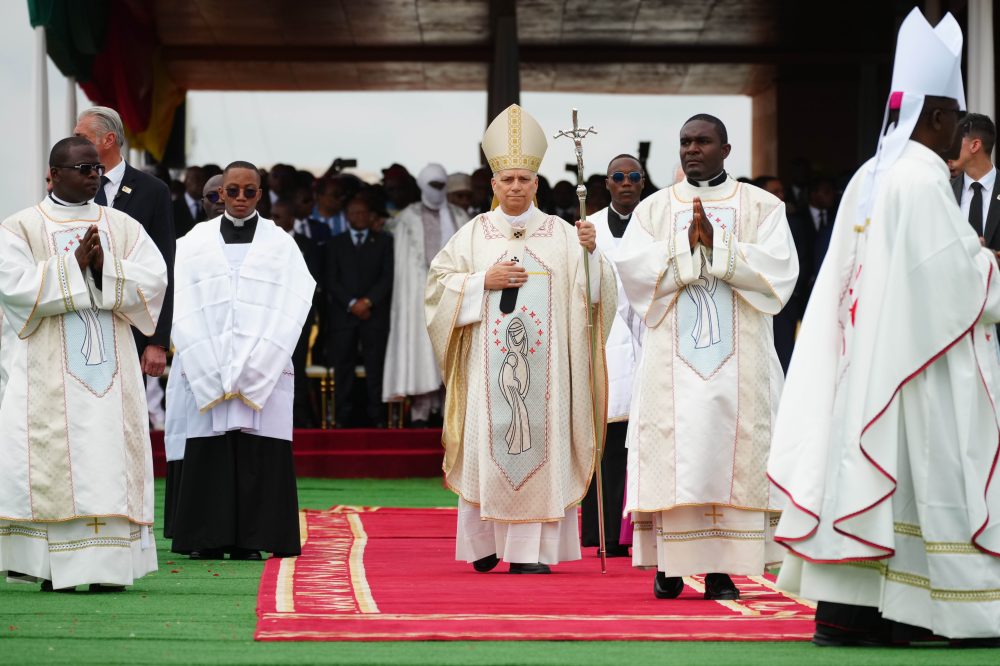

YAOUNDE, Cameroon (AP) — Pope Leo XIV concluded his Cameroon visit on Saturday by urging the creation of “structures of solidarity” to support marginalized populations before departing for Angola as part of his ongoing four-country African tour.
The pontiff conducted Mass at Yaounde Airport before thousands of attendees, including 93-year-old President Paul Biya, currently the globe’s eldest head of state. The energetic and celebratory crowd highlighted the enthusiasm that the third papal visitor has generated in this former French territory, where approximately one-third of citizens practice Catholicism.
Among the congregation were individuals with mobility challenges who arrived at the service in wheelbarrows operated by relatives.
Throughout his Cameroon stay, Leo focused on inspiring hope among youth facing discouragement while condemning elite groups for exploiting the nation’s resources and people for financial gain.
During Saturday’s French-language sermon, Leo emphasized that respecting human dignity forms the foundation of all societies.
“For this reason, every community has the obligation to create and sustain structures of solidarity and mutual aid in which, when faced with crises — be they social, political, medical or economic — everyone can give and receive assistance according to their own capacity and needs,” he said.
Following the Mass, Leo departed for Luanda, Angola’s capital city, where meetings with President Joao Lourenco and his inaugural address to Angolan officials awaited.
Angola, home to roughly 38 million people in southern Africa, achieved independence from Portugal in 1975. However, the nation continues recovering from a brutal civil conflict that erupted immediately after independence and persisted intermittently for 27 years until concluding in 2002. Estimates suggest over half a million lives were lost.
The prolonged conflict became a Cold War battleground, with the United States and apartheid South Africa supporting one faction while the Soviet Union and Cuba backed the opposition.
“I would like to hear a message of peace, a message of reconciliation,” said Luanda resident Sergio Jose. “I would also like to hear good political messages and I would also like to hear that the pope would also talk about the upcoming elections in Angola.”
Modern Angola ranks as Africa’s fourth-largest oil producer and sits among the world’s top 20, according to International Energy Agency data. The country also holds the position of the globe’s third-largest diamond producer and possesses substantial gold reserves plus valuable critical minerals.
Despite this wealth of natural resources, World Bank data from 2023 indicated that over 30% of Angolans survive on less than $2.15 daily.
During his Cameroon visit, Leo condemned the “chains of corruption” blocking development and criticized the “handful of tyrants” devastating Earth through warfare and exploitation. Similar themes are anticipated during his Angola visit.
Former President Jose Eduardo dos Santos, who governed Angola for 38 years from 1979 to 2017, faced accusations of redirecting billions in public funds to his family, primarily from oil revenues, while millions endured poverty.
When Lourenco assumed the presidency, his government calculated that dos Santos had stolen or misused at least $24 billion. Lourenco’s administration has pledged to combat corruption and has pursued recovery of funds allegedly taken during the dos Santos period.
However, critics point to Angola’s persistent corruption issues and question whether Lourenco’s efforts target political opponents to strengthen his own authority.
As a Portuguese colony, Angola served as the central hub of the transatlantic slave trade. More than 5 million of approximately 12.5 million enslaved Africans departed from Angolan ports, exceeding any other nation, though not all were native Angolans.
Leo’s Angola visit will culminate Sunday with his trip to Muxima, located south of Luanda. This significant Catholic pilgrimage site attracts believers in a country where roughly 58% of the population follows Catholicism.
Portuguese colonizers constructed the Church of Our Lady of Muxima in the late 16th century as part of a fortress and it became central to slave trading operations. The site serves as a lasting symbol of the historical connection between Catholicism and African exploitation centuries ago.
Leo, the first American-born pope in history, descends from both Black and white ancestors including enslaved individuals and slave owners, genealogical studies reveal. His Muxima visit will include praying the Rosary, acknowledging the location’s transformation into a popular pilgrimage destination after reported Virgin Mary appearances around 1833.