
NABATIYEH, Lebanon — Emergency medical crews arrived at the outskirts of Mayfadoun village in southern Lebanon during late morning hours, responding to reports of attacks on fellow paramedics.
The rescue teams had learned just minutes before on Wednesday that Israeli forces had struck two ambulances in the area, targeting the second vehicle as it arrived to assist the first. Despite knowing the risks, they rushed to help their colleagues and discovered a devastating scene.
Both initial ambulances lay in ruins with blown tires and shattered glass. Six of the eight crew members were bloodied and scattered across the roadway or inside the damaged vehicles. In one driver’s seat, a paramedic with blood flowing from his stomach held an unconscious colleague, desperately urging him to remain awake.
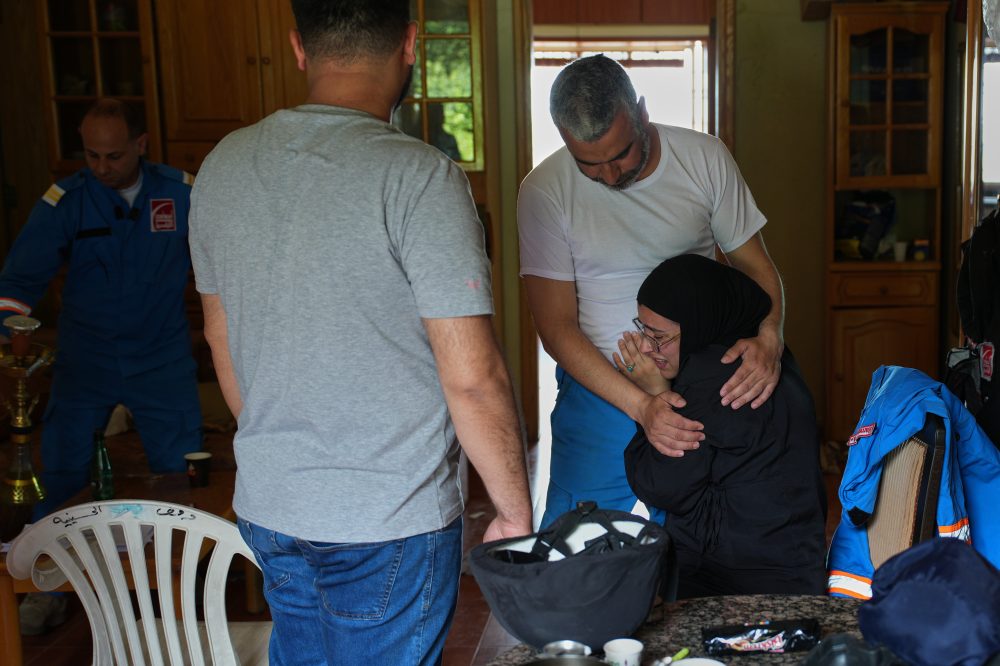
“I felt sick. I couldn’t believe my eyes,” Mohammed Jaber, 43, shared with The Associated Press on Friday from his emergency team’s base in Nabatiyeh, where crew members rested on foam mattresses. A 10-day ceasefire in the Israel-Hezbollah conflict gave the exhausted workers a rare break from constant explosions.
Jaber explained that his team quickly began loading the most severely injured victims into their functional ambulances. However, as team leader Mahdi Abu Zaid moved to secure the vehicle doors, they too came under fire.
These three separate attacks, resulting in four paramedic deaths and six injuries, represent another instance of Israel targeting Lebanon’s medical infrastructure.
During the 2024 Israel-Hezbollah conflict, such strikes became a major point of controversy, with Israel claiming that Hezbollah, like Hamas in Gaza, operated from Lebanese medical facilities — allegations both Hezbollah and Lebanon’s Health Ministry reject.
The frequency of these attacks has remained steady, with humanitarian organizations documenting an average of two healthcare worker deaths daily throughout the war until Friday’s ceasefire began.
When asked about the Mayfadoun incidents, Israeli military officials did not reiterate previous claims about Hezbollah’s use of medical sites. They stated they were “aware of reports about the ambulance attacks” and that “the incident is under review.”
The assault on the third rescue team occurred while they were still evaluating injuries from the first two crews, happening less than six minutes after they reached the scene.
According to colleagues who spoke with the AP, an Israeli drone shattered the vehicles’ windows and hit 30-year-old Abu Zaid, knocking him to the ground. Abu Zaid, who had a 4-year-old child and worked selling spices and nuts when not volunteering as a paramedic, was declared dead upon arrival at al-Najda Hospital.
The medical workers’ testimonies align with video evidence from a GoPro camera worn by one paramedic. The footage documents intense gunfire striking the ambulance while medical personnel treated two bloodied colleagues, one breathing weakly through an oxygen mask.
Following the third assault, a fourth rescue team successfully reached the trapped medics and evacuated the wounded without being targeted.
These ambulance attacks have sparked widespread criticism, including from the United Nations’ human rights office, which expressed being “shocked” and cautioned that deliberately targeting medical personnel constitutes a war crime.
For the emergency workers involved, this incident exemplifies Israel’s campaign to dismantle southern Lebanon’s healthcare infrastructure as its military expands security operations to the Litani River, approximately 20 miles into Lebanese territory, seeking to protect northern Israeli communities from Iran-backed Hezbollah.
“They should be targeting fighters, where the fighting is happening, at the border,” said Jaber. “Why target medics and civilians? So that life becomes unbearable and people tell Hezbollah to give up?”
Lebanon’s Health Ministry has documented at least 100 medical worker fatalities since Israel began its bombing campaign and ground operations in Lebanon, responding to Hezbollah missile attacks across the border on March 2, following Israeli and U.S. strikes against Iran.
“This war is different than all the other wars,” stated Mohammed Suleiman, chief paramedic for Nabatiyeh Emergency Services.
Suleiman’s own 16-year-old son Joud — who had accompanied and assisted on missions since childhood — died alongside a fellow paramedic in an Israeli motorcycle strike on March 24, marking the unit’s first casualties since its 2002 establishment.
“I always had my fears, but I believed that as a neutral organization with no connection to politics, we would be safe, off-limits,” he explained.
Beyond its military operations, Hezbollah functions as one of Lebanon’s most influential political parties and operates an extensive network of civilian institutions including medical facilities and educational centers.
The initial two paramedic teams attacked Wednesday were deployed by the Islamic Health Committee, a major healthcare provider connected to Hezbollah, and the Risala Scout Association, a medical response group linked to Hezbollah’s ally, the Amal movement.
Numerous paramedics from both organizations have died during these six weeks of warfare. The primary Islamic Health Committee facility in Jibsheet village, near Nabatiyeh, was destroyed in an Israeli airstrike last month, joining 59 primary healthcare centers closed due to Israeli attacks, according to the World Health Organization.
The U.N. health agency also condemned Israeli strikes that hit Lebanon’s Tebnine Government Hospital twice within three days this week, injuring 11 medical staff, damaging the emergency ward and pharmacy, and destroying vital equipment including ventilators and monitoring devices.
With Friday’s ceasefire in place, the Nabatiyeh medics hired a tow truck and returned to the Mayfadoun roadside where they were attacked. The three ambulances remained there, riddled with shrapnel, while bloodstains marked the pavement.
They transported Abu Zeid’s destroyed ambulance to a public square in Nabatiyeh, hoping it would serve as a memorial.
“We want this vehicle to bear witness,” said Mahdi Sadeq, a service coordinator. “To bear witness to what happened, to what this war has done to our profession.”