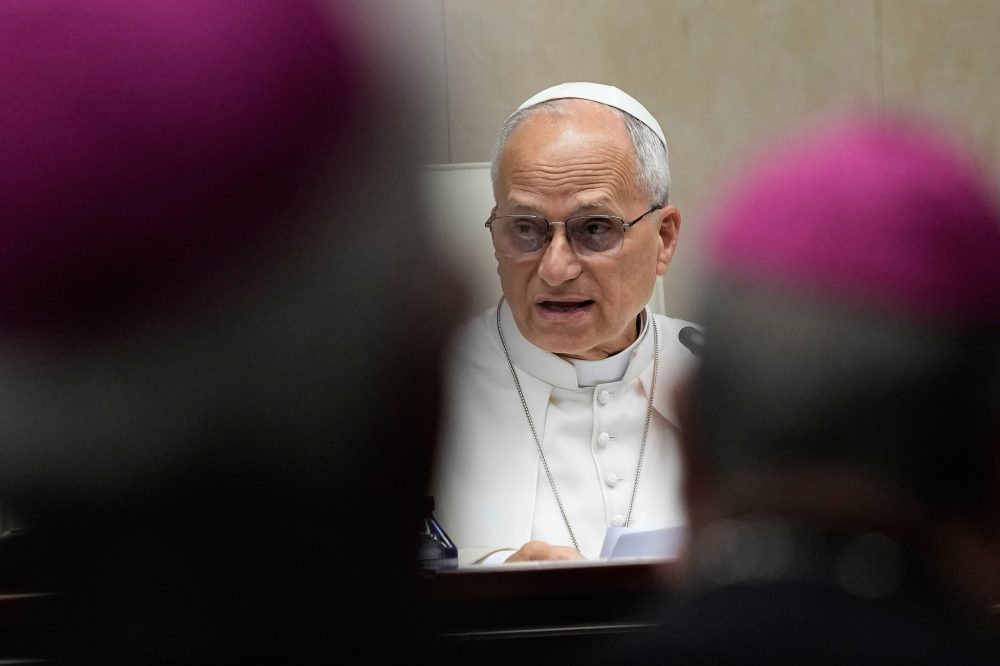

MADRID (AP) — During his weeklong visit to Spain, Pope Leo XIV called on the nation’s Catholic leadership Monday to compensate survivors of clergy sexual abuse and address the crisis with transparency, with an anticipated meeting with survivors on the horizon.
The pontiff urged Spanish bishops that the church community as a whole must maintain an “ever more determined commitment to prevention and a culture of care.” For decades, Spain’s Catholic hierarchy had largely downplayed the extent of abuse within their institution until media outlets started exposing a pattern of abuse and concealment.
“Faced with this scourge, the ecclesial community is called to respond with listening, truth, justice reparation,” Pope Leo XIV stated. “Every wounded person must be able to find sincere listening, welcome, protection and real paths to healing.”
Following public anger over the abuse scandal, Spain established a compensation program this year for clergy abuse cases that are too old for criminal prosecution, requiring cooperation between the Catholic Church and Spanish authorities.
While other nations and religious institutions have created compensation programs to pay survivors and offer therapy, Spain’s approach stands out by giving government officials significant involvement in the procedure and ultimate authority over payment decisions.
The voluntary system, which has received both support and doubt from advocacy organizations and survivors, allows individuals one year to submit applications.
Before the anticipated encounter with Pope Leo XIV, multiple survivor advocacy groups reported being kept uninformed about the meeting details and staged a small demonstration outside the Vatican’s embassy in Madrid.
“Our associations are pleased that a group of victims from the reparation plan can be heard by the pope, but they do not represent all the victims, and deep down they are being used by the church, by the bishops conference, to clean up the image of a Spanish church that has never been able to live up to its victims,” stated Juan Cuatrecasas, a spokesperson for the Robbed Childhood association.
Globally, sexual abuse by clergy and subsequent cover-up scandals have shaken Catholic dioceses, harming the church’s standing more than thirty years since the crisis initially became public in Western nations.
Pope Leo XIV also reinforced the Catholic Church’s position on maintaining confidentiality in the sacrament of confession, despite efforts across Europe and other regions to require Catholic priests to report abuse discovered during private conversations.
Investigations worldwide into clergy abuse have pointed to the seal of confession as a significant barrier to exposing and stopping abuse, with calls for its elimination. These studies have shown how perpetrators exploited the confessional to abuse minors and then depended on confession secrecy to hide their crimes.
Speaking to Spain’s parliament Monday, Pope Leo XIV presented the church’s right to maintain confidential priest-penitent discussions as an issue of religious freedom.
“To protect it legally, as is done in a similar way in some professions, means preserving a sacred space of inner freedom, where the believer can open his or her soul to God without fear of external pressures,” he explained.
Several former members of the influential Catholic organization Opus Dei, which originated in Spain and maintains significant influence there, were denied a meeting with Pope Leo XIV. They had hoped to discuss psychological and other forms of abuse they claim to have experienced within the movement.
“We do not speak out of bitterness, nor do we seek any kind of revenge; rather, we speak out of a sense of responsibility and moral duty as those who have firsthand knowledge of a reality that has caused grave harm to the church and suffering to many people,” eight former members wrote to Pope Leo XIV on May 24 requesting an audience.
While the pontiff’s office received their correspondence, they could not schedule the meeting due to the short notice, according to Gareth Gore, an author who met with the pope at the Vatican in March regarding his 2024 book about alleged abuses in Opus Dei, which the organization firmly rejected as baseless.
By refusing the meeting, Pope Leo XIV may be avoiding any appearance of interfering with church and Argentine investigations into the organization. In 2024, Argentine prosecutors determined there was sufficient evidence to begin a criminal investigation into the movement’s top South American leaders on human trafficking and labor exploitation charges involving 44 women.
Opus Dei’s Argentine branch has rejected these allegations.