
Pope Leo arrived in Angola Saturday afternoon, continuing his ambitious tour across Africa where he has emerged as an increasingly bold voice on global issues.
The pontiff, who hails from Chicago and is the first American to hold the papacy, landed in the capital city of Luanda around 3 p.m. local time. He’s scheduled to meet with President João Lourenço and speak to the nation’s political leadership about pressing social issues.
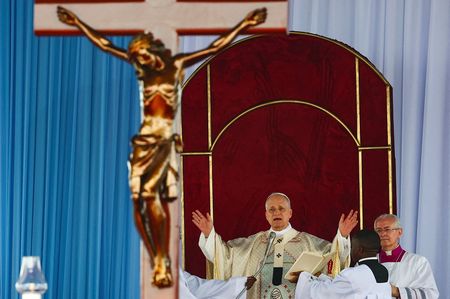
Before departing Cameroon earlier Saturday, Pope Leo delivered a farewell Mass in Yaounde, offering words of encouragement to those facing the Central African nation’s ongoing struggles, including deadly violence in English-speaking regions that has claimed thousands of lives.
“In moments when we seem to be sinking, overcome by adverse forces, when everything appears bleak … Jesus is with us always, stronger than any power of evil,” the pope told Mass attendees.
“In every storm, he comes to us and repeats: ‘I am here with you: do not be afraid’,” Pope Leo added.
The papal visit to Angola comes as the nation grapples with severe economic inequality despite its status as a major oil producer in sub-Saharan Africa. While petroleum exports make up roughly 95% of the country’s foreign sales, more than 30% of Angola’s 36.6 million residents survive on less than $2.15 daily, World Bank statistics show.
Catholics represent more than half of Angola’s population, making this visit particularly significant for the faithful there.
During his time in Cameroon, Pope Leo drew enthusiastic crowds, including an estimated 120,000 people who gathered for Friday’s Mass in Douala. Supporters lined roadways wearing colorful clothing decorated with the pope’s image.
The pontiff has faced criticism from President Donald Trump this week following papal statements condemning the Iran conflict. On Thursday, Pope Leo declared that the world was “being ravaged by a handful of tyrants.”
This marks a notable shift for Pope Leo, who maintained a relatively quiet public presence during his initial 10 months in office. However, his current 10-day African journey has featured increasingly direct commentary on warfare and social injustice.