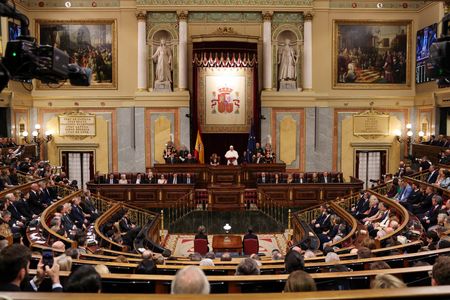

Pope Leo delivered a historic address to Spain’s parliament on Monday, declaring that rising conflicts, growing polarization, and widespread human rights violations have plunged the world into a severe crisis during one of his most comprehensive political speeches to date.
The pontiff, who has recently taken a stronger stance against current global leadership trends, reiterated his opposition to rising European defense expenditures, calling on political leaders to focus on ending global conflicts and assisting migrants instead.
“The world is undergoing a profound spiritual and cultural crisis, which is manifested in multiple forms of violence, polarization, and mutual distrust,” Pope Leo stated during his address, delivered just hours after Israel and Iran resumed hostilities in the most significant challenge to a two-month ceasefire.
“Weapons can impose a temporary silence; but they can never build an authentic and lasting peace,” he declared.
The papal address, delivered in Spanish and met with a seven-minute standing ovation from legislators, marked an unprecedented moment as the first time a pope has spoken before Spain’s parliament. The speech is part of a week-long tour during which the pontiff has engaged with migrants and homeless individuals while urging national leaders to stop creating divisions among their citizens.
Pope Leo’s visit will conclude with meetings with migrants in the Canary Islands who risked treacherous Atlantic crossings to reach Europe. He told lawmakers that insufficient support for global migrants threatens “the ethical foundation of the international order.”
The pope emphasized that nations must seek solutions beyond “the mere management of flows” and should tackle root causes forcing people to flee their homelands, including warfare, poverty, and climate change.
“The moral greatness of a nation is manifested above all in its capacity to accompany, protect, and love those lives that pass through the greatest fragility,” Pope Leo told parliament.
According to NGO Caminando Fronteras, over 3,000 people perished in 2025 attempting to reach the Canary Islands off Africa’s western coast, often in improvised boats. Prime Minister Pedro Sanchez’s administration has launched a comprehensive amnesty program, enabling approximately 500,000 immigrants to seek legal status.
Pope Leo, who released an urgent manifesto last month calling for governments to regulate AI development, urged “rigorous ethical vigilance” regarding artificial intelligence use in military applications on Monday.
He described increasing European defense spending, which reached its highest levels since the Cold War ended amid pressure from U.S. President Donald Trump, as “troubling.”
Spanish Prime Minister Pedro Sanchez has rejected Trump’s demands for NATO nations to boost defense spending to 5% of GDP, though expenditures have tripled during his tenure since 2018, climbing from approximately 10 billion euros ($11.5 billion) to over 34 billion euros.
Last month, the pope characterized European rearmament as a democratic betrayal.
Pope Leo also provided his most detailed comments to date on Church-state relations, advocating for religious freedom protection and arguing that faith “cannot be relegated to silence as though it were irrelevant to public life.”
The pontiff also defended the confidentiality of Catholic confession, which requires priests to maintain secrecy regarding information shared by penitents.
Multiple nations, including France, have considered requiring priests to report sexual abuse revealed during confessions following scandals that have impacted the Church globally.
Preserving confession confidentiality, Pope Leo argued, maintains “a sacred space of inner freedom, where the believer can open his or her soul before God.”
A 2023 investigation by Spain’s human rights ombudsman estimated hundreds of thousands of clerical abuse victims across decades. The Vatican announced the pope would meet with victim representatives during his visit but has not provided additional details. The pope did not address Catholic clergy abuse in his parliamentary speech.