
WASHINGTON — A fresh national survey reveals significant public concern about Iran’s nuclear capabilities, even as Americans express doubts about President Donald Trump’s decision-making on overseas military operations during ongoing diplomatic talks in Geneva.
The latest research from The Associated Press-NORC Center for Public Affairs Research shows roughly half of American adults express high levels of worry that Iran’s atomic program directly threatens the United States. An additional 30% report moderate concern, while only 20% indicate minimal or no worry about the issue.
Researchers gathered data between February 19-23 amid escalating tensions in the Middle East between Washington and Tehran. American officials are working toward an agreement that would restrict Iran’s nuclear development and prevent weapons production, while Iranian leaders maintain they aren’t seeking weapons capability and continue resisting calls to stop uranium processing or surrender their enriched uranium supplies.
The current president, who abandoned a previous Iranian nuclear accord during his earlier administration, has made multiple threats to employ military action against Iran’s atomic facilities. Trump claimed to have “obliterated” the program after a 12-day conflict in June that saw American forces strike Iranian nuclear locations. Tehran has promised retaliation for any attacks. Trump has also issued warnings regarding Iran’s treatment of demonstrators. Officials from both nations have indicated readiness for armed conflict should diplomatic efforts collapse, with America deploying its most substantial Middle Eastern military presence in recent decades.
Survey results show 61% of Americans classify Iran as an adversary of the United States, representing a slight increase from a September 2023 Pearson Institute/AP-NORC study. However, public faith in the president’s foreign policy judgment remains limited, with only approximately 30% of respondents expressing substantial confidence in Trump’s handling of international relationships and military decisions abroad.
Some Republican voters, particularly younger party members, harbor concerns about Trump’s capability to navigate these critical situations appropriately.
This year’s administration has conducted two sets of nuclear discussions with Iran through Omani intermediaries, with additional talks beginning Thursday. Previous negotiations between the countries collapsed following Israel’s involvement in the June military action.
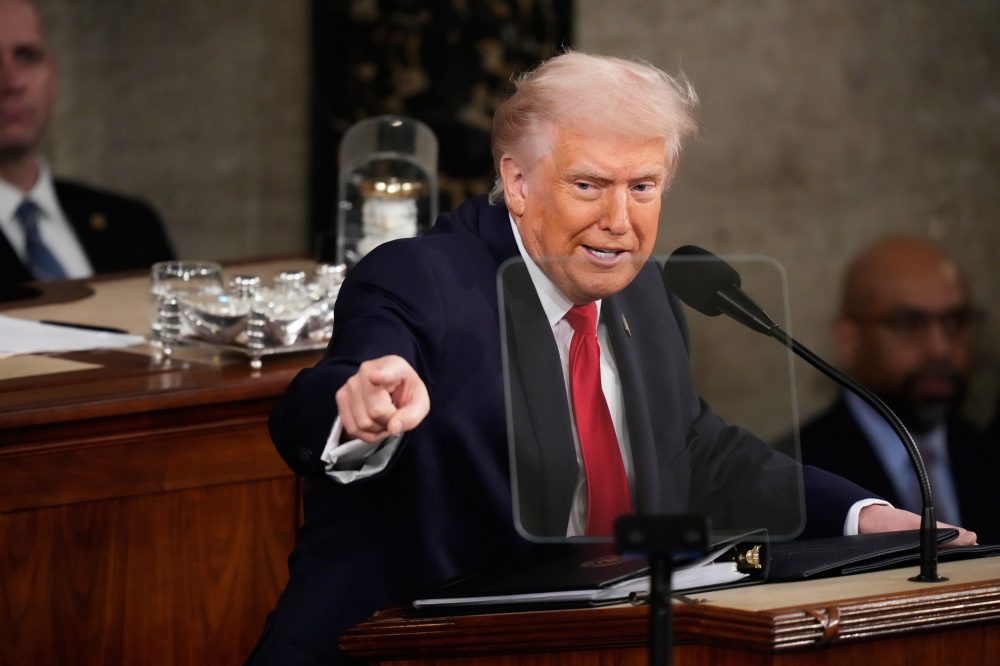
“We are in negotiations with them,” Trump stated during Tuesday evening’s State of the Union speech, delivered after poll completion. “They want to make a deal, but we haven’t heard those secret words: We will never have a nuclear weapon.”
The AP-NORC survey demonstrates substantial American skepticism regarding Trump’s foreign policy judgment. Only about 30% of adults express high confidence in the president’s military decision-making, adversarial relationship management, or nuclear weapons policies. More than half report minimal or no trust in these areas.
Republican respondents show greater confidence than Democrats and Independents in presidential decision-making. Approximately 60% of Republicans express high trust levels in Trump, while roughly 90% of Democrats report low confidence.
Republican support varies by age group. Younger Republicans under 45 show less confidence than older party members in Trump’s military judgment, with about half expressing high trust compared to two-thirds of older Republicans.
Current findings showing 48% of adults expressing high concern about Iran’s nuclear threat align with July 2025 AP-NORC polling, suggesting American opinions remain stable despite recent escalations.
Prior to the June conflict, Iran had been processing uranium to 60% purity levels, approaching weapons-grade concentrations. The International Atomic Energy Agency identified Iran as the only non-nuclear nation enriching uranium to such levels.
Iran continues blocking IAEA inspection requests for sites damaged during June’s military action, raising proliferation concerns among experts.
Concern about Iran’s nuclear development spans party lines, though Republicans currently show higher worry levels. About 56% of Republicans express high concern compared to 44% of Democrats.
Americans maintain predominantly negative views of Iran, with stronger opposition among older citizens.
Approximately 60% of adults classify Iran as an American enemy, up from 53% in the 2023 Pearson/AP-NORC survey. About 30% describe relations as unfriendly but not hostile, while only 10% consider Iran friendly or allied.
Age differences emerge in these perceptions, with only half of Americans under 45 viewing Iran as an enemy compared to 70% of those 45 and older. Generational gaps also appear in nuclear concerns, with about one-third of younger Americans expressing high worry versus 60% of older respondents.
Decades-long tensions over Iran’s nuclear program may explain older Americans’ heightened concern. Nuclear negotiations stalled after Trump’s 2018 decision to withdraw America from Iran’s 2015 international nuclear agreement.
The AP-NORC survey included 1,133 adults interviewed February 19-23 using NORC’s AmeriSpeak Panel, designed to represent the U.S. population. The margin of error is plus or minus 4.0 percentage points.