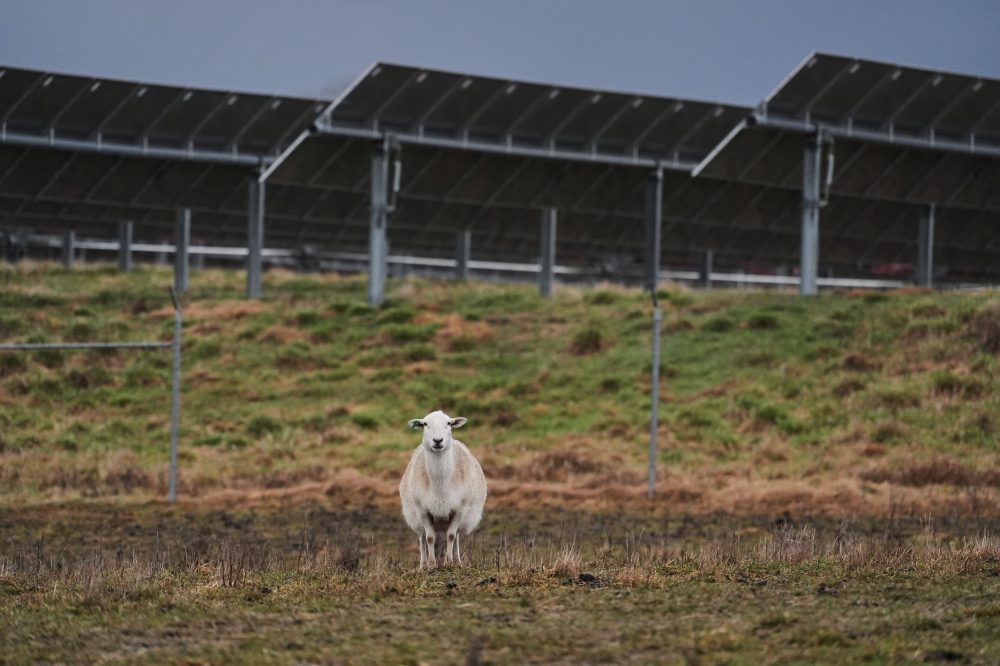

A Kentucky livestock producer’s experience highlights the growing challenges farmers nationwide face when trying to invest in solar energy following recent federal policy changes.
Daniel Bell, who raises sheep in Kentucky, had planned to install rooftop solar panels on a new barn he needed to construct for his expanding operation. Since his property sits far from existing power infrastructure, solar seemed like the perfect solution for heating the structure.
Bell intended to seek financial assistance through the Department of Agriculture’s Rural Energy for America Program, known as REAP, but discovered the Trump administration had essentially stopped issuing grants through the initiative. This development forced him to abandon his original solar installation plans.
“For me, it’s just been about freedom. Freedom to lower bills, freedom to control my own assets,” Bell explained.
Agricultural operations typically operate with extremely tight profit margins, making cost-cutting measures essential for survival. Many producers have turned to federal assistance programs to help finance solar panel installations on barns, grain storage facilities, and farm offices. Others have explored commercial renewable energy lease agreements as both additional income sources and ways to utilize unused farmland.
During Trump’s second term, two crucial federal initiatives supporting solar energy development – REAP and clean energy tax incentives – have faced significant rollbacks. Analysis conducted by The Associated Press and Grist examining data on both large-scale solar developments and small rural energy projects revealed that the Department of Agriculture has not distributed any rural energy grants or loan guarantees during the current fiscal year.
Reporters reached out to approximately 75 of the nearly 300 developers who have proposed agricultural land projects over the past two years. They discovered these companies are either preparing to operate without federal support or have already suffered millions in losses due to the administration’s revised tax credit policies.
Bell ultimately chose an alternative approach: rather than building on his own property, he requested permission to construct two temporary barns on land owned by a commercial solar operation where he receives payment for grazing his sheep beneath solar panels to maintain vegetation. If approved, these barns could access less expensive power from the solar facility’s operation. However, such opportunities remain unavailable to most farmers.
The impact of these policy modifications varies significantly. Some solar developments face delays due to permitting complications, others proceed as scheduled, and some are accelerating as developers rush to begin construction before tax credits disappear. Collectively, these findings demonstrate how the reduction in federal solar support has affected American agriculture from large corporations to family operations.
President George W. Bush signed the Energy Policy Act of 2005, which established a 30% investment tax credit for large-scale clean energy projects, providing a major boost to the solar industry. This tax credit received extensions under President Barack Obama and again under Trump in 2020.
When President Joe Biden signed the 2022 climate legislation, the tax credit was extended through 2032 or until specific emissions reduction goals were achieved. Last July, Congress passed Trump’s tax legislation, which reversed the timeline for clean energy tax credits. Now commercial solar projects must begin construction by July 2026 and become operational by the end of 2027 to qualify for the credit.
At least 126 solar projects proposed since early 2024 are currently waiting for regulatory approval, according to analysis of the most recent information developers provided to the Energy Information Administration. Each project is located near or on agricultural land, with at least 20% of the surrounding area used for livestock grazing or crop production, and would collectively generate approximately 20 gigawatts of electricity if completed. According to the Solar Energy Industries Association, this represents enough renewable energy to power roughly 4.5 million homes.
The compressed timeline has led some developers to abandon projects after determining they cannot move quickly enough to meet the new tax credit deadline.
Bogdan Micu, CEO of German solar developer Alpin Sun, reported his company had to abandon projects representing approximately $6 million in investments totaling about 1,000 megawatts in the northeastern United States.
“Well. We lost our projects,” Micu stated. The company simply could not accelerate its projects sufficiently to meet the deadlines, he explained.
Through REAP, the USDA provides grants and loans to farmers, ranchers, and rural businesses interested in renewable energy installations to reduce utility expenses. According to Richa Patel, a policy specialist at the National Sustainable Agriculture Coalition, REAP has funded over 19,000 grants totaling more than $1.8 billion since its establishment nearly two decades ago, supporting tens of thousands of renewable energy and energy efficiency projects nationwide.
The program received significant additional funding from the Inflation Reduction Act in 2022 and enjoyed largely bipartisan support until some congressional Republicans began questioning the grant structure. For many farmers whose awards or applications were affected as Trump returned to office, the past year has made farm country’s already challenging economic situation even more difficult.
Elisa Lane, who grows flowers and fruit in Hampstead, Maryland, will always remember the stress she experienced in February 2025 when she learned the Trump administration had frozen her $30,576 REAP grant awarded in 2024 for solar panel installation – without providing any explanation.
“Man, was that so stressful,” said Lane, who spent months worried she would be responsible for the amount she had already contracted a solar company to install. The system was supposed to reduce the burden of her energy bills, which she says averaged around $500 monthly before installing solar.
In March 2025, the agency announced it would release previously awarded grants and loans – but with apparent conditions. The USDA invited recipients to voluntarily revise their proposals to align with Trump’s executive order by “eliminating Biden-era DEIA and climate mandates embedded in previous proposals.”
Despite anxiously awaiting the funds, Lane chose not to revise her proposal after a local USDA representative advised against doing so. The representative assured her she would receive the payment, according to emails reviewed by Grist and the AP. Later that spring, she heard from the USDA that the payment would be released and she could proceed with construction.
She moved forward, paying the full $70,000 cost to install the panels. By August, they were operational on her property. By September, she received her reimbursement check covering approximately half the project cost from USDA – more than six months after the funding was initially frozen.
Over roughly seven months, the USDA froze the program’s grant funding, invited grantees to reapply without climate and diversity language, imposed extensive new restrictions on agricultural solar installations, and suspended future application cycles.
“It was so disruptive,” she said. “I just want to have a farm and be able to focus on my business.”
Now she is doing exactly that. The panels represent a long-term investment in reducing her farm’s substantial energy expenses.
While things eventually worked out for Lane and other recent REAP recipients, analysis of USDA Rural Development data found the program has not committed any funding for renewable energy development since September. Despite the agency indicating it anticipated doing so last October, USDA never reopened REAP’s grant application process. Its loan guarantee program – designed for larger farm and rural business projects – has remained available, though analysis found the agency has awarded no new agreements this fiscal year.
On March 31, the USDA announced suspension of all REAP grant awards so the agency could update program regulations to comply with an executive order Trump issued last July. The agency noted it “will not be making further grant awards until the new regulations are in effect,” but added that REAP guaranteed loans “will continue to be awarded in this time.”
In response to a comment request, a USDA spokesperson said the “suspension of REAP grant awards is temporary” but provided no additional details about how long grants will remain paused. When asked why the USDA has not issued any loans this fiscal year through the program, the spokesperson said the agency “continues to administer REAP in accordance with current guidance” and is “prioritizing program integrity and alignment with Administration direction as it conducts its review.”
Robert Bonnie, who served as undersecretary for farm production and conservation at the USDA under the Biden administration, said any reduction in the program’s funding will impact rural America broadly. Part of the USDA’s long-term role, he explained, has been channeling investment into rural areas while making rural prosperity part of the climate agenda.
“In places like Iowa and Texas, renewables matter, not just for additional power, and lower power bills, and clean energy, but also matters for farmers’ pocketbooks,” Bonnie said. “Anything you do to pull back on that is hugely problematic.”
For RIC Energy North America, a renewable energy developer headquartered in New York City, the solar tax credit changes triggered an urgent effort to advance every project in its pipeline, said CEO Jon Rappe. The company manages approximately 150 solar projects in its North American portfolio, with most developments on unused land, hayfields and former agricultural property.
“Now, some companies are probably going to go out and continue to sign sites, and take some risks, in case there’s an extension of tax credits or something like that,” Rappe said. “But the next generation of projects is not going to happen unless there’s some change at the federal level.”
One of RIC Energy’s developments involves creating 15 acres of solar installations on Tim Covert’s property in the predominantly agricultural community of Sheridan, New York. The community solar project, featuring small-scale arrays that would allow low-income residents to subscribe for monthly utility bill credits, provides a new source of consistent income for Covert, a former dairy farmer who received cancer treatment in the past year and struggled to work as a result.
“I’m 100% cancer-free, but with the treatments, there’s some side effects that take a little while to get rid of,” he said, including mental fog, muscle pain and reduced energy. “So it would be great if they did have it done by fall, and I started getting money.”
Under the agreement, the larger payment, which Covert says equals roughly 25% of his income as an electrical contractor, will not begin until the project is finished and operational – and Covert remains uncertain when that will occur given the changing federal environment. Currently, he receives a small payment simply for leasing his land. He has been told construction could begin as early as late May, though “it seems to be changing a lot.” RIC Energy told reporters that construction is scheduled to begin late summer to early fall.
“I don’t think they’re going to stop now, because they have quite a bit of time and money invested in this thing already,” he said. “So I don’t see them pulling the plug.”
Despite the policy shifts, some clean-energy developers report they are succeeding. Solar energy remains one of the most affordable energy forms, and energy demand continues growing, partly due to artificial intelligence data center construction. Additionally, tax equity sometimes complicated project financing, so losing the tax credit also removed a barrier to completion, said Nick Cohen, president and CEO of Doral LLC, a large-scale solar energy and battery storage developer with about 450 megawatts operating and approximately 16,000 more planned or under construction.
It’s “a very exciting time if you’re a large enough developer that was in the right place at the right time doing large projects,” he said.
“All the new rules really favor the big guys like us.”