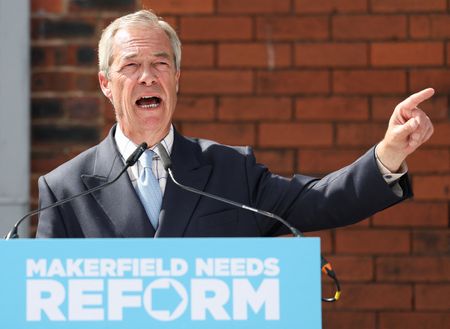

LONDON — Nigel Farage, who has long cast himself as a thorn in the side of Britain’s political elite, made another dramatic move Tuesday, announcing he would step down from his parliamentary seat and immediately campaign to win it back — a direct response to mounting questions about his personal finances.
The surprise announcement follows recent reports that Farage accepted a £5 million (roughly $6.7 million) gift from a Thailand-based billionaire who invests in cryptocurrency, a transaction critics say was not properly disclosed and is now under investigation by a parliamentary standards watchdog. Questions have also been raised about financial support he received from a political ally who was previously convicted of wire fraud in the United States.
Farage described the decision to force a by-election as part of his strategy of “sticking two fingers up at the establishment,” saying he expected voters in his constituency to reaffirm their support for him as their representative in parliament.
The gamble carries real risk. Opposition parties could flood resources into the race, coordinate their efforts to back whoever has the best chance of defeating him, or dismiss the whole exercise as a publicity stunt. Regardless of how rival parties respond, the resulting vote would effectively become a referendum on Farage’s political future — well ahead of the next scheduled national election in 2029.
Farage, 62, has been one of the most polarizing and influential figures in British politics for more than two decades. As the leading public voice for Brexit, he spent years pressuring successive prime ministers to take a harder line on immigration and ultimately helped force the 2016 referendum in which British voters chose to leave the European Union by a margin of 52% to 48%.
His Reform UK party has topped nearly every national opinion poll for more than a year and has scored wins in local elections, putting serious pressure on both the Labour and Conservative parties, which have dominated British politics for a century.
Despite never serving in government and only winning a seat in the national parliament on his eighth attempt — in 2024 — Farage is widely seen as having reshaped British political debate more than many prime ministers who actually held power.
His career has been anything but straightforward. He has resigned four times from two separate political parties and has had very public falling-outs with numerous colleagues. Yet his everyman image — often photographed holding a cigarette in one hand and a pint of beer in the other — has kept him a constant presence in British media.
After the Brexit referendum victory, Farage abruptly quit as leader of the United Kingdom Independence Party just eight days later, saying he wanted his “life back.” He returned two years later when Brexit negotiations stalled in parliament. His newly formed Brexit Party won the European Parliament elections in 2019, rattling Conservative lawmakers enough that they moved to oust then-Prime Minister Theresa May.
He stepped back again to pursue a media career and cultivated a close relationship with U.S. President Donald Trump. Eventually, he re-entered politics under the Reform UK banner, and his party’s strong showing is widely credited with contributing to the Conservative Party’s worst-ever electoral defeat.
Over the past year, Reform UK has worked to build a more professional political operation, bringing in major donors and relocating to a new headquarters near parliament. Pollsters now suggest the party could win the most seats in the 2029 general election — a result that would put Farage in position to become prime minister.
But reaching that goal would require him to withstand the kind of intense scrutiny that comes with being a genuine contender for government leadership, not simply a critic from the outside.