
PITTSBURGH (AP) — Pittsburgh’s media scene experienced a dramatic revival this spring, bouncing back from what seemed like certain doom just weeks earlier.
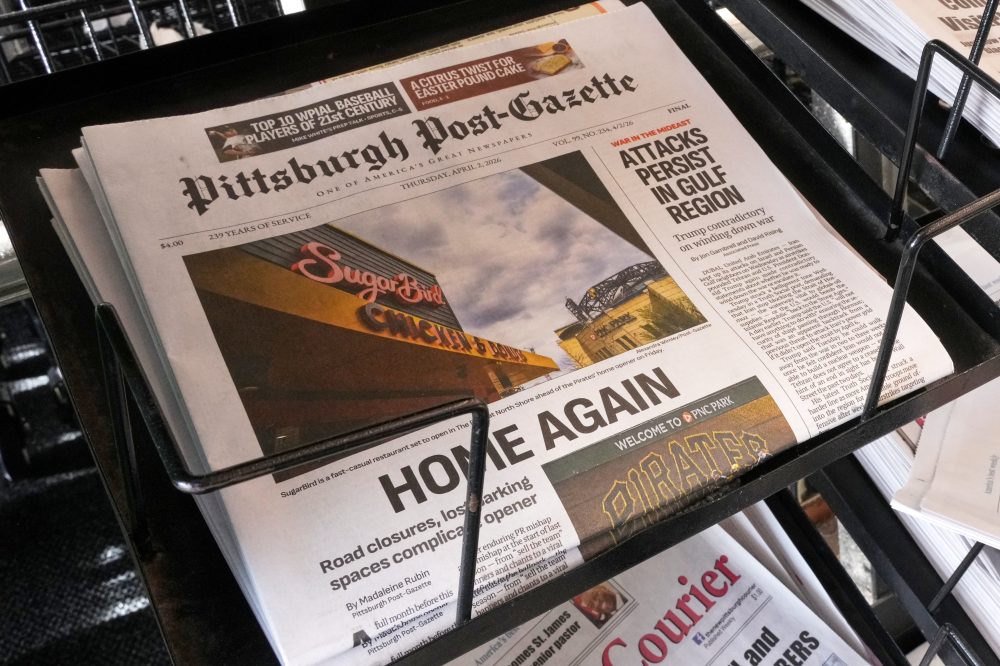
The historic Pittsburgh Post-Gazette found new life when its owners announced a sale to a nonprofit foundation committed to continuing operations. The publication, which existed before America’s Constitution was written, had been scheduled to shut down on May 3, potentially leaving Pittsburgh as the country’s biggest city without its own major newspaper.
Just weeks before that announcement, the Pittsburgh City Paper also made a stunning comeback under new ownership, after its staff discovered on New Year’s Day that the alternative weekly was closing after three decades of operation.
These developments stand out as rare bright spots in an industry that has faced devastating losses over the past twenty years — with newsrooms closing or drastically reducing staff, reporters losing jobs, and readers turning elsewhere for information. Nobody expects Pittsburgh’s media recovery to be simple, but the city’s brush with a complete news blackout may have helped prepare the community for change.
“It’s human nature that sometimes you have to be shaken a bit to realize what’s important in your life,” said Halle Stockton, co-executive director and editor-in-chief of the digital news outlet Public Source.
The Pittsburgh Gazette first published on July 29, 1786, becoming the inaugural newspaper west of the Allegheny Mountains. The publication underwent multiple name changes as the city’s newspaper market expanded and contracted, once supporting seven different papers at the start of the 1900s. Various iterations included The Commercial Gazette, the Gazette-Times, and briefly, the Pittsburgh Gazette and Manufacturing and Mercantile Advertiser.
When the Pittsburgh Post shut down in 1927, a merger created the Post-Gazette, a name that has endured for nearly a century.
The newspaper built a strong reputation over the decades, earning a Pulitzer Prize in 2019 for covering the Tree of Life synagogue shooting. “The Post-Gazette is really the paper of record for this city,” said Kevin Acklin, chief of staff to a former Pittsburgh mayor and former president of the Penguins hockey team. The city’s other major “paper of record,” The Pittsburgh Press, ceased operations in 1992 following a Teamsters Union strike.
Labor disputes also plagued the Post-Gazette’s final years. Most staff members went on strike from 2022 through 2025, while the publication struggled to continue operating. Owner Block Communications, Inc. announced the closure on the same January day the U.S. Supreme Court rejected its appeal regarding a health benefits ruling that favored former strikers.
Speculation about the newspaper’s fate continued for months afterward. Acklin collaborated with other investors during the winter to purchase the publication, but negotiations collapsed when Block demanded the union be excluded from any deal.
A hint about the newspaper’s future emerged across town in mid-March for those paying close attention.
“You thought we were dead and gone, didn’t you?” Ali Trachta, top editor at the Pittsburgh City Paper, wrote on the outlet’s revived website. “So did I. But, to be honest, only very briefly.” She revealed that the publication was resuming coverage of community news, politics, arts “and the creative, weird and uniquely Pittsburgh stories” that have characterized it since 1991.
A new nonprofit called Local Matters, headed by a former Apple engineering manager, had assembled investors to acquire the City Paper. The publication planned to resume monthly print editions and launch a membership program for reader support. Most previous staff members would return. The paper had printed weekly until its former owner decided in 2025 to reduce print editions to just four per year.
That previous owner was Block Communications.
When Block announced the Post-Gazette sale last week, the buyer was also a nonprofit. The Venetoulis Institute for Local Journalism, which operates the successful digital publication The Baltimore Banner, purchased the Post-Gazette despite Block stating they weren’t the highest bidder. Many Pittsburgh residents had worried about a sale to a hedge fund known for gutting newspaper resources.
Does this make Block, long viewed as a villain in local journalism circles, a hero in this situation?
“For better or worse, the Blocks will never get credit for that,” said Andrew Conte, a journalism professor at Point Park University who runs Pittsburgh’s Center for Media Innovation. “But it does seem like they made an effort to come up with the best outcome they could as they were leaving Pittsburgh. They could have just walked away and said, ‘You know, we’re done.’”
The real work now begins. Venetoulis officials didn’t respond to Associated Press inquiries. The institute’s benefactor, hotel magnate Stewart Bainum Jr., has announced plans to invest $30 million in both the Banner and Post-Gazette over five years. The Newspaper Guild of Pittsburgh expressed hope to participate in rebuilding efforts, though union involvement remains uncertain.
“This is going to be one of the most closely-watched newspaper acquisitions in years,” said Tim Franklin, founding director of the Medill Local News Initiative at Northwestern University. “Can a money-losing newspaper with serious labor strife be saved and resurrected as a non-profit? If Stewart Bainum and his team pull this off — and I hope they do — it could be a model for the nation.”
Other Pittsburgh news organizations had begun preparing to fill potential gaps in coverage and aren’t necessarily changing those plans despite the Post-Gazette sale.
The Pittsburgh Tribune-Review will restart Sunday print editions in Pittsburgh on May 9 after stopping city printing a decade ago. The Trib also plans to hire approximately a dozen journalists to expand coverage of business, healthcare, transportation and education, according to CEO Jennifer Bertetto. Based in Greensburg, 30 miles east of Pittsburgh, some city residents consider the Trib an outsider.
Stockton’s Public Source, established in 2011 primarily for investigative reporting, is expanding its focus. The organization has hosted town halls recently for residents to discuss their local news preferences and published a directory of 40 to 50 small regional outlets covering specialized topics like arts and business, or specific neighborhoods and communities.
People previously unengaged with news were seeking alternatives. “People are actively interested in where they get their information and who they can trust for it,” Stockton said. “So we’re leaning into that.”
With their careers uncertain for months, Post-Gazette content editor Erin Hebert and photographer Steve Mellon joined other journalists meeting regularly as the Pittsburgh Alliance for People-Empowered Reporting, or PAPER, exploring the possibility of creating a digital news site. Hebert said those plans remain undecided following recent developments.
Conte can walk from the university to show office space designated for journalists from small, local publications. He hopes to persuade the Tribune-Review to print periodic inserts featuring top reporting from these outlets.
The challenge facing news organizations in 2026 becomes clear when speaking with students in Conte’s journalism classes. When asked how many checked the Post-Gazette’s website that morning, only a few hands hesitantly rise.
Instagram and TikTok often serve as their news sources. These platforms are more convenient and don’t have paywalls, said Gabriela Wait. The journalism students know to verify information with reliable sources when uncertain about content credibility. Many of their peers don’t follow this practice.
Makenna Smith remembered her grandparents and parents reading newspapers during her childhood, staying informed and entertained. Few people her age maintain similar habits.
A recent Pew Research Center study revealed declining public interest in news across all age groups. Pew discovered that 37% of Americans closely followed local news in 2016, dropping to 21% in 2025.
For Conte, this emphasizes the importance of news organizations working together. As a former Trib reporter, he remembered intense rivalry with the Post-Gazette.
“Literally, they were trying to kill each other,” he said. “I don’t think any of us want to go back to a point where we’re doing that. We’ve evolved. We’re trying to work together. Even if we’re competing for scoops and clicks and dollars, there’s also a benefit to having us get around the same table once a month.”