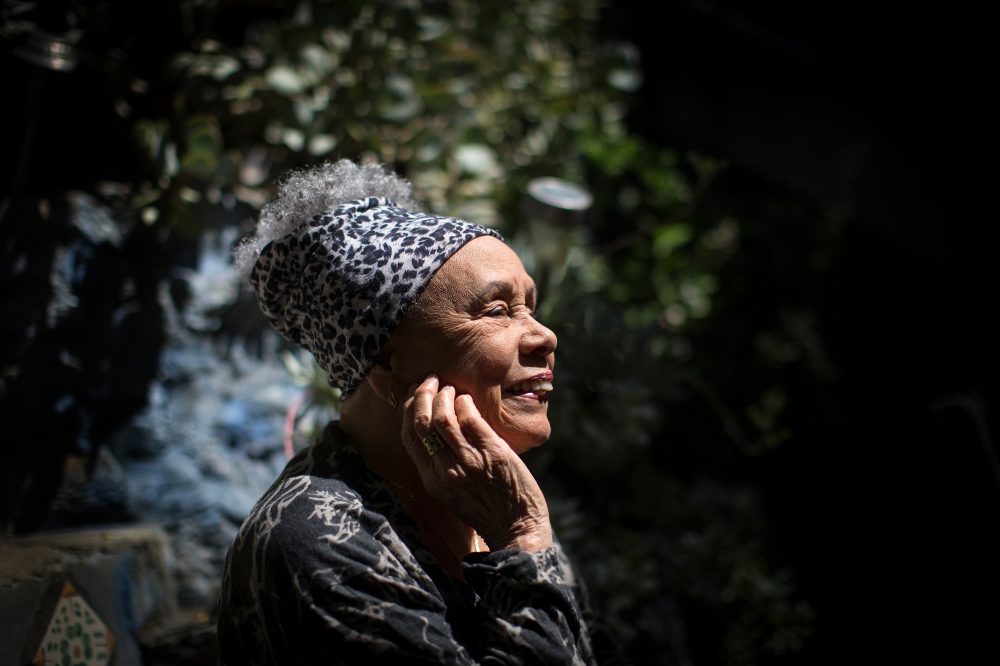

Betye Saar, a trailblazing artist celebrated for her deeply personal explorations of Black identity, culture, and spirituality, died Sunday morning in Los Angeles. She was 99 years old.
Family members confirmed her passing on Monday. In a poignant twist, Saar would have celebrated her 100th birthday later that same week.
Saar was a central voice in the 1960s Black Art Movement, known for pioneering the art of assemblage — sculptures crafted from everyday found objects. She became especially recognized for reclaiming Jim Crow-era memorabilia and transforming those objects into powerful symbols of Black liberation.
Roberts Projects, the Los Angeles gallery that represented her, described the scope of her legacy this way: “Her symbolically rich body of work has evolved over time to demonstrate the environmental, cultural, political, racial, technological, economic, and historical context in which it exists.”
Saar did not begin her artistic career right away — she started out in design and didn’t transition to making art until she was 35 years old. Despite that late start, she continued creating well into her 90s. She grew up in Pasadena and was embedded in a community of Black artists in nearby Altadena. She frequently pointed to Simon Rodia’s Watts Towers as one of her earliest sources of creative inspiration.
The gallery also noted: “Her appropriation of Black collectibles, heirlooms, and utilitarian objects are transformed through subversion. Among the older generation of Black American artists, Saar is without reproach.”
Her artistic practice spanned painting, printmaking, and sculpture, and often incorporated found objects such as dolls, washboards, and other antiques.
One of her most celebrated works, “Black Girl’s Window,” was created in 1969 and considered groundbreaking at the time — though it wasn’t widely recognized until many years later. The Museum of Modern Art in New York acquired the piece in 2019. Saar once reflected on the challenges she faced: “There weren’t that many galleries in Los Angeles at the time and there certainly weren’t any for Black artists.”
Another landmark work, “The Liberation of Aunt Jemima,” was completed in 1972. The piece incorporated memorabilia that had historically been used to demean Black people, including a depiction of the “mammy” — a 19th century minstrel character portrayed smiling while serving white slave owners. In Saar’s reimagining, that same figure smiles but holds a rifle and a hand grenade, reclaiming the image as one of defiance and power.
Angela Robinson Witherspoon connected the work to a specific historical moment: “That was done as an answer to the killing of Dr. King,” she said, referencing the 1968 assassination of the Rev. Martin Luther King Jr. in Memphis, Tennessee. “She was raising her three young daughters and she wanted to be part of the Civil Rights Movement.”
The Aunt Jemima brand had been part of Quaker Oats for more than 130 years before the company announced in 2020 that it would retire the brand, acknowledging that the logo’s origins were “based on a racial stereotype.”
Robinson Witherspoon, who produced and directed a 2023 documentary about Saar titled “Betye Saar: Ready to Be A Warrior,” spoke to the artist’s drive and purpose. “I think that she had boundless energy for making art. I think she had a lot to say and was tired of the art world being dominated by white males,” she said. The documentary features interviews with John Legend, Tina Knowles, and other prominent voices.
While Saar’s work appeared in a solo exhibition at the Whitney Museum in 1975, major institutions showed her work only occasionally over the following decades. That changed in 2019, when the Los Angeles County Museum of Art and MoMA mounted simultaneous solo shows dedicated to her work.
Throughout her career, Saar also shaped the next generation of Black artists through teaching and mentorship, including painter Kerry James Marshall. She has long been regarded as a defining figure in the West Coast arts community.
In spring 2026, Saar was inducted into the American Academy of Arts and Letters.
An exhibition focusing on her costume design work, titled “Let’s Get It On: The Wearable Art of Betye Saar,” is currently on display at Roberts Projects in Los Angeles.