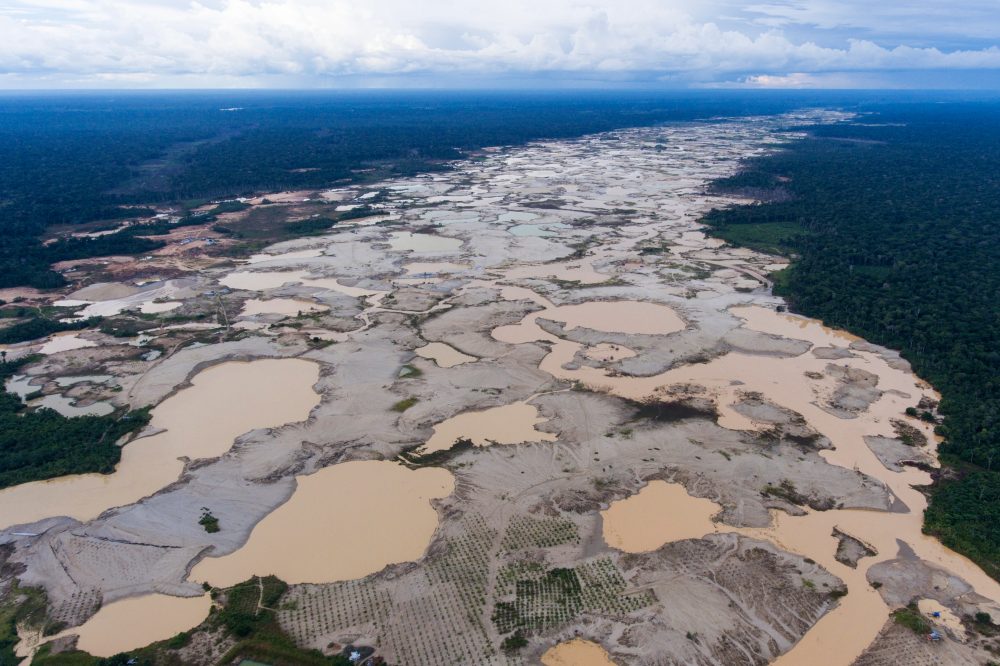

BOGOTA, Colombia (AP) — Voters in Peru cast ballots this Sunday for their next president and legislative representatives, yet the campaign season has largely overlooked unlawful mining operations that drive widespread forest destruction and mercury contamination throughout Amazon regions and native lands.
Researchers caution this oversight demonstrates Peru’s inability to address what has evolved into the nation’s most profitable underground economy, creating devastating consequences for natural ecosystems, community health, and indigenous populations.
Environmental attorney César Ipenza stated: “Political parties don’t understand that illegal mining has become the country’s main criminal activity and the one that moves the most money. There is either ignorance about what this represents for the country — or, in some cases, parties are already part of this economy.”
Data from Peru’s Institute of Economics shows unlawful mining operations produced over $11.5 billion during 2025 along with more than 100 tons of exported gold — matching legitimate industry output while exceeding narcotics trade revenues.
Several presidential hopefuls, including former government officials Jorge Nieto and Alfonso López Chau, have proposed limited solutions like gold tracking systems, financial oversight, and environmental activist protections, though these suggestions lack comprehensive coordination.
Meanwhile, other contenders from major conservative and populist movements — including Keiko Fujimori, Rafael López Aliaga, and César Acuña — emphasize security concerns, economic expansion, or resource extraction without confronting illegal mining’s connections to government corruption and Amazon territorial control. Some candidates like Ricardo Belmont and Carlos Álvarez, both former media personalities, completely ignore the problem in their platforms.
Magaly Ávila, who leads environmental governance efforts at Proetica, a Peruvian anti-corruption organization, explained: “Illegal mining and illicit economies are not being prioritized in government plans.” She noted approximately 64% of party platforms inadequately address these issues, while only 5% tackle them “clearly and explicitly.”
Research conducted in March by Peru’s Observatory of Illegal Mining supports these findings, revealing just 12 among 36 registered political organizations present detailed proposals, while others provide vague statements lacking concrete action plans or completely avoid the topic.
Government officials have previously announced enforcement campaigns and anti-mining strategies, though specialists indicate implementation remains weak. The Associated Press reached out to multiple government departments seeking commentary on illegal mining and indigenous protection matters but received no responses before publication.
Peru’s legislature has continuously renewed temporary permits allowing unofficial miners to operate while pursuing legal status, creating what critics describe as a widely exploited system that enables illegal mining growth.
Simultaneously, recent legal modifications have reduced prosecutors’ and judges’ abilities to pursue organized criminal networks, including illegal mining groups, according to advocacy organizations.
Policy experts believe these changes reflect political influence from small-scale mining operators who organize demonstrations demanding relaxed regulations, hampering stricter enforcement efforts.
These protests display sophisticated coordination, indicating involvement from influential behind-the-scenes players, according to Julia Urrunaga, Peru program director at the Environmental Investigation Agency (EIA).
Unlawful mining has expanded dramatically in recent years, driven by skyrocketing gold values reaching approximately $4,500 to $5,000 per ounce — making even minimal gold quantities extremely profitable. Previously concentrated in areas like Madre de Dios, these activities have spread across additional Amazon territories and beyond.
Ipenza observed: “The price of gold has reached historic highs, and that has obviously driven illegal mining to expand. The state does not have the capacity to respond or pursue this activity.”
Illegal mining sites frequently use mercury for gold extraction, poisoning waterways and contaminating food supplies through fish consumption.
Mariano Castro, Peru’s former environmental vice minister, explained: “In Amazonian river communities, between 50% and 70% of the diet is fish. So exposure increases exponentially, and mercury is highly toxic, with serious neurological impacts.”
Environmental and medical specialists warn contamination levels in certain regions already surpass safety guidelines, creating long-term health dangers.
Anticipated growth throughout Amazon areas “will bring contamination, transnational criminal groups and direct impacts on Indigenous and local populations,” Ipenza predicted.
Unlawful mining currently “puts at risk our health, biodiversity and ways of life,” stated Tabea Casique, a governing board member of AIDESEP, Peru’s primary Indigenous advocacy group.
“Most political parties are not taking this problem into account or presenting concrete proposals,” she added.
Former vice minister Castro described government responses as “insufficient” and noted lawmakers have also reduced legal mechanisms for prosecuting illegal mining, including lowering penalties and restricting authorities’ ability to classify such operations as organized crime. Oversight gaps enable illegally extracted gold to enter legitimate markets, frequently through processing facilities where it gets laundered.
Ipenza advocated for improved government oversight of small-scale processing operations and enhanced coordination between agencies — including customs, financial intelligence departments, and prosecutors — to monitor gold movement and detect illegal activities.
Policy analysts identify inadequate tracking systems as a fundamental weakness.
EIA’s Urrunaga stated: “There is no real way to trace mining production in Peru. Authorities hold fragmented pieces of information, but there is no system — and apparently no political will — to connect them.”
“We are talking about more than $12 billion in illegal gold exports,” she continued. “How can this be happening in almost total impunity?”
Specialists warn that continued inaction will make the crisis increasingly difficult to manage. Peru’s incoming administration will confront mounting pressure to address what they describe as an already escalating emergency.
Castro concluded: “Authorities cannot fulfill their responsibility to protect citizens if they continue to normalize an activity that causes significant harm.”