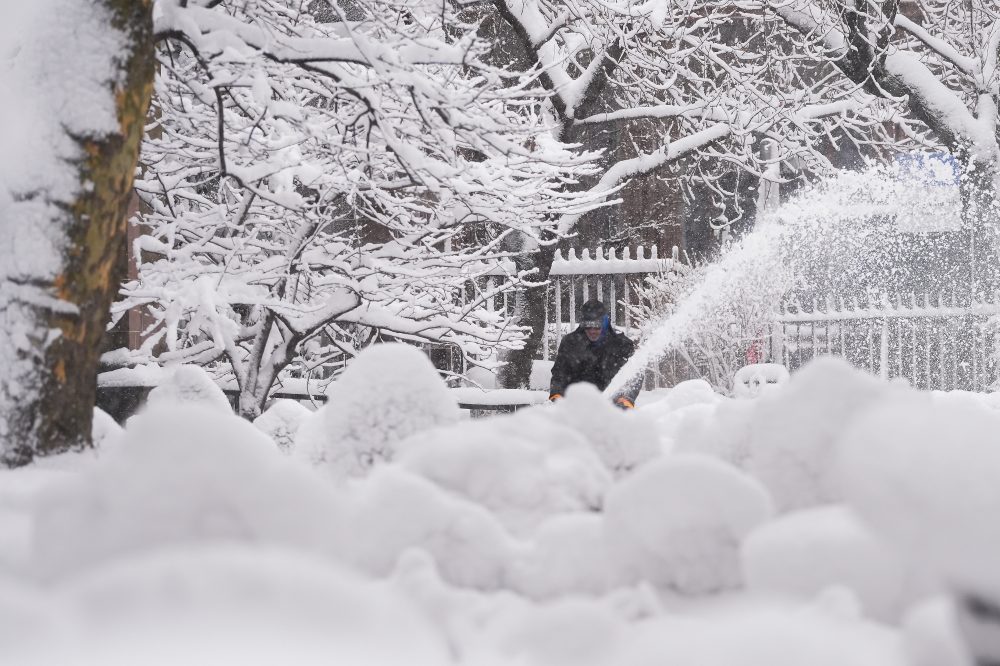

WASHINGTON — A devastating nor’easter that buried much of the Northeast under nearly three feet of snow represents the most powerful winter storm to strike the region in ten years, according to weather experts who describe it as a textbook example of extreme weather conditions.
The massive storm rapidly strengthened into what meteorologists classify as a “bomb cyclone” while producing rare phenomena including thundersnow and lightning strikes. Despite creating dangerous and paralyzing conditions for millions across the Eastern Seaboard, weather professionals expressed fascination with the storm’s remarkable combination of intensity and meteorological perfection.
According to Owen Shieh, warning coordination meteorologist at the National Weather Service’s Weather Prediction Center in Maryland, the blizzard achieved what he called a “Goldilocks situation” — perfect atmospheric conditions that maximized snowfall potential. The temperatures were precisely right for heavy, wet snow accumulation; slightly warmer conditions would have prevented snow formation, while colder air would have contained insufficient moisture to fuel such massive precipitation.
The storm also followed an optimal path for maximum impact. Jeff Masters, co-founder of Weather Underground and current meteorologist at Yale Climate Connections, explained that a track slightly more inland would have cut off the system’s oceanic energy source, while a more seaward path would have dumped the heaviest snow over open water instead of populated areas.
“I’ve always been fascinated about how Mother Nature figures out how to put all the pieces together in order to maximize the most extreme outcome,” said private meteorologist Ryan Maue, a former chief scientist for the National Oceanic and Atmospheric Administration. “I think you could make a pretty good case that this is on par with some of the most impressive blizzards in history.”
“There’s this sweet spot that can generate your highest snow totals and that’s kind of where we’re at, so in a way that kind of adds to that classic-ness of it,” Shieh said.
By Monday midday, Providence shattered its all-time snowfall record with 32.8 inches, surpassing the previous mark set in 1978, with snow continuing to fall, according to the National Weather Service office in Boston.
Other significant accumulations included 26.5 inches at Islip Airport on Long Island, 24.2 inches in Freehold, New Jersey, and 24 inches in Southampton, New York — all recorded before noon Monday while precipitation continued. New York City measured over 15 inches with totals still climbing, and Philadelphia exceeded 13 inches, based on preliminary weather service data.
Shieh warned that the heavy, moisture-laden snow poses serious health risks, particularly for cardiac events during snow removal activities.
“Just a word of caution for those who are going to be out shoveling the snow, that this will be easy to overexert yourself on,” Shieh said. “So take frequent breaks.”
Weather experts evaluate storm strength by measuring atmospheric pressure at the system’s center — lower pressure indicates greater intensity. This particular storm underwent rapid intensification, with pressure dropping 39 millibars within 24 hours, far exceeding the 24-millibar daily decrease threshold required for “bombogenesis” or “bomb cyclone” classification, according to Shieh and Maue.
“I guess you could call it a superbomb,” Maue said.
Masters explained that such winter storms derive their power from temperature contrasts between cold continental air masses and warm, moisture-rich oceanic air, combined with thermal energy from the seas.
“This is about as intense as you can get,” Maue said. The storm’s minimum pressure reading of 966 millibars would equate to Category 2 hurricane strength in tropical systems, leading him to describe it as “a hurricane with snow.”
Former weather service director Louis Uccellini, who authored meteorological textbooks on winter storms, praised the system’s exceptional characteristics, comparing it to notable storms from 2016 and 1961. “It is a classic in terms of not only the snowfall rates, but the intensity of the storm itself,” said Uccellini. “It was just an amazing storm system.”
Research published last summer indicates that climate change is causing the most powerful nor’easters to become significantly more intense in our warming world.
MIT’s Judah Cohen identified a stretched polar vortex — when extremely cold Arctic air typically confined near the North Pole extends southward — as a contributing factor that began just before the storm developed. His separate research from last year found these polar vortex stretching events are becoming more frequent due to Arctic warming.
The storm produced an extraordinary combination of winter and summer weather phenomena, including thundersnow and lightning strikes that excited meteorologists covering the event. Masters noted that such occurrences happen “only in the most intense winter storms.”
Weather Channel extreme weather meteorologist Jim Cantore experienced lightning strikes while reporting live from Plymouth, Massachusetts — remarkably, the same location where he witnessed similar phenomena 11 years earlier during another storm.
“Holy smokes. We got it again baby,” Cantore screamed. “In the same place. Unbelievable.”
Meteorologist Matthew Cappucci, a Plymouth native who said he had long hoped to witness thundersnow, expressed excitement about the “really cool” lightning strikes that hit a New York City skyscraper and offshore wind turbines near the Massachusetts coast. However, Shieh noted that the weather service received no thundersnow reports from New York City.
Weather enthusiasts including Cappucci, Cohen, and Uccellini celebrated satellite imagery of the storm, which clearly showed all the meteorological elements that created such perfect conditions.
Shieh said the storm’s appearance was almost too perfect to be real, resembling something from a Hollywood production.
“It almost looks like CGI (computer generated image),” he said.