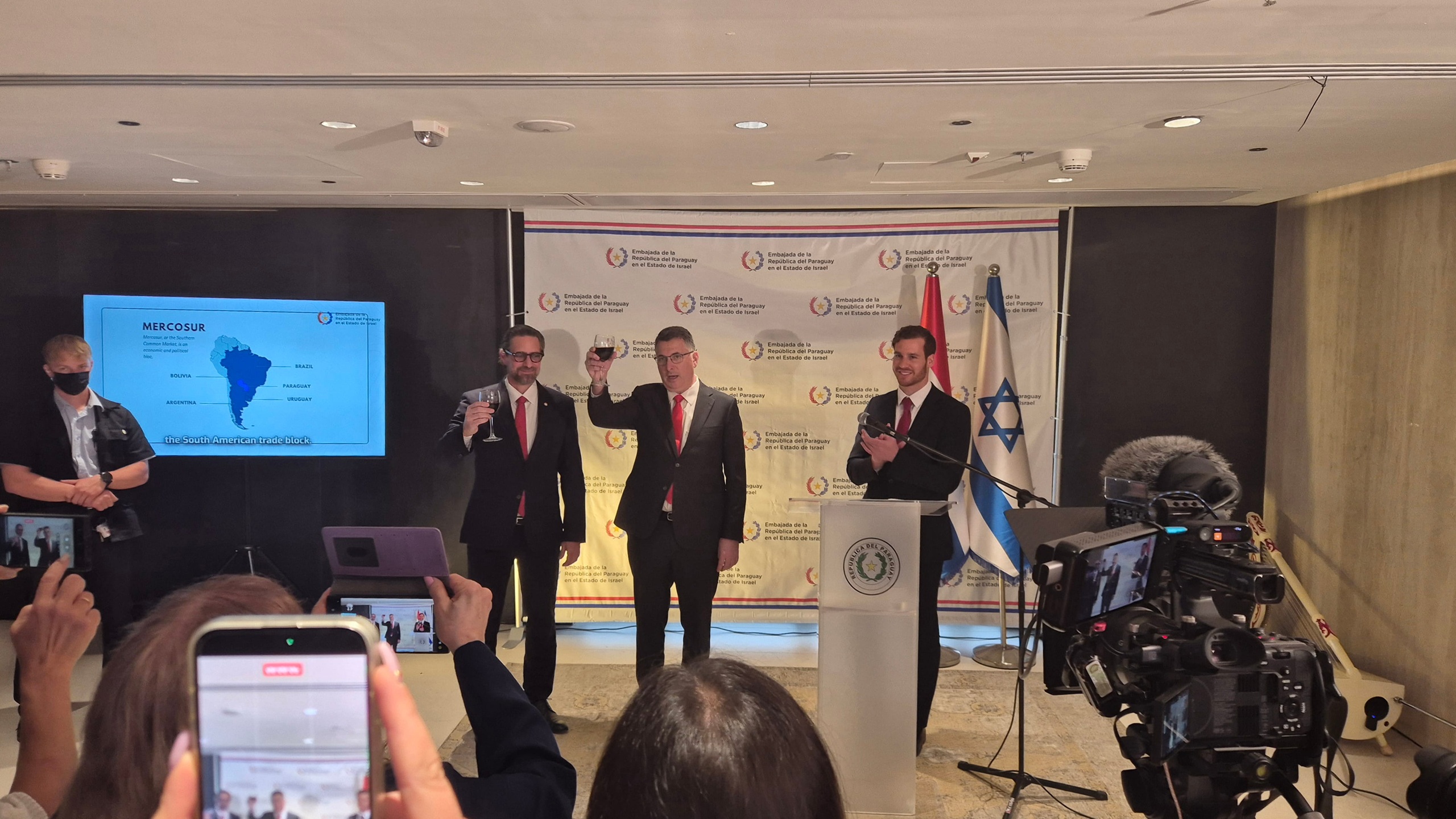

During Paraguay’s 215th Independence Day celebration at its Jerusalem embassy, Ambassador Alejandro Rubin Cymerman delivered a powerful message about his nation’s unwavering support for Israel. The diplomatic gathering featured Israeli Foreign Minister Gideon Sa’ar, Knesset members Boaz Toporovsky and Evgeny Sova, along with various diplomats and community leaders.
The ceremony included traditional diplomatic elements – flags, speeches, wine, and formal greetings. However, the most memorable moment came when Rubin explained Paraguay’s decision to locate its embassy in Jerusalem rather than following typical diplomatic protocol.
“Paraguay is in Jerusalem because it believes in Israel,” Rubin declared during his address. “Paraguay is in Jerusalem because it honors its word. Paraguay is in Jerusalem because it understands that true friendship is shown with actions.”
Rubin drew connections between the two nations’ independence stories. Paraguay gained independence on the evening of May 14, 1811, completing the process in the early morning hours of May 15. Similarly, Israel declared independence on May 14, 1948, just before the British Mandate ended at midnight. The ambassador noted that this year’s celebration also aligned with Jerusalem Day.
“Some coincidences are not invented. They simply exist,” Rubin observed. “They wait to be seen with attention. And they invite us to think.” He characterized Jerusalem as representing memory, faith, history, identity, and future – not merely a capital city.
The ambassador emphasized that Paraguay’s Jerusalem presence wasn’t directed against any other nation, but rather supported what his government views as historical truth and genuine friendship. “Peace is not built by asking a people to hide its history, to hide its identity, or to put aside what is essential to its national soul,” he stated. “Peace is built when people truly recognize each other.”
In a later interview with The Media Line, Rubin explained that Paraguay’s Israel relationship extends beyond government policy into Paraguayan society itself. He mentioned that President Santiago Peña has shared how ordinary citizens urged him to support Israel during his campaign. According to Rubin, Paraguay’s foreign policy centers on three main pillars: the United States, Taiwan, and Israel.
The ambassador connected Paraguay’s support for Israel to his country’s historical trauma, particularly the devastating War of the Triple Alliance in the 19th century, which claimed a catastrophic portion of Paraguay’s male population. This experience, he suggested, created an emotional bond with Jewish history and Holocaust memory.
“It stayed in the genes of the Paraguayan,” Rubin said, explaining why Israel support resonates widely in Paraguay compared to other Latin American countries. He compared this stance to Paraguay’s continued Taiwan recognition despite potential economic advantages from China relations.
“Paraguay does not move by convenience,” Rubin emphasized. “Paraguay moves by values.” He noted that when he arrived in Israel in January 2024, many Israelis knew little about Paraguay or confused it with Uruguay. Now, he said, the response is markedly different: “Today I say Paraguay, and the Israeli tells me: Thank you.”
Sa’ar praised Paraguay as a “stable friend” of Israel during his remarks, distinguishing it from countries whose friendliness fluctuates with political changes. He highlighted how such stability benefits not only governments but also business investors considering long-term commitments.
“With Paraguay, Ambassador, it’s not only that you really enjoy political stability and economic stability,” Sa’ar noted. “It’s a stable friend of the State of Israel. Its friendship is stable.” He recalled his Paraguay visit approximately six months earlier and joked that the Jerusalem embassy location made his schedule easier by being close to his office. “That’s a hint for other embassies,” he added.
Sa’ar outlined Israel’s straightforward foreign policy approach: investing in friendships with supportive nations. “We want to be friendly with those who are friendly to us,” he said. “It is very simple.” He mentioned that Fiji had also opened a Jerusalem embassy, with Somaliland expected to follow suit.
The economic dimension of the relationship has shown dramatic growth. Rubin reported that Paraguay’s annual beef sales to Israel, previously around $110 million, nearly doubled last year and could exceed $300 million this year if current trends continue, following more than $80 million in first-quarter sales.
However, Rubin stressed that Paraguay seeks recognition beyond meat exports. He described his country as offering food, energy, water, agro-industry, applied technology, logistics, services, maquila, and investment opportunities. As a Mercosur member, Paraguay provides access to both its domestic market of approximately 7.5 million people and a regional market of hundreds of millions.
“Israeli businesspeople are starting to discover that big things can be done from Paraguay,” he said. He also expressed interest in attracting Israeli backpackers, describing Paraguay as beautiful, affordable, fun, and safe for Israeli visitors.
Toporovsky, who attended shortly after resigning from the Knesset, told The Media Line about his close friendship with Rubin and how Israeli officials value Paraguay’s clear support. He identified opportunities for expanded cooperation in business, economics, diplomacy, politics, education, and research.
Sova, deputy speaker of the Knesset from the Yisrael Beitenu party, described visiting Paraguay two years ago as a Knesset member and maintaining regular contact with Paraguayan lawmakers and parliament speaker Raúl Latorre. He called Paraguay’s leaders “true friends” and emphasized the importance of their Latin American support.
“It is important to preserve the relationship, and it is important to support our friends,” Sova stated. “Regardless of the identity of the government in Israel, our relations with Paraguay will only grow stronger.”
The cross-party attendance reinforced Paraguay’s positioning as a long-term partner rather than merely a supporter of the current Israeli administration. During a period when Israel’s international relations often focus on war, diplomatic pressure, and isolation, Paraguay’s Independence Day celebration presented a different narrative: a Latin American embassy in Jerusalem openly celebrating sovereignty while declaring itself among Israel’s most devoted allies.
Rubin concluded by connecting symbols with action, arguing that diplomacy should extend beyond ceremonies and documents to “help bring good closer” and organize realities. His comments underscored that Paraguay’s Jerusalem embassy represents more than symbolic gesture – it constitutes a public alignment statement with Israel and a deliberate effort to make that friendship visible.