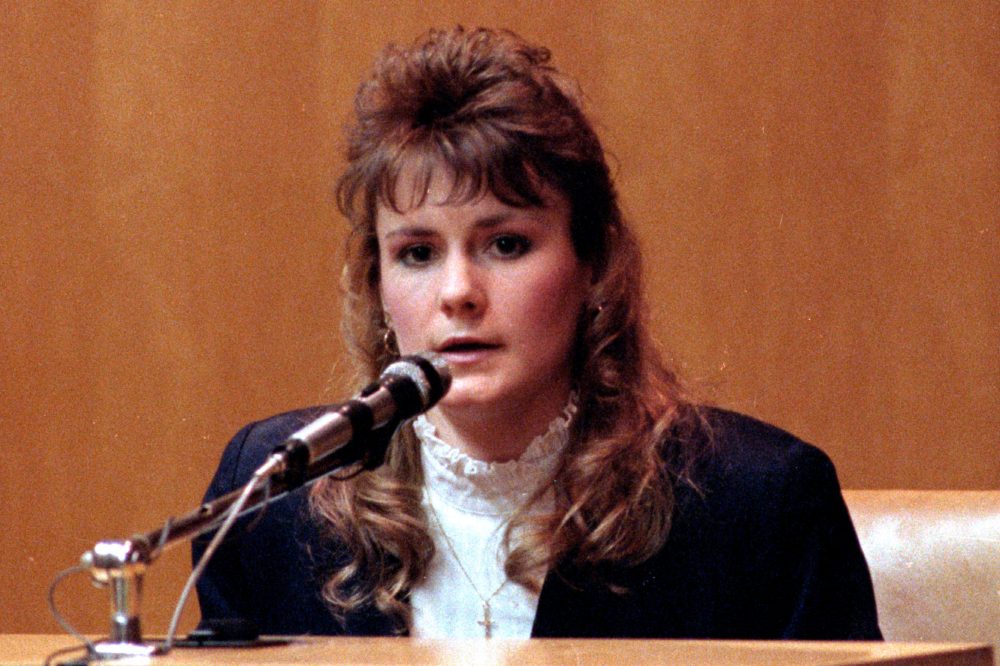

CONCORD, N.H. — Attorneys representing Pamela Smart appeared before a New Hampshire judge Monday, hoping to convince the court to allow her most recent petition for a new trial to proceed. Smart has been imprisoned for life after being convicted of arranging the killing of her husband through a teenage student back in 1990.
Smart was just 22 years old and working as a high school media coordinator when she began a sexual relationship with a 15-year-old student, who later shot and killed her husband, Gregory Smart, in Derry, New Hampshire. Her trial became one of the first in American history to be broadcast live on television in its entirety.
The teenager who pulled the trigger was released from prison in 2015 after completing a 25-year sentence. Smart maintained she had no knowledge of any murder plot, but a jury found her guilty of being an accomplice to first-degree murder along with additional charges. She received a sentence of life without the possibility of parole.
Smart, now 58, filed a habeas corpus petition in January of this year, asking the court to overturn her conviction based on what her legal team describes as multiple constitutional violations. She was permitted to attend Monday’s hearing by video from the Bedford Hills Correctional Facility for Women in New York, where she is housed.
A central argument from Smart’s attorneys is that prosecutors gave jurors inaccurate transcripts of secretly recorded conversations. They contend certain key words that appeared in those written transcripts were not actually audible on the recordings themselves.
Specifically, her lawyers say the word “killed” in the phrase “you had your husband killed,” the word “busted” in “I’m gonna be busted,” and the word “murder” in “this would have been the perfect murder” could not be heard on the tapes but were included in the transcripts shown to jurors.
Her attorney, Matthew Zernhelt, addressed this concern in a statement released earlier this year. “Modern science confirms what common sense has always told us: when people are handed a script, they inevitably hear the words they are shown,” he said. “Jurors were not evaluating the recordings independently — they were being directed toward a conclusion, and that direction decided the verdict.”
Smart’s legal team raised additional concerns, arguing the trial was compromised by overwhelming media coverage and that jurors received flawed instructions. They say jurors were told they had to find Smart acted with premeditation but were never instructed to consider only evidence presented during the trial itself. Her attorneys also contend the trial court improperly handed down a mandatory life sentence without parole for the accomplice charge, even though New Hampshire law does not require that punishment for that specific offense.
Attorneys for the state have asked the judge to throw out the petition entirely. They argue that nearly every claim Smart raises was either already addressed through the appeals process and ruled on by the New Hampshire Supreme Court, or could have been brought up during those earlier appeals but was not.
The state also pointed out that during the original trial, Smart’s defense only raised concerns about transcripts failing to capture instances where two voices overlapped — not about specific missing words. The trial judge at the time instructed jurors that if the recordings differed from the written transcripts, they should rely on what they heard. The state Supreme Court previously noted that Smart’s legal team never provided a detailed showing of inaccuracies in the transcripts or explained how those alleged errors harmed her case.
State lawyers also said Smart’s team has not substantiated other claims, including ineffective assistance of counsel and the fact that her case was tried in New York rather than New Hampshire.
Smart’s avenues for relief have grown increasingly narrow over the years. She has repeatedly and unsuccessfully sought a sentence reduction hearing before an elected state council in New Hampshire that oversees contracts and court appointments. After one rejection, she appealed to the state Supreme Court, which dismissed her petition in 2023.
Her current petition came after New Hampshire Gov. Kelly Ayotte turned down her request last year to bring the matter before the council once more. Ayotte stated she had reviewed the case and concluded it did not merit a hearing.
In 2024, Smart publicly accepted full responsibility for her husband’s death. In a video statement, she acknowledged that she had spent years deflecting blame, describing it as “almost a coping mechanism.”
Smart’s trial captured national attention as one of the country’s earliest high-profile cases involving a sexual relationship between a school employee and a student. The student, William Flynn, testified that Smart told him she needed her husband dead because she feared losing everything in a divorce, and that she threatened to end their relationship if he refused to kill Gregory Smart. Flynn and three other teenagers cooperated with prosecutors and have all since been released from prison.
Flynn and 17-year-old Patrick Randall broke into the Smarts’ Derry condominium and forced Gregory Smart to his knees in the entryway. While Randall held a knife to his throat, Flynn shot him in the head with a hollow-point bullet. Both pleaded guilty to second-degree murder and were sentenced to 28 years to life, receiving parole in 2015. Two additional teenagers also served prison time and have been freed.
The case went on to inspire Joyce Maynard’s 1992 novel “To Die For” and a 1995 film adaptation of the same title, which starred Nicole Kidman and Joaquin Phoenix.