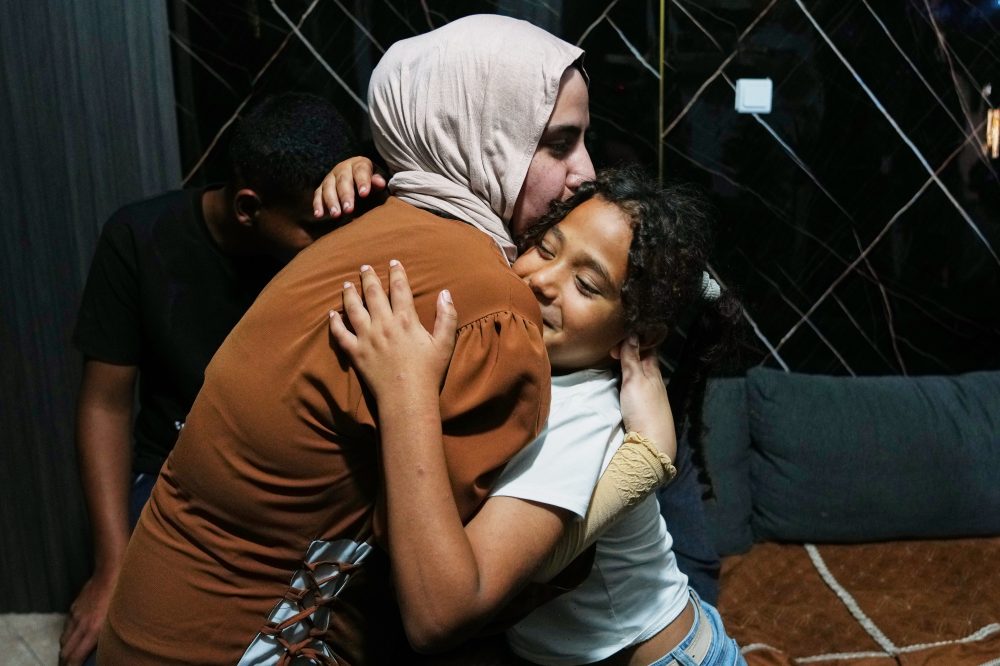

TULKARM, West Bank – The Ghanem family huddles in a makeshift shelter with only thin metal sheeting overhead as Iranian missiles streak across the sky above them, a stark reminder of their vulnerability since being forced from their longtime home in a Palestinian refugee camp.
This family represents thousands among approximately 32,000 residents whom Israeli forces removed from their homes across three established refugee settlements in the occupied West Bank during the past year.
Their dangerous circumstances intensified following the February 28 strikes by the United States and Israel against Iran, which left the West Bank exposed to falling wreckage from Iranian missiles destroyed by Israeli defense systems.
“The children were terrified by the sound of the rockets,” explained Madleen Ghanem, who shares a single-room shelter with her four youngest children ages three, eight, 11 and 14, while her older offspring live in separate locations.
Palestinian Civil Defence rescue services report that more than 270 fragments of missile wreckage have crashed into the West Bank since hostilities began.
The contrast with Israel is stark – while bomb shelters are commonplace there, the West Bank offers virtually no protective facilities, leaving families like the Ghanems with nowhere to seek safety.
Although Iran has not been documented as intentionally striking Palestinian areas, four Palestinian women died last month when an Iranian missile struck the West Bank city of Hebron.
“We don’t have shelters, the space where we stay is the same space we hide in. There are no shelters and no place to run to,” Madleen stated.
Israeli military officials did not provide immediate responses to requests for comment.
During early 2025, as a temporary ceasefire with Hamas in Gaza took effect, Israeli forces initiated demolition operations targeting homes and infrastructure in the Tulkarm camp, the adjacent Nur Shams camp, and the Jenin refugee camp throughout the northern West Bank.
Israeli officials justified these operations as necessary to eliminate civilian infrastructure that could potentially be used by militant groups. Human Rights Watch condemned these forced relocations as war crimes and crimes against humanity in a displacement report released last year.
Several members of Israel’s governing coalition have repeatedly advocated for annexing the West Bank, a territory spanning roughly 100 kilometers that Palestinians envision as central to their future sovereign state, alongside Gaza.
Israel points to historical and biblical connections to the West Bank territory, which it occupied during the 1967 conflict.
Before their displacement, the Ghanems occupied a three-story residence within the densely populated Tulkarm camp, where the family’s women had cultivated trees, flowers and climbing vines that adorned their porches for decades.
Areej Ghanem, Madleen’s sister-in-law, recalls Israeli troops forcing entry into their family residence without advance notice during nighttime hours last year.
“We didn’t take clothes, nothing at all. They made us leave. Our father can’t get up or down…He’s an old man, he can’t walk. We left, dragging him,” Areej recounted.
Israeli military representatives did not respond to inquiries regarding the Ghanem family’s specific situation.
Following the destruction of their home along with numerous others in the camp, Areej relocated with her sister, niece and their 89-year-old father Mahmoud Ghanem to a cramped rented room in nearby Tulkarm town.
As the sole income earner working as a domestic worker, Areej supports the family in their small quarters that lack kitchen facilities, forcing her to wash dishes in the bathroom. Financial constraints have prevented them from purchasing meat for over a year.
“Honestly I have no hope for the future. We can’t even provide basic food,” Areej shared.
Separately, Madleen relocated with her husband Ibrahim – Areej’s brother – and their children to another section of Tulkarm, where they had purchased a small parcel of land in 2023, shortly before the Gaza conflict erupted.
Ibrahim previously worked in construction, joining thousands of Palestinians authorized to enter Israel for employment. However, following the Hamas-led attacks in 2023 that triggered the Gaza war, Israel revoked work permits for most Palestinians, leaving Ibrahim without employment since then.
Ibrahim explains that he and his wife sometimes cannot afford cooking gas, instead preparing meals over outdoor fires.
Despite living approximately an hour’s walk from each other, the family attempts weekly gatherings to maintain some sense of normalcy.
During a recent Friday afternoon at a dusty roadside playground, Areej and Madleen laid out a picnic blanket over worn synthetic grass while their children played nearby.
Madleen expressed her dream of completing the house construction they began and hopes the family can eventually reunite in a single home. Areej emphasized that staying together remains the priority.
“Either we die together or we live joyfully together,” she concluded.