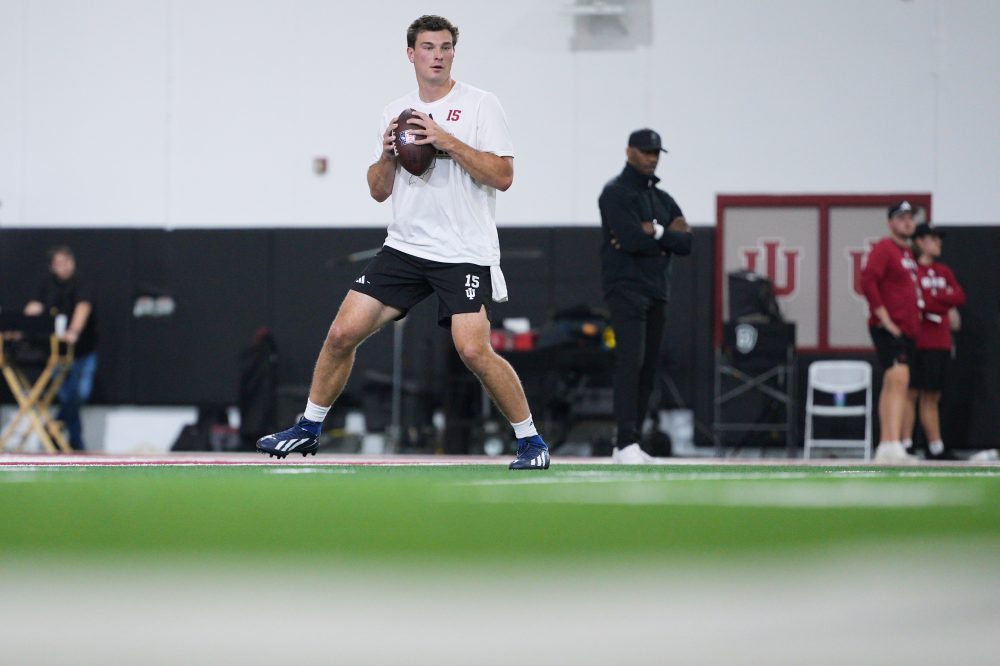

INDIANAPOLIS (AP) — Jack Endries recognized what college recruiting specialists completely missed about Fernando Mendoza right away in 2022.
The ex-California tight end observed his roommate grinding in video sessions and during practice to transform into a reliable team captain, an exemplary quarterback, and a complete winner. While Endries couldn’t have predicted Mendoza would capture a Heisman Trophy, claim a national title, or become the likely top selection in this week’s NFL draft after transferring from Berkeley to Bloomington, Indiana, he immediately recognized Mendoza possessed all the tools needed to beat the odds.
“During our extended practice sessions, you witnessed the commitment from both of us, just running extra passing drills and staying late at the training facility,” Endries remembered at the NFL scouting combine in Indianapolis. “You could observe as he began assuming more leadership, he would remain later and later at the facility. He was there until approximately nine o’clock most evenings when we finished at three.”
Nobody anticipated Mendoza would reach these heights.
He completed his high school career in Miami as an undervalued prospect who had already committed to Yale over schools like FIU, Bryant, Lehigh and Pennsylvania. Prior to Cal finally extending a scholarship offer, Mendoza appeared ready to accept a walk-on opportunity with a more established Football Bowl Subdivision program like his local Hurricanes or Alabama.
Yet somehow during an era when major programs invest significantly in discovering talents like Mendoza, recruiting coordinators and scouts failed to predict he would become the first signal-caller to capture college football’s most coveted honors — the Heisman and a championship — in one season since Joe Burrow at LSU in 2019.
Currently, Mendoza stands in prime position to follow Burrow as the NFL’s number-one draft selection.
“At this moment, I’m unemployed, I have no job,” Mendoza stated in February, a message he’s echoed frequently over the past two months. “So this represents my job interview. Everyone mentions it’s the most crucial job interview of your life and currently I’m attempting to do everything to hopefully secure employment.”
That shouldn’t pose any challenges for Mendoza.
His journey represents just one compelling narrative in a draft class packed with overachievers.
Endries, a walk-on who didn’t begin playing football until his freshman year of high school, also wasn’t expected to reach this level.
The same applies to 5-foot-10, 207-pound quarterback Diego Pavia, the Heisman Trophy runner-up, or tight end Riley Nowakowski, a walk-on at Wisconsin who transferred to join Mendoza with the Hoosiers last season.
Throughout history, the NFL has provided opportunities for underdog success stories.
Consider 6-foot Drew Brees, who accumulated over 80,000 passing yards and earned Super Bowl MVP honors despite some franchises’ height concerns.
Three-time NFL Defensive Player of the Year J.J. Watt and Super Bowl champion Clay Matthews III both began as college walk-ons before becoming first-round selections and dominant pass rushers. The most recent example occurred last year when Cleveland Browns linebacker Carson Schwesinger, a UCLA walk-on, captured the league’s Defensive Rookie of the Year Award.
Pavia ranks just outside the top 10 quarterbacks in this year’s class and believes he can join that list because he’s proven himself before. He spent his initial two college seasons at New Mexico Military Institute and two additional years at New Mexico State before helping Vanderbilt become an SEC championship contender over the last two seasons, and confidence radiates from the vocal Pavia.
“I feel like I’m going to carry that chip (being overlooked) on my shoulder wherever I go,” he stated. “Whatever team gets me is going to get a hard worker, a heck of a teammate. And then, if my number, when my number is called, you know, I’ll be ready.”
Pavia represents this broader, more diverse group of players who have traveled similar paths.
Eli Stowers, Pavia’s teammate over the past three seasons, could become the first tight end selected despite beginning his college career as a Texas A&M quarterback. Nowakowski played linebacker and fullback with the Badgers before discovering a better fit as a tight end. Endries spent this season at Texas in more split formations and receiver roles after using his Cal career as a more conventional tight end.
Endries also experienced his college aspirations affected by COVID, with his junior season reduced to six games and shifted to spring — challenging for an inexperienced player in his third year in the sport. Consequently, he walked on at Cal, became Mendoza’s roommate, and later played with Arch Manning at Texas, meaning he caught passes from one quarterback everyone expects will be the No. 1 pick when he declares and one quarterback few believed would advance this far.
Endries recognized the potential.
“I knew he possessed the ability, but considering where he originated, like a typical Cal guy, nearly a walk-on to a Heisman winner and national champion,” he said, reflecting on Mendoza’s journey. “That represents a significant leap. Somewhat surprising, but I could envision it occurring. He’s a leader and a competitor.”