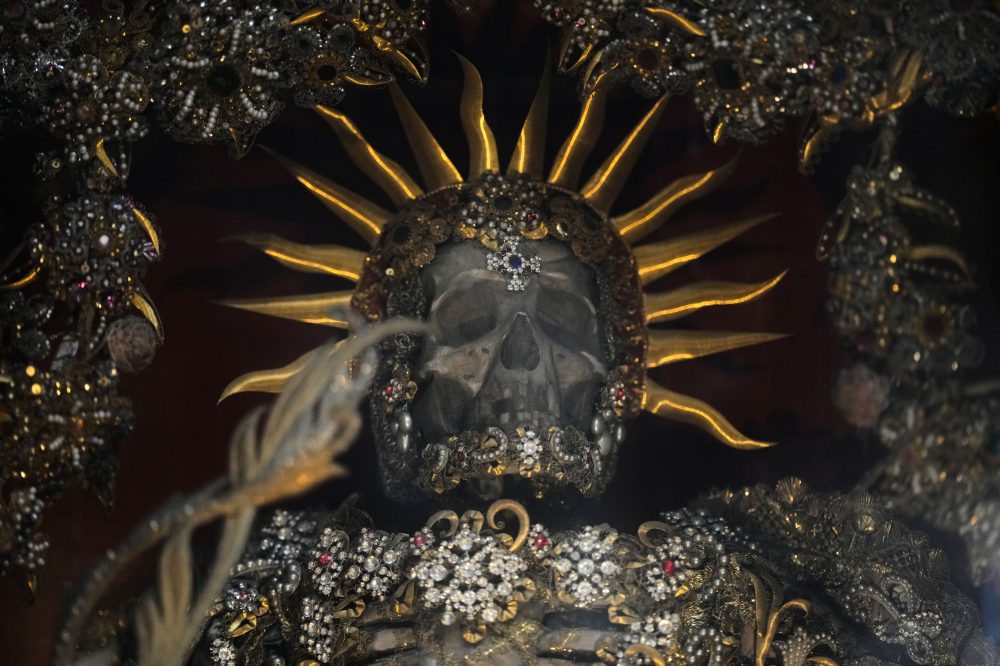

BAD STAFFELSTEIN, Germany — A startling display awaits visitors to the Benedictine monastery church of Banz in southern Germany: four complete human skeletons dressed in luxurious silk and brocade fabrics, decorated with jewels, delicate gold work, silver ornaments and intricate lace that have been exhibited for hundreds of years.
These skeletal remains — called Vincenzius, Valerius, Benedictus and Felix Benedictus — are examples of what historians call catacomb saints, transported to this Benedictine religious site near Bad Staffelstein from Rome during the 1600s and 1700s.
“It’s actually a little creepy,” whispered church custodian Anita Gottschlich as she looked at one of the skeletons. It seemed to be staring right back at her through its hollow eye sockets.
“I notice that when older people come here who visited as children, they always look for the Holy Bodies, because they can still remember them,” she added, noting the enduring fascination the skeletons hold for people of all ages.
Though these displays might appear strange or even unsettling to contemporary visitors, catacomb saints — also called Holy Bodies — remain common features in numerous Baroque Catholic churches and religious houses throughout Bavaria.
These skeletal displays, typically housed in glass containers resembling coffins, are also regularly seen in churches across Austria, Switzerland, Czech Republic, and Italy.
According to tradition, these sacred remains belonged to early Christian martyrs in Rome who were unearthed during the 1500s from anonymous burial sites within the city’s underground catacombs.
“At the time, the church simply designated them all as saints,” said Catholic priest Walter Ries. “And, of course, in many countries, including Germany, people wanted to have such holy remains, such relics, simply because this enhanced the status of their own church or monastery and perhaps turned it into a place of pilgrimage.”
Ries serves a congregation of 211 members connected to the monastery church. This represents a dramatic decline from the institution’s peak years, as the monastery was established by Benedictine monks in 1070 and thrived for centuries before being disbanded in 1803. Today, only the church remains operational for religious services; the former monastery buildings now house a political foundation.
“A great deal has changed over the course of the centuries,” the priest said. “Back then, these relics were very important, but today they really aren’t anymore.”
The worship of catacomb saints during the late 1600s and 1700s occurred while much of Europe, including Bavaria, was still recovering from the devastating Thirty Years’ War. This conflict started as a religious conflict between Catholic and Protestant forces and resulted in an estimated 4 to 8 million deaths from warfare, starvation, and disease.
“That was a terrible time,” said Ries. “And so people tried to open the gates of heaven through the Baroque. That’s why everything was designed so beautifully. It was an escape from the present, which was often so terrible. That’s also why these eerie skeletons were so beautifully draped and depicted as lifelike as possible.”
The monastery leaders at Banz, along with their ornately decorated church featuring abundant gold, angels, and Baroque artwork, dispatched representatives to Rome in 1680 and once more in 1745. These missions successfully secured the four skeletal remains, which were then ornately dressed by religious sisters in the nearby city of Bamberg.
To maintain the special nature of viewing the Holy Bodies, they remain hidden throughout most of the year behind wooden panels showing painted images of the respective skeletons attached to their display cases. During significant religious occasions, including All Saints’ Day, these covers are removed to reveal the Holy Bodies to worshippers.
Overall, the ornate decorations “is not meant to show the dead body of a saint, but rather to show his glorified body,” said Günter Dippold, a historian who has been researching the catacomb saints and the Banz monastery.
“It is therefore intended to show the faithful who view it what we will look like after the resurrection, after being raised from the dead, when we no longer have our earthly bodies but rather glorified ones.”