
BRUSSELS — For the first time in 16 years, European Union leaders gathered in Brussels for a summit without Hungarian politician Viktor Orbán in the room.
Over the years, prime ministers, chancellors, and presidents have come and gone, but Orbán remained a constant presence in Brussels’ corridors of power. He became known for steering Europe toward the political right and championing a form of nationalist populism that has gained traction across the continent and earned admiration from the Make America Great Again movement in the United States.
But after losing a critical election in April, Orbán — now Hungary’s top opposition figure — finds himself watching from the outside for the first time in a generation. His successor, Péter Magyar, is now seated alongside leaders such as Spain’s Pedro Sanchez, France’s Emmanuel Macron, and Germany’s Friedrich Merz, advancing policies that are likely to conflict with Orbán’s worldview.
While the EU summit opened with discussions on increasing support for Ukraine and other matters, Orbán was across town participating in a Thursday gathering of his Patriots for Europe party group — a coalition of far-right parties from across the bloc that makes up the third-largest caucus in the European Parliament.
Despite the stinging election defeat — which many EU leaders welcomed with relief and many observers interpreted as a rejection of his confrontational stance toward the EU and his close relationship with Russia — Orbán has not wavered in his conviction that far-right movements across Europe are approaching a major turning point.
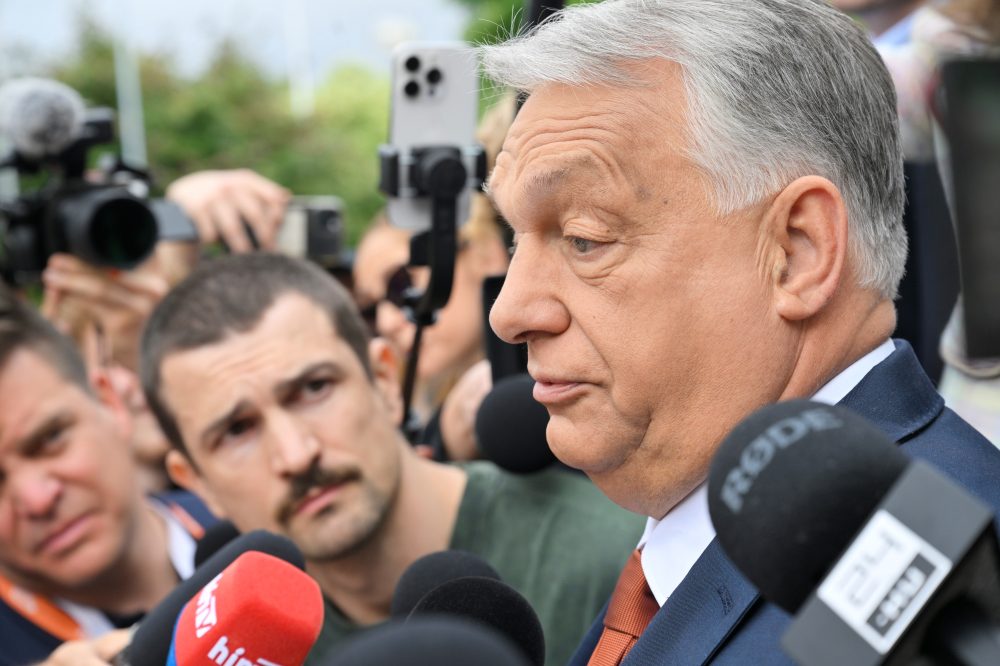
At a news conference in Brussels on Wednesday, Orbán said his loss at the polls had not slowed “the rise of patriotic political organizations, communities, and parties across Europe.”
“No one election loss can stop this historical process,” he said. “Anti-migration and sovereigntist political forces in Europe will continue to grow stronger in the coming months and years.”
Orbán envisions Patriots for Europe as a vehicle to reshape the EU according to his priorities — reducing the bloc’s authority over rule of law and democracy, taking a hardline stance on immigration, and fostering closer ties with Russia and China.
He had long been the primary obstacle to Ukraine’s path toward EU membership. However, Hungary’s new government, led by Magyar and his center-right Tisza party, has committed to working more cooperatively with the EU. Last week, Hungary dropped its veto on launching Ukraine’s accession process, following weeks of negotiations with Kyiv over restoring minority rights for ethnic Hungarians living in western Ukraine.
“Hungary obviously had issues that they were able to resolve to allow this to happen this week,” said Thomas Byrne, Minister for European Affairs for Ireland, which is set to take over the rotating EU presidency in July for a six-month term. During that period, accession talks for Ukraine and Moldova, among others, are expected to move forward more rapidly.
Europe’s far-right parties have indeed notched some recent wins. France’s National Rally, led by Marine Le Pen, made gains in municipal elections earlier this year, while Alternative for Germany, known as AfD, has been climbing in opinion polls. Orbán ally Andrej Babis, the populist leader of the Czech Republic, returned to the prime minister’s office last year and is currently the only Patriots for Europe member heading an EU-member nation.
The far right also helped push through a significant overhaul of the EU’s migration policy, made possible through an alliance with the center-right European People’s Party. Human rights organizations sharply criticized the changes, which expand the bloc’s surveillance capabilities, increase deportations of migrants, and establish detention facilities outside the EU known as “return hubs.” When the right-wing coalition passed the migration reform on Wednesday, far-right and center-right lawmakers erupted in cheers inside the European Parliament chamber in Strasbourg, France.
“Send them back,” they chanted.
Still, cracks have begun to show within Europe’s far-right coalition, driven by disagreements over the United States and Israel’s war in Iran and U.S. President Donald Trump’s threats to annex Greenland, a territory belonging to EU member Denmark.
And with Orbán no longer able to veto EU decisions — a strategy that had increasingly come to define his role at bloc summits — Ukraine’s biggest hurdle to beginning its EU membership process has been cleared.