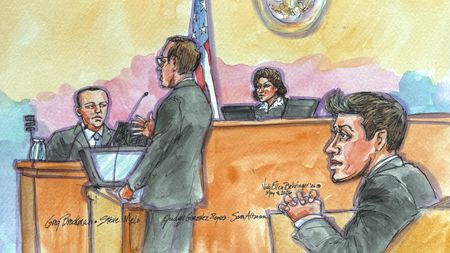

Greg Brockman, co-founder and president of OpenAI, revealed extensive financial connections to CEO Sam Altman during court testimony Monday, including a personal stake in the artificial intelligence company valued at nearly $30 billion.
The disclosure came as part of ongoing legal proceedings in a California courtroom, where Tesla CEO Elon Musk is pursuing a lawsuit against the ChatGPT creator. Musk claims the organization violated its original mission by transforming from a charitable nonprofit into a profit-driven enterprise.
During his testimony, Brockman confirmed his ownership interest in OpenAI approaches $30 billion in value – a figure that had not been publicly revealed before. Legal representatives for Musk argued these financial arrangements may have influenced Brockman’s decision-making and compromised his ability to act independently from Altman.
The court learned that in 2017, Altman provided Brockman with an ownership percentage in Altman’s family investment office, valued at $10 million during that period. This same year marked discussions among OpenAI leadership, including Musk and Brockman, about restructuring the organization as a for-profit entity to fund expensive computational resources needed for artificial intelligence development.
Email correspondence presented in court showed communication between Altman and Jared Birchall, who manages Musk’s family office operations. Birchall informed Musk about the compensation arrangement in writing.
“One thing worth mentioning now is that he compensated Greg on the side by giving him a percentage ownership of Sam’s personal family office,” Birchall stated in the message, suggesting the agreement might mean “Greg is going to have a greater allegiance to Sam as a result of this arrangement.” Musk responded by forwarding the message to Brockman with two question marks.
When questioned about his loyalty to Altman, Brockman responded, “I don’t know I would say it quite like that.”
Additional financial entanglements emerged during Monday’s proceedings. Brockman acknowledged owning shares in Cerebras, an artificial intelligence chip manufacturer, including periods when OpenAI considered acquiring the company. OpenAI announced plans this year to purchase substantial quantities of Cerebras processors.
Brockman also confirmed investment in Helion Energy, a nuclear fusion startup where Altman has committed hundreds of millions in funding. Altman recently resigned from Helion’s board of directors in March as the companies explored potential collaboration opportunities.
The legal battle, now in its second week, centers on Musk’s allegations that OpenAI leadership secured his $38 million in contributions and assistance by promising to maintain a nonprofit structure focused on safe artificial intelligence development. Musk contends they subsequently abandoned this commitment to pursue personal financial gain through for-profit operations.
The lawsuit seeks $150 billion in damages and demands the removal of both Altman and Brockman from their executive positions. Musk’s legal claims include breach of charitable trust and unjust enrichment.
OpenAI has countered that Musk’s motivations stem from his desire to control the organization and resentment over the company’s achievements following his departure from the board in 2018. The company maintains that Musk showed little concern for safety protocols during his involvement and is now attempting to benefit his competing venture, xAI, which has struggled to match OpenAI’s market penetration.
The trial’s outcome could significantly impact OpenAI’s future direction. The company triggered widespread interest in generative artificial intelligence following ChatGPT’s debut in late 2022, subsequently raising more than $100 billion from investors to fund research staff, computing infrastructure, and expansion plans ahead of a potential public offering that could reach trillion-dollar valuations.