
Stock markets across Asia were mostly in positive territory Monday as oil prices tumbled more than 4% following signs that the United States and Iran were pulling back from open conflict and exploring the possibility of resuming ceasefire negotiations.
Chinese memory chipmaker CXMT stole the spotlight, with its shares skyrocketing approximately 470% on their first day of trading on Shanghai’s technology board. The dramatic surge catapulted the company to the top of China’s publicly traded firms, giving it an estimated market value of 3.3 trillion yuan — nearly $490 billion.
The Pentagon declined to comment on reports of a pause in U.S. strikes on Iranian coastal areas and infrastructure. The fighting had been escalating for nearly two weeks after Iran began firing on vessels attempting to pass through the Strait of Hormuz.
Financial markets responded with clear relief. U.S. stock futures jumped early Monday, and the international oil benchmark — Brent crude — dropped 4.6%, settling at $87.46 per barrel. The U.S. benchmark crude price fell 5.1% to $84.79 a barrel.
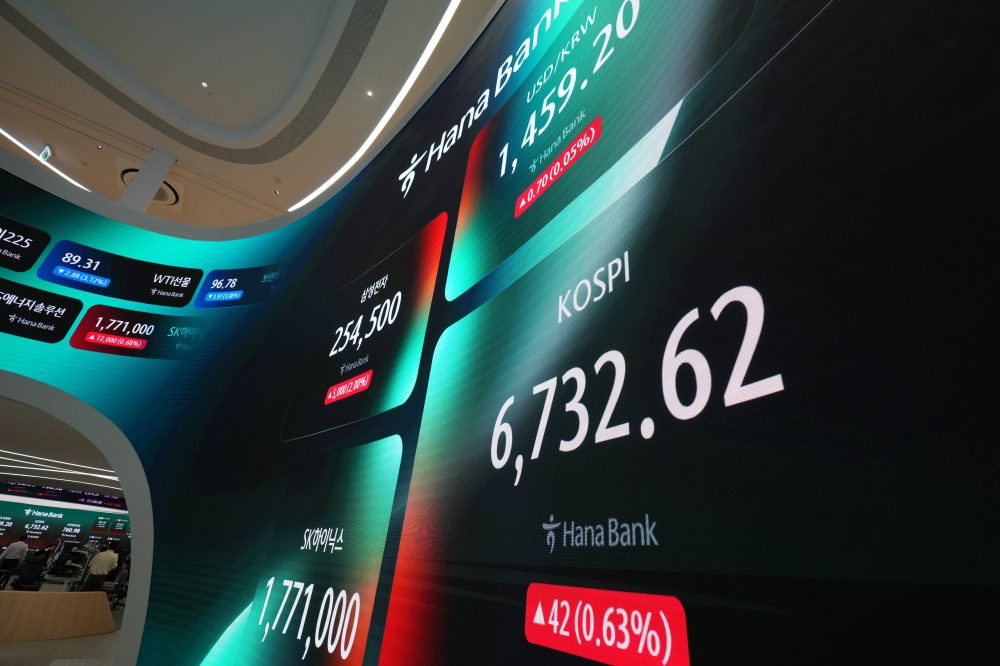
Across Asian exchanges, Japan’s Nikkei 225 edged up 0.2% to 64,771.02, and South Korea’s Kospi gained 0.3% to reach 6,708.87. Hong Kong’s Hang Seng climbed 0.8% to 25,164.81, while China’s Shanghai Composite index rose 0.4% to 3,827.96. Australia’s S&P/ASX 200 posted the strongest gain among major indexes, surging 1.3% to 8,883.00. Taiwan’s Taiex dipped 0.3%, while India’s Sensex added 0.7%.
On Friday in the U.S., the S&P 500 barely moved, inching up less than 0.1% to close at 7,411.98. That marked the index’s second straight week of losses — something that had not occurred since March. The Dow Jones Industrial Average gained 0.5%, finishing at 51,947.25, while the Nasdaq composite slid 0.6% to 24,975.82, dragged lower by steep drops in major technology stocks.
Micron Technology tumbled 7% and Broadcom fell 2.7%. Both companies carry large market values and were key contributors to the Nasdaq’s decline.
Investors are also keeping a close eye on inflation pressures. Rising energy costs and fresh tariffs announced last week by the administration of U.S. President Donald Trump could push prices higher, adding strain on consumers and complicating decisions at the Federal Reserve. The Fed is scheduled to meet this week, but growing inflation has largely extinguished hopes for an interest rate cut in the near future. In fact, Wall Street is now leaning toward the possibility of a rate increase to bring prices under control.
Higher fuel costs are eating into household budgets, with more spending shifting toward necessities like gasoline. The national average price for a gallon of gas currently stands at $4.11, according to AAA. While that figure is still below the peak seen this spring when tensions with Iran were escalating, it is nearly a dollar more than the same time last year.
On the corporate side, earnings reports are drawing scrutiny over whether the massive wave of spending on artificial intelligence can sustain broader profit growth. Tech heavyweights such as Alphabet and Nvidia have been pouring money into expanding AI infrastructure, and investors are increasingly questioning whether those investments will generate enough returns to justify the enormous stock valuations that have driven markets upward throughout the year.