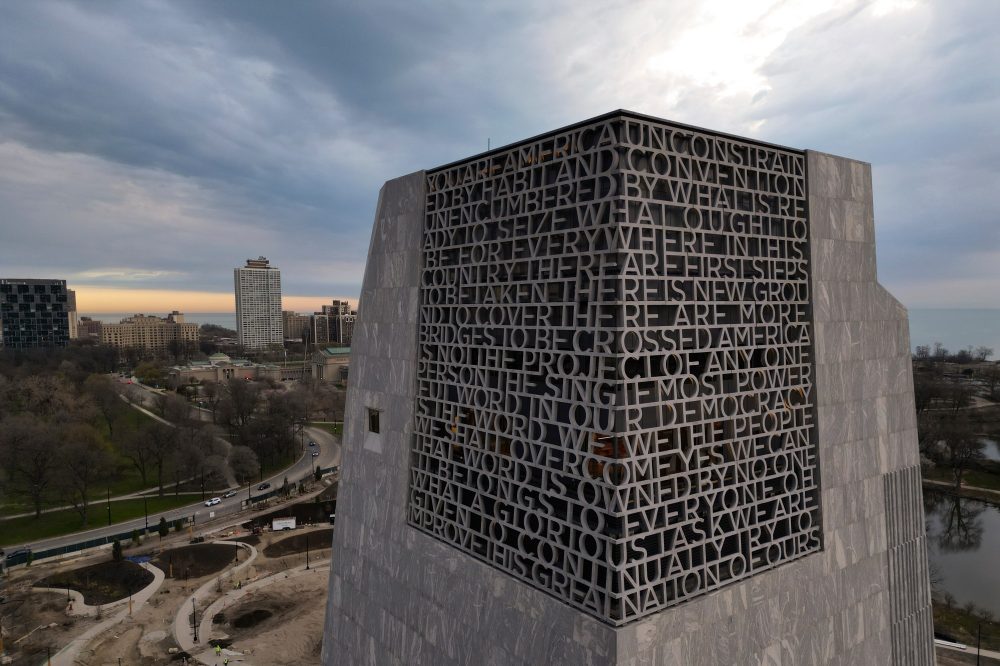

CHICAGO (AP) — The personal touch of former President Barack Obama permeates every corner of his presidential museum, from its Chicago South Side setting to the textured stonework on its striking tower and the striped reading chairs that mirror those found in his personal residence.
Following a ceremonial dedication ceremony attended by dignitaries in Chicago, the Obama Presidential Center will welcome the general public on Juneteenth. Thousands of visitors — including museum staff family members, students and media representatives — have already received preview tours of the nearly 20-acre facility while workers complete final art pieces and grounds work.
The approximately $850 million development encompasses both the political career and private life of America’s first Black president. While the ticketed museum tower displays campaign artifacts and presidential memorabilia, the expansive campus’s public areas highlight other Obama priorities: a new library branch, basketball facility and picnic space with grilling stations.
“This serves as a welcoming environment where people can come to contemplate the significant moments from this presidency and the campaigns, while also gathering as a community to consider what changes you might implement in your own neighborhood,” Josh Harris, the Obama Foundation’s vice president of public engagement, explained during a recent Associated Press tour.
Here are the main highlights of the campus anticipated to attract up to 1 million annual visitors.
This presidential museum breaks new ground as the first completely digital facility of its type, abandoning traditional displays of official documents.
Visitors will instead encounter high-tech and interactive exhibits covering the campaigns, pivotal moments from Obama’s presidency and White House experiences.
Among the most popular features is a full-scale recreation of the Oval Office.
During a recent visit, a steady flow of guests, including schoolchildren, moved through the circular space, pausing to sit at the desk for photographs. The top drawer contains a handwritten letter copy from his predecessor, former President George W. Bush, and Obama’s cherished BlackBerry device.
“We aim to ensure that individuals from every background get the chance to sit at the Resolute Desk,” Harris stated. “You consider the potential that if a young community organizer from Chicago’s South Side can become president, you might become president as well.”
Additional museum sections explore the Affordable Care Act and immigration policies, alongside intimate moments such as Obama’s spontaneous singing during a 2015 memorial service for victims of a South Carolina church attack. A large display screen shows Obama performing “Amazing Grace.”
Scattered throughout are spaces for personal contemplation, which museum planners consider essential.
“We’re handing over that responsibility and encouraging people to take change back to their communities, however change might be understood, whether modest or significant,” explained Louise Bernard, the museum’s director.
During the museum’s 2021 groundbreaking ceremony, Obama anticipated one of the major attractions.
“We want this center to be more than a static museum or a source of archival research,” Obama remarked at the location. “It won’t just be a collection of campaign memorabilia or Michelle’s ballgowns, although I know everybody will come see those.”
About twelve outfits displayed on mannequins sit behind protective glass, including a black and red Narciso Rodriguez creation that the former first lady wore during 2008 Election Night in Chicago.
Guests can also feel fabric samples, including the rose gold chain mail Atelier Versace evening dress she selected for her last state dinner in 2016.
The museum sits close to where Barack Obama launched his political journey, served as a law professor at the University of Chicago, and where the family resided. Michelle Obama also spent her childhood on the South Side.
As a lifelong basketball enthusiast, Obama requested a glass-walled professional-quality basketball court for community programming.
The former first lady created a garden where lettuce and strawberry plants were growing during a recent visit. Charcoal grills will be publicly available, fulfilling Obama’s vision from community meetings almost ten years ago.
“President Obama frequently discussed his connection to Chicago and one of his cherished memories involved grilling in the park,” Harris noted.
The Obamas’ aesthetic preferences and appreciation for history are clearly visible.
The museum campus displays dozens of specially commissioned artworks while various campus sections honor notable figures. The central “John Lewis Plaza,” honoring the late congressman and civil rights champion, serves as a public meeting place.
Within a new Chicago Public Library branch, a 70-foot artwork portrays literary icons including Walt Whitman and James Baldwin. At its center stands a boy in an orange shirt being read to by Toni Morrison, representing young Obama.
The presidential reading room contains thousands of books selected by the Obamas, spanning presidential biographies to popular fiction. Obama particularly favors two tall-backed chairs with blue, yellow and black stripes, chosen by the former president as excellent reading chairs resembling ones in his home.
Admission costs $30, the steepest price among all U.S. presidential museums or libraries. The Richard Nixon Presidential Library and Museum in California follows at $29.
Obama Foundation executives justify the pricing for the cutting-edge facility.
The neighboring Griffin Museum of Science and Industry charges $25.95. In downstate Illinois, the Abraham Lincoln Presidential Library and Museum in Springfield costs $15.
Besides complimentary days and Illinois resident discounts, Obama Foundation representatives emphasize that most campus areas are free, with only four museum tower floors requiring admission.
Visitors can freely explore the campus, utilize the playground, library, sledding hill or grilling facilities. The tower’s uppermost floor, offering sweeping views of the nation’s third-largest city, is also complimentary.
“The concept behind this institution, this campus, centered on making it available to the greatest number of people possible,” Harris said.