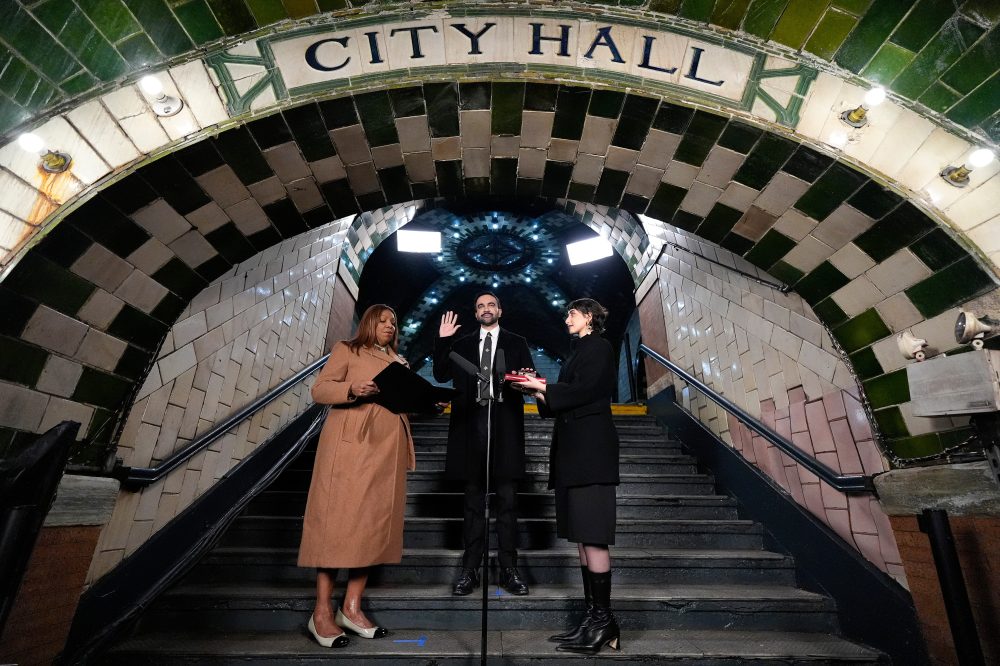

NEW YORK (AP) — During his opening 100 days as New York City’s mayor, Zohran Mamdani has transformed municipal leadership with an unprecedented level of celebrity influence rarely witnessed in local politics.
Large gatherings of supporters regularly attend his public announcements. Standard city operations have gained fresh energy and public attention. High-profile entertainers actively promote his policy initiatives.
Through this approach, he has secured several significant early accomplishments. He has also established a working relationship — temporarily at least — with President Donald Trump, an unpredictable leader who appreciates celebrity culture.
However, as the Democratic mayor reaches this early benchmark in his administration, questions remain about whether his public prominence can translate into successful implementation of the progressive policies that helped him win election.
While facing determined opposition, particularly from those who continue to criticize his previous statements about law enforcement and Israel, the mayor has managed to reduce concerns among some former doubters.
Jay Jacobs, who leads the state Democratic Party and notably declined to support Mamdani during the campaign, said: “It’s early but so far, so good. We may not agree on everything philosophically, but he is getting the job done.”
As his administration reached the 100-day mark — traditionally used to evaluate new leadership — his staff has emphasized their focus on fundamental municipal responsibilities.
Although these tasks represent standard mayoral duties — waste collection, snow removal and road maintenance — the 34-year-old leader has utilized his talent for creating viral online content to generate public engagement with government services.
When winter weather threatened the city, Mamdani’s social media appeals for additional snow removal volunteers successfully recruited thousands of new workers. A separate online video from the mayor promoting the city’s emergency notification system attracted over 50,000 new participants within one week, according to his administration.
Working with WNBA player Natasha Cloud from the New York Liberty, Mamdani launched a tournament-style voting system allowing residents to select minor infrastructure repairs they wanted the mayor to personally address in their communities. Within several weeks, the initiative received more than 21,000 votes.
To generate excitement for his childcare initiative serving 2-year-olds, Mamdani enlisted rapper Cardi B to help evaluate a musical competition that will select the program’s official theme song.
Speaking to journalists on his 99th day in office this week, Mamdani stated: “The challenge that we set out for ourselves was to work as hard and as fast as New Yorkers do.”
The celebrity attention, however, can create negative reactions. His unexpected guest spot on “Tonight Show With Jimmy Fallon” during an extreme cold period drew criticism as inappropriate timing while homeless deaths were increasing throughout the city.
Curtis Sliwa, a Republican candidate who opposed Mamdani in last year’s election, criticized what he called “Too much styling and profiling,” pointing to persistent issues with street homelessness, public housing conditions and infrastructure problems.
Nevertheless, Sliwa, who strongly criticized Mamdani during the campaign but recently joined the mayor in a comedic performance at the City Hall press corps’ annual event, seemed to offer qualified praise.
“We just had Eric Adams, swagger man who’d party to the break of dawn, and now we have a guy who seems like he’s got a normal working schedule,” Sliwa said, referring to the previous mayor. “So having Zohran as the alternative, I think for a lot of people even if they disagree with him, there’s some stability.”
Mamdani has also directed his significant public following toward another standard aspect of municipal leadership: budget planning.
Earlier this year, Mamdani conducted an unusually serious news conference at City Hall regarding a substantial budget shortfall, stating that either the state would need to impose higher taxes on wealthy residents or he would be forced to raise local property taxes to achieve budget balance.
The mayor’s public strategy was widely interpreted as an attempt to pressure New York Governor Kathy Hochul into supporting a millionaires tax, a central priority for Mamdani and his political supporters. Hochul, a centrist Democrat facing reelection this year, has firmly rejected such legislation.
When the City Council presented an alternative budget proposal using different methods to address the deficit, Mamdani criticized the plan and produced a video targeting Council Speaker Julie Menin, which led to online harassment of the speaker by some of his supporters.
The city’s financial difficulties, which remain unresolved, may present a significant obstacle for Mamdani as he works to advance his policy agenda.
Andrew Rein, who heads the fiscally conservative Citizens Budget Commission, described Mamdani as facing an “extra challenging” budget process, but noted that the mayor’s communication abilities could help him manage difficult circumstances.
“What we’ve seen is him bringing his newer strategies and tools to communications but in a very practical, old-school problem,” Rein explained. “When he uses his communications skills to get people more invested and to improve the functioning of government and to help New Yorkers the trade offs that have to be made, that is going to be a great win.”
On the evening of Mamdani’s victory celebration, hundreds filled the streets, many arriving spontaneously, hoping to catch sight of the mayor-elect as he departed the event. Departing campaign workers received cheers by name well past midnight. One observer compared the street celebration to Beatlemania.
Medhavie Agnihotri, a 25-year-old technology consultant, remarked: “I feel like I’m at a presidential inauguration. This is the first time in a while I’ve felt this hope.”
His celebrity appeal has remained strong among certain groups since taking office.
Around City Hall, New Yorkers and visitors regularly request photographs, looking through the metal fencing hoping to spot the mayor.
This week, during the mayor’s 97th day in office, a large crowd assembled in the main area of Manhattan’s busy Bellevue Hospital, observing as Mamdani announced the city would begin transferring certain individuals with severe medical conditions from the notorious Rikers Island detention facility to the hospital.
He arrived to cheers and applause from the substantial gathering, many appearing to be hospital employees who raised their phones to record the mayor’s remarks. Additional spectators watched from elevated walkways above.
Ricardo Granados, a 67-year-old retiree accompanying his son to a medical appointment, paused to investigate the commotion. He expressed enthusiasm upon learning Mamdani would appear, mentioning he had previously met Mamdani when the politician was campaigning in Granados’ neighborhood.
“I’m extremely fond of him. I think he’s going to make a real difference,” Granados said. “He wants to find out who needs what and he wants to help.”