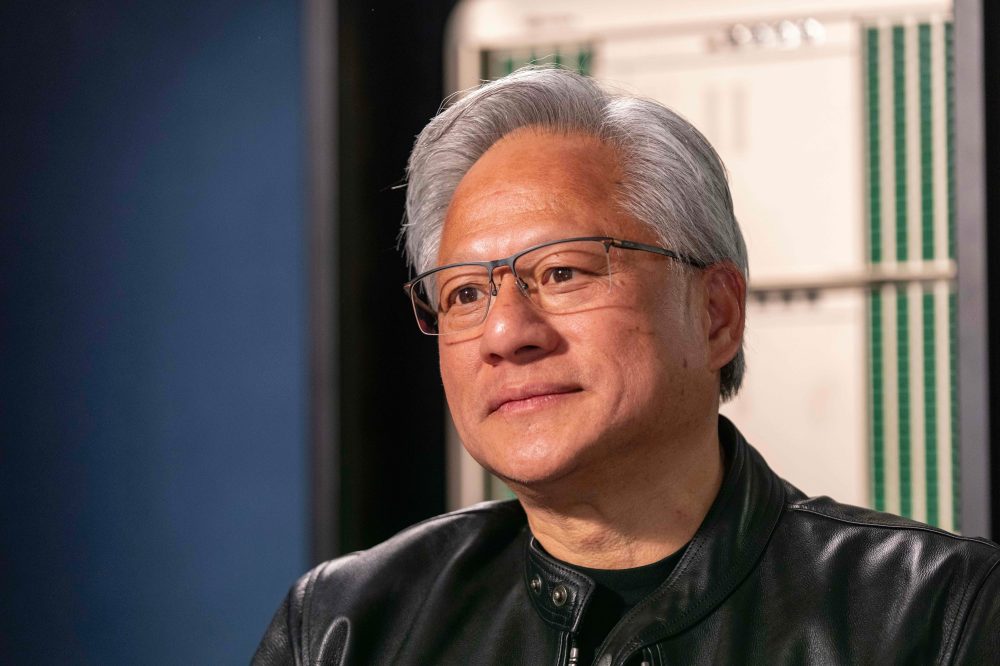

SHERMAN, Texas — Nvidia CEO Jensen Huang, whose company played a central role in making artificial intelligence possible, says society must change to keep pace with AI — and that there is simply no alternative.
In an interview Tuesday, Huang acknowledged the concerns raised by critics who warn that AI could eliminate jobs or pose dangers to humanity. But he remained upbeat about the technology’s ability to drive economic growth and accelerate scientific discovery.
“We need to create new social norms,” Huang said. “I would advocate that everybody use AI. Just go engage it.”
Huang argued that AI is actually helping to close the technology gap in America. Whether someone wants to build a website, sort through complicated documents, assist with cutting-edge research, or even map out a kitchen renovation, AI makes it possible without requiring any programming knowledge.
He also called for government regulation and safety standards around AI, saying national security must be treated as a top priority as the technology continues to fuel stock market growth and drive much of the broader U.S. economy.
Huang compared society’s adjustment to AI to how people once adapted to the automobile. Cars were initially blamed for endangering children, he noted, but communities eventually responded by building sidewalks and crosswalks and keeping kids off the streets.
“When I was growing up, I used to play in the streets,” Huang said. “When cars came along, you obviously can’t play in the streets now.”
Nvidia now carries a market capitalization of roughly $5 trillion, making it the most valuable company in the world. AI firms OpenAI and Anthropic are each on track to potentially surpass the $1 trillion mark once their shares become publicly available.
That rapid accumulation of wealth within a small cluster of AI companies has stoked fresh concerns about economic inequality. President Donald Trump has floated the idea of the U.S. government taking ownership stakes in AI companies so that financial gains could be shared more broadly with the public — a concept also supported by Sen. Bernie Sanders, I-Vt., and OpenAI CEO Sam Altman.
Huang pushed back on that idea, saying he believes Americans will already share in the benefits AI companies generate.
“I’m not exactly sure what they’re trying to achieve,” he said of government ownership proposals. “I haven’t had a dialogue with them about that. But just remember that these are American companies. Their success benefits the stock price, of which many Americans are investors in. It generates taxes, which helps many Americans. It creates a lot of jobs.”
He added that the rise of AI could also boost profits for energy producers, construction companies, and hardware technology firms.
“Americans have a stake in American companies already, naturally, in a whole lot of different ways,” Huang said. “I’m not exactly sure what they’re trying to achieve beyond that.”