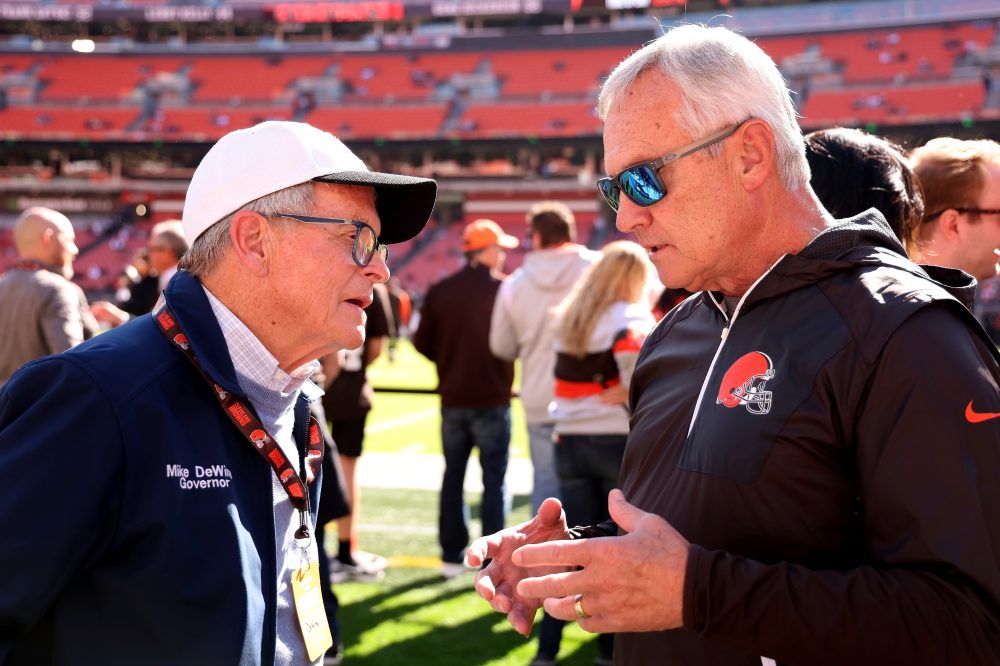

COLUMBUS, Ohio — Ohio Gov. Mike DeWine stepped into the spotlight Tuesday to make a public push for eliminating the death penalty in his state, leveraging a career in public service that spans more than four decades.
The 79-year-old Republican pointed to his background as a former county prosecutor, a member of both chambers of Congress, a former Ohio attorney general, and seven years as governor as the foundation for his stance on the issue.
However, DeWine’s call for change faces an uphill battle — even within his own Republican-controlled state. DeWine is considered more moderate than many of the younger Republicans now shaping Ohio politics, whose careers depend heavily on backing from President Donald Trump, a firm supporter of capital punishment.
DeWine’s political career dates back to 1976, when he was elected prosecuting attorney in Greene County, where he was raised and still resides. He and his wife, who together have eight children, lived in a historic home there where they hosted an annual summer ice cream social for 50 years to celebrate and support Republican candidates and officeholders. That tradition came to a close just last weekend.
When DeWine joined the Ohio state Senate in 1980, the state had no active death penalty law — the previous one had been struck down as unconstitutional. DeWine played a key role in crafting the new law, which passed both legislative chambers with strong bipartisan support and has been on the books since 1981.
On Tuesday, DeWine said he had long believed that the moral case for capital punishment rested on its ability to discourage violent crime.
During his four terms in the U.S. House of Representatives, DeWine backed federal legislation signed by President Ronald Reagan that broadened the range of crimes eligible for the death penalty. As a U.S. senator, he supported a bill signed by President Bill Clinton aimed at accelerating the review of capital cases in federal courts.
Between those congressional roles, DeWine served as lieutenant governor of Ohio under longtime Republican Gov. James Rhodes.
After losing his Senate reelection campaign to Democrat Sherrod Brown in 2006, DeWine stepped away from politics briefly before winning the Ohio attorney general’s race in 2010. He said Tuesday that in that role he carried out the state’s death penalty law “vigorously.”
Since taking over as governor in 2019, difficulty securing lethal injection drugs has resulted in an unofficial halt to executions in Ohio. The state’s last execution was carried out in 2018.
While DeWine holds the top position in the Ohio Republican Party, his influence over the party has its limits. The Trump era in particular has brought sharp divisions within Ohio’s GOP.
Tensions ran especially high during the COVID-19 pandemic, when DeWine and then-state Health Director Amy Acton — now the Democratic nominee for governor — oversaw one of the country’s most aggressive early pandemic responses in 2020. A faction of Republicans soon pushed back hard against DeWine’s mandates, especially business closures, and threatened to curtail his powers or even pursue impeachment.
In 2023, DeWine vetoed a ban on gender-affirming care and a prohibition on transgender athletes competing in girls’ sports. The Republican-controlled state Legislature overrode his veto with ease.
Party divisions have also surfaced in this year’s key elections. DeWine had sought to position former Ohio State Buckeyes football coach Jim Tressel — whom he appointed as lieutenant governor last year — as a potential successor. But the state Republican Party moved quickly to rally behind Trump-endorsed biotech billionaire Vivek Ramaswamy in the May 2025 race, even before Tressel had decided whether to enter. DeWine ultimately endorsed Ramaswamy in January.
DeWine acknowledged Tuesday that he had not informed Ramaswamy, now the GOP’s gubernatorial nominee, of his plan to call for ending the death penalty. Separately, DeWine has found himself defending his administration’s record on Medicaid fraud as the Trump administration targets the issue — even as Ramaswamy, Ohio-born Vice President JD Vance, and Republican lawmakers have criticized Ohio’s current anti-fraud efforts.
DeWine’s push did attract support from a number of fellow Republicans, including some with strong conservative credentials.
“For many years, I was a proponent of the death penalty,” said former congresswoman and current state Rep. Jean Schmidt in a written statement. “My views changed because of the risks of executing an innocent person, the exorbitant costs, and my belief in the sanctity of life. The death penalty is no longer a policy worth preserving.”
Former Ohio Auditor and Attorney General Jim Petro pointed to wrongful convictions as one of the critical flaws that make capital punishment no longer sustainable.
Former Ohio Gov. Bob Taft — the great-grandson of President William Howard Taft and grandson of Sen. Robert A. Taft Sr., known as “Mr. Republican” — also expressed support for DeWine’s position.
DeWine “has been thoughtful and given this issue the careful consideration it needs,” Taft said.