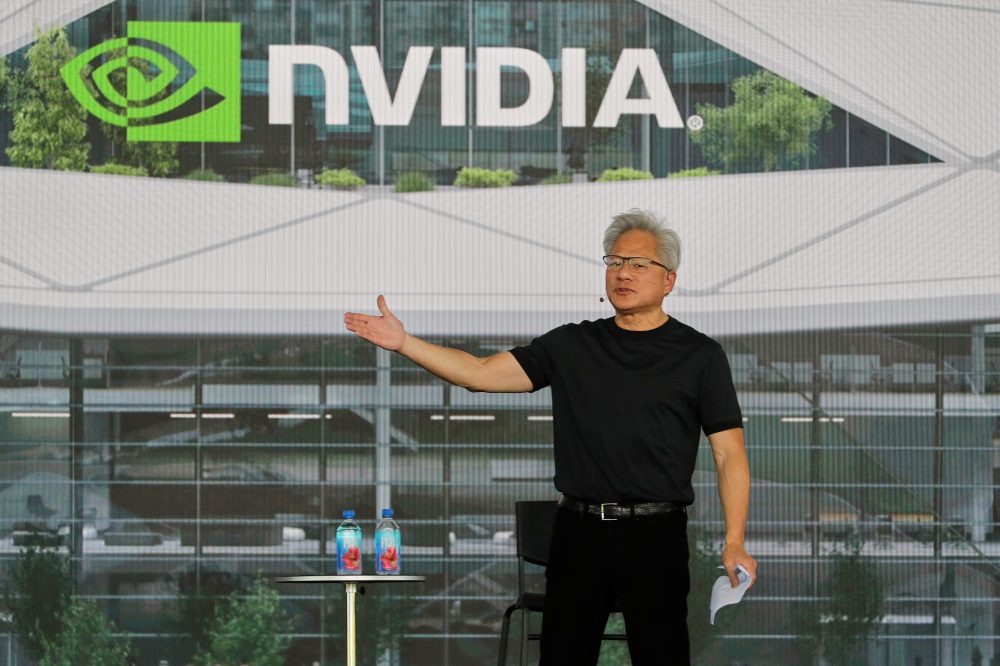

SHERMAN, Texas — Nvidia CEO Jensen Huang, whose company makes the computer chips at the heart of the artificial intelligence revolution, is now betting that the AI buildout can breathe new life into U.S. manufacturing — and a factory just north of Dallas may be the proving ground for that idea.
On Tuesday, Nvidia formally announced a major expansion of its AI infrastructure through a $2 billion partnership with Coherent, the company that owns the Sherman, Texas facility. The factory will manufacture the material needed to produce a specialized laser that transmits data between computer chips, allowing them to function together as a unified, more powerful and efficient system. Executives described the technology ahead of the public announcement.
“AI factories are the infrastructure of the new industrial revolution,” Huang said in a statement.
The facility represents a real-world challenge to a central question in the AI debate: will the technology create jobs, or will it replace workers as machines become capable of writing software, analyzing data, running assembly lines, and even operating vehicles with little human involvement?
Under Huang’s leadership, Nvidia has grown into the world’s most valuable company, valued at roughly $5 trillion. The company is now looking beyond chip manufacturing toward building complete AI systems. The businesses expected to rely on those systems to advance AI development could soon join the group of companies valued at more than $1 trillion. How that wealth is distributed — and what consequences the technology brings — has become a central debate about the direction of the United States.
AI is fueling breakthroughs in research and carries the promise of significant economic growth. But while stock markets have responded positively, many Americans have raised concerns about the technology’s electricity demands, potential job losses, and emerging national security implications.
President Donald Trump’s administration, which had previously favored a hands-off regulatory approach to encourage AI development, has recently begun changing direction. It imposed export controls on AI company Anthropic’s newest models, prompting the company to shut down all public access to those models on Friday over security concerns.
Trump, a Republican, signed an executive order calling for new AI models to be voluntarily reviewed by the federal government. He has also floated the idea of the government taking an ownership stake in AI companies, so the public could share in the financial gains — though that would blur the boundary between the public and private sectors.
At the same time, Trump is counting on the AI industry to drive economic growth, boost manufacturing and construction, and push stock markets higher. He has made a point of including Huang on international trips, most recently having Air Force One stop in Alaska to pick up the leather-jacketed CEO while heading to China for a state visit.
Trump has described Huang as “smart,” a “friend,” and “amazing,” and has publicly acknowledged that he once considered breaking up Nvidia due to its market dominance — before concluding that Huang was someone he needed as an ally.
“We are proud to have you in our country,” Trump told the Taiwanese immigrant last year.
The Coherent factory in Sherman received support from both political parties. The Biden administration approved $33 million in funding through the CHIPS and Science Act to help build out the facility, while the Trump administration followed with an additional $17 million grant to help ensure this piece of AI infrastructure would be produced domestically.
Coherent estimates the factory will generate approximately 1,000 jobs in total, including construction workers, with around 550 positions in advanced manufacturing, engineering, and technical fields.
The factory expansion will ramp up production of Indium Phosphide, a material used to make a laser with the optical intensity of the surface of the Sun. Every second, light pulses hundreds of billions of times through a fiber the width of a human hair, enabling Nvidia’s chips to share information and operate as one combined system — what Huang calls “AI factories.”
The technology could cut power consumption by as much as 50%, allowing computations to happen faster and at significantly lower cost. Reducing the cost of tokens — the industry’s measurement of AI usage — could help the technology expand its reach and capabilities.
“This investment expands America’s capacity to manufacture critical AI-enabling technologies, creates high-value jobs, and reinforces U.S. leadership in advanced manufacturing, photonics, and innovation,” said Coherent CEO Jim Anderson in a statement.
A paper published this month by economists Jessica Wachter and Jonathan Wachter found that the five largest U.S. technology companies invested $380 billion last year as part of the AI buildout — a figure that could roughly double in the current year. Based on that level of investment, the economists see the potential for rapid economic growth as AI takes up a larger share of U.S. gross domestic product. While AI currently makes up about 3% of the economy, that share could grow to somewhere between 8% and 39%.
One Nvidia executive, speaking on background to outline the company’s industrial strategy, said Nvidia is transitioning from selling computer chips to delivering complete AI systems. That shift has meant concentrating more production in the U.S., with chip manufacturing increasingly based in Arizona and assembly operations increasingly centered in Texas, creating a more dependable domestic supply chain.
The executive described Nvidia as providing both a brain and a nervous system to its customers, allowing the intelligence produced to be applied to their businesses in ways that generate new products and uncover savings. That could enable manufacturers currently relying on overseas suppliers to bring production back to the U.S. — taking AI from laptops into factory floors where it can, in their words, “move atoms.”
President Trump has made clear he views the AI industry as central to American strength. “It’s an amazing industry,” Trump told reporters last week. “It’s bigger than any industry anyone’s ever seen. We are leading China by a lot. And whoever leads that is going to really lead the world to a large extent, that’s how big it is.”