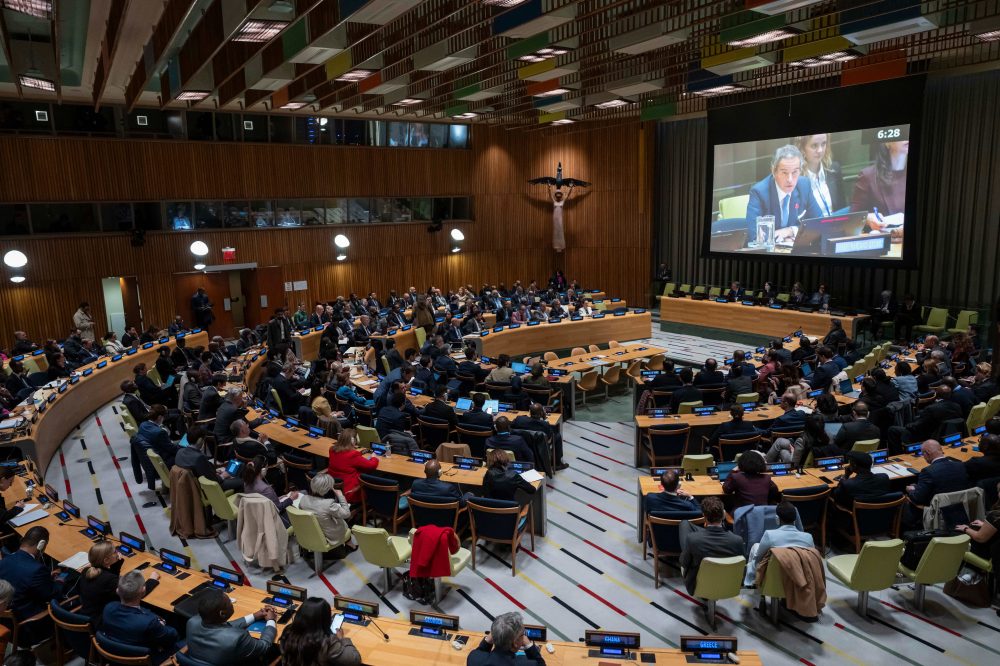

UNITED NATIONS (AP) — A top international nuclear official delivered a stark warning Wednesday about the potential consequences if major world powers proceed with nuclear weapons testing.
Robert Floyd, who leads the Comprehensive Nuclear Test Ban Treaty Organization, cautioned U.N. reporters that nuclear testing by the United States, Russia, or other nations could prompt a dangerous chain reaction of similar actions worldwide.
“That is a spiral that we do not want to see start, because it may never be able to be stopped,” Floyd stated during his briefing.
The warning comes after both superpowers — which possess the world’s most extensive nuclear weapons stockpiles — made threats to restart nuclear testing in recent months, sparking international concern.
Floyd noted the dramatic reduction in nuclear testing since the treaty was first opened for signatures three decades ago. While more than 2,000 nuclear tests had occurred before that time, fewer than a dozen have taken place since, with six of those conducted by North Korea.
His comments coincided with the United Nations beginning its review of a different nuclear non-proliferation agreement this week. The review occurs amid ongoing tensions related to Iran’s nuclear program, which President Donald Trump has cited as justification for military action to prevent Tehran from acquiring nuclear capabilities.
Although the nuclear test ban agreement was established in 1996, it remains inactive because nine of the 44 required countries have yet to ratify it for the treaty to take effect.
Several major powers have signed but not ratified the agreement, including the United States, China, Iran, Egypt, and Israel. Meanwhile, India, Pakistan, and North Korea have taken no action on the treaty. Russia previously signed and ratified the agreement but withdrew its ratification in 2023.
Floyd suggested that coordinated ratification by China, Russia, and the United States would represent “certainly be a powerful step forward” for the treaty’s implementation.
While both China and Russia claim to maintain voluntary testing moratoriums, U.S. State Department officials have publicly questioned the activities of both nations since 2019. Trump recently accused both countries of conducting tests and announced he had directed the Defense Department to begin nuclear weapons testing “on an equal basis.”
Russian Deputy Foreign Minister Sergei Ryabkov responded by stating Russia would only restart nuclear testing if the United States acted first.
Floyd revealed he recently traveled to Moscow to argue to Foreign Minister Sergey Lavrov “that it is not in any state’s interest to see an unconstrained return to testing.” He also mentioned meeting with U.S. State Department officials and expressed interest in speaking with Secretary of State Marco Rubio.
The treaty official emphasized that the international monitoring network can identify even relatively small nuclear explosions anywhere on Earth. Any country attempting to develop nuclear weapons would need to conduct tests, and “if they did it will be known to all,” Floyd explained.