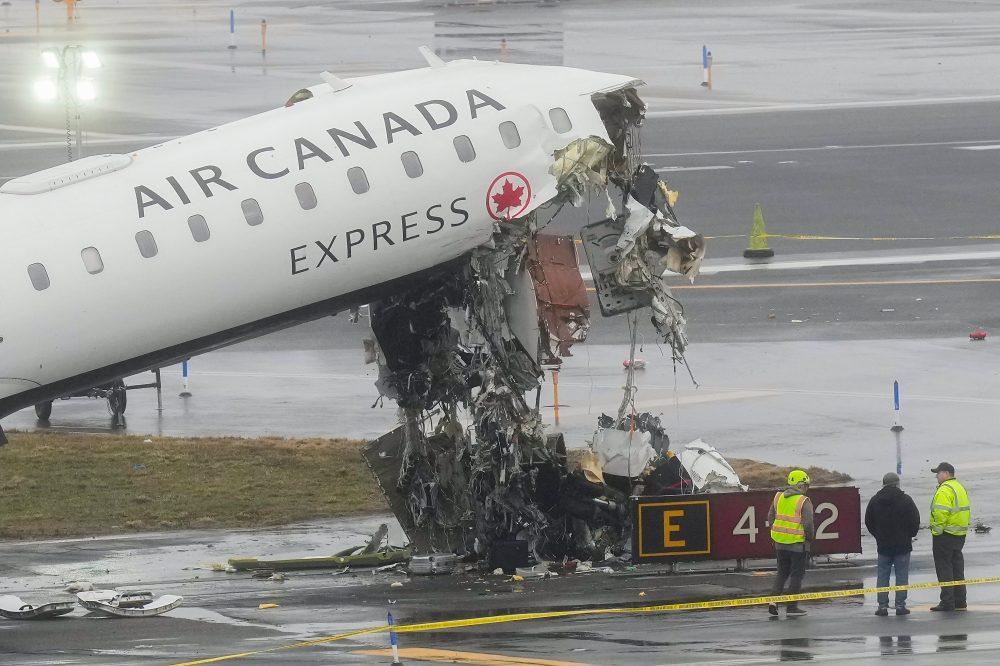

NEW YORK — Federal investigators revealed Thursday that a firefighter involved in last month’s deadly runway collision at LaGuardia Airport initially couldn’t tell who air traffic control was warning when they shouted “stop, stop, stop” over the radio.
The National Transportation Safety Board released preliminary findings showing that safety systems failed to prevent the March 22 crash that claimed the lives of both pilots aboard an Air Canada regional jet. The airport’s crash prevention technology didn’t sound any alarms in the control tower, and runway crossing lights remained illuminated until just three seconds before impact, according to the report.
The fire truck’s turret operator told investigators that after hearing the controller’s first warning, he then heard “Truck 1, stop, stop, stop” and understood the command was meant for them. However, by that point their vehicle had already entered the runway as Air Canada Express Flight 8646 was touching down and racing toward them.
According to the turret operator’s account to investigators, he spotted the aircraft’s lights on the runway as their truck made a left turn onto the tarmac.
The urgent warnings came after controllers had given the fire truck permission to cross the runway just 12 seconds before the incoming plane made contact with the ground.
The CRJ900 aircraft arriving from Montreal was carrying more than 70 passengers and crew. Pilots Antoine Forest, 24, and Mackenzie Gunther, 30, died in the collision. Approximately 40 individuals, including the fire truck’s two occupants, required hospital treatment.
One flight attendant, still secured in her seat, survived despite being ejected onto the runway surface.
The fire truck was at the front of a six-vehicle emergency response team that included four fire engines, a boarding stairs truck, and a police car. They were responding to reports of a concerning odor in the passenger cabin of a departing United Airlines flight.
LaGuardia’s control tower was experiencing unusually heavy traffic that evening due to flight delays that more than doubled the scheduled arrivals and departures after 10 p.m., based on information from aviation data company Cirium.
Aircraft were arriving every few minutes, with twelve flights landing between 11 p.m. and the time of the collision less than 40 minutes later. Simultaneously, controllers were managing the emergency response to the cabin odor that was causing flight attendants to feel sick.
LaGuardia operates one of 35 sophisticated surface monitoring systems at major U.S. airports designed to prevent dangerous runway intrusions and collisions. These systems provide controllers with tower displays showing real-time positions of all aircraft and ground vehicles.
The ASDE-X system failed to function properly because the fire truck lacked the required transponder equipment, investigators determined. The close grouping of multiple emergency vehicles also prevented the system from activating its warning alerts.
Air traffic control recordings show Flight 8646 received landing clearance for Runway 4 at 11:35 p.m.
Approximately two minutes afterward — and 25 seconds before the collision — the fire crew requested permission to cross that same runway, which lay between the airport’s fire station and the United Airlines aircraft’s parking position.
Five seconds later, as Flight 8646 approached the runway at slightly over 100 feet altitude, controllers authorized the fire truck to proceed across.
Then, with just nine seconds remaining before impact, the controller urgently radioed: “Stop, stop, stop, stop. Truck 1. Stop, stop, stop, stop.” The aircraft’s wheels touched down one second later.
This marks LaGuardia’s first fatal crash in 34 years.