
A preliminary investigation report released Friday by the National Transportation Safety Board reveals that both engines on a small business jet lost power before the aircraft crashed onto a Texas highway in June, leaving the flight crew with no way to reach a nearby airport.
Before the crash, the pilots had searched for a field or other flat surface to land on, but air traffic controllers told them no such options were available in the area. The accident claimed one life and left six others injured.
The NTSB report indicates that early in the flight, the crew noticed an unfamiliar “unusual vibration” they had never encountered before. The aircraft had taken off from the Mexican resort city of San José del Cabo, bound for Austin. After consulting with staff at NetJets, the company that operated the jet, the crew determined it was safe to continue to their destination.
As the jet neared the U.S.-Mexico border, warning messages began appearing in the cockpit indicating low fuel pressure. Additional alerts followed, and the crew declared an emergency.
The flight crew reported a generator failure and “multiple other failures” — including a “fuel level low” warning — to Houston air traffic controllers, and requested permission to divert to Laredo International Airport. That request was approved, but as the jet made its final approach, the right engine “flamed out,” and the left engine followed just moments later.
Surveillance footage captured “two instances of fire flaring up around the airplane as it was on final approach,” according to the report.
A pilot radioed the Laredo air traffic control tower asking whether there was an open field to the right of their position. A controller responded that there was not. When the pilot asked again about any open area to the right, the controller replied, “It’s just going to be the main highway, and that’s just about it.”
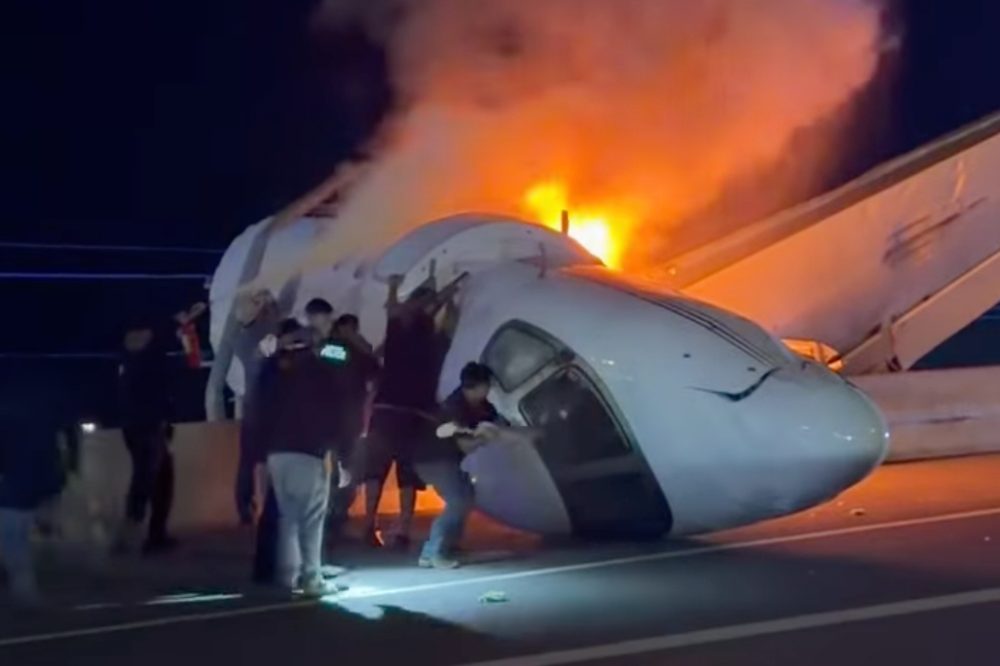
With no other options, the flight crew guided the plane onto the highway, touching down roughly one mile — about 1.6 kilometers — southeast of the airport. Upon landing, the jet “sheared off several light poles,” struck a vehicle, and came to rest straddling the edge of an overpass with the main cabin exit door “oriented upward.” That door was eventually forced open, and five people were able to get out.
The fiery scene near the Mexican border drew bystanders rushing from their vehicles to help police pull passengers and crew from the burning wreckage. Video from the chaotic scene showed one person attempting to break the cockpit glass with a sledgehammer, while others used improvised tools to pry open the plane’s door. Local officials reported that a firefighter entered the smoke-filled aircraft to pull out one remaining person after the others had already escaped. The NTSB report noted that the jet “sustained substantial damage” to its fuselage, both wings, and its tail.
According to the Laredo Police Department, two pilots and three teenagers survived the crash and were later discharged from the hospital. A dog that was also on board suffered smoke inhalation but was expected to recover, according to Jose Baeza, an investigator with the police department, who spoke in June.
The crash claimed the life of Joshua Baer, a prominent figure in Texas’ technology and startup communities.