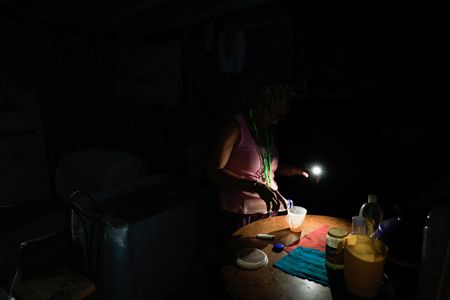

HAVANA — Cuba’s entire national power grid went dark again on Friday, the second time this week the island has suffered a complete nationwide blackout and the fourth total outage of the year so far.
Cuba’s energy ministry announced via social media that recovery efforts were underway, stating, “Protocols are being activated to begin the recovery process,” as grid operator UNE worked to restore electricity to the island’s millions of residents.
The latest collapse came just days after a prior nationwide outage struck on Monday. Authorities had managed to bring most of the grid back online by late Tuesday, but large portions of the country — including the city of Santiago de Cuba — remained without power due to critical fuel shortages.
Yailin Fis Garcia, a 26-year-old woman, stood outside her unlit cafe and pizza restaurant in central Havana with her 5-month-old baby resting on her shoulder. She and her family had opened La Criolla cafe only a few weeks earlier, and Friday’s blackout was already the second total grid failure since they launched the business.
“All the food spoils, which is an economic hit,” she said.
Despite the hardship, she acknowledged things could be even worse. Her neighborhood on the edge of the capital has been experiencing such extreme energy shortages that for the past month, her home has only had electricity for one or two hours each day.
U.S. President Donald Trump imposed an oil blockade on Cuba after Washington removed Venezuelan President Nicolas Maduro from power on January 3. Venezuela had been Cuba’s main supplier of fuel, and additional U.S. pressure subsequently led Mexico to cut off its own oil shipments to the island as well.
The repeated power failures have intensified social unrest, triggering scattered pot-banging protests in Havana following Monday’s blackout. The demonstrations brought to mind the widespread protests of July 11, 2021, when thousands of Cubans flooded the streets in the largest anti-government uprising the communist-governed island had seen in decades.
Cuba’s government points to the longstanding U.S. trade embargo as the root cause of its crumbling infrastructure, while Washington counters that the blackouts are the result of poor management of Cuba’s state-controlled economy.
The United States has openly declared its intention to bring down Cuba’s government, calling for democratic elections and the freeing of individuals it considers political prisoners.
At a United Nations General Assembly debate held Tuesday, U.S. Ambassador to the U.N. Michael Waltz placed the responsibility squarely on Cuban authorities, declaring, “Change your ways and turn the lights back on for your people.”
However, the overwhelming majority of nations that addressed the debate urged the United States to lift the blockade and roll back the economic sanctions that have severely weakened Cuba’s economy.
Cuba’s Minister of Foreign Affairs, Bruno Rodríguez Parrilla, condemned the U.S. fuel embargo and economic sanctions as a “systematic violation of the human rights of an entire people in an act of collective punishment,” and described U.S. policy toward the island as “cruel and ruthless.”