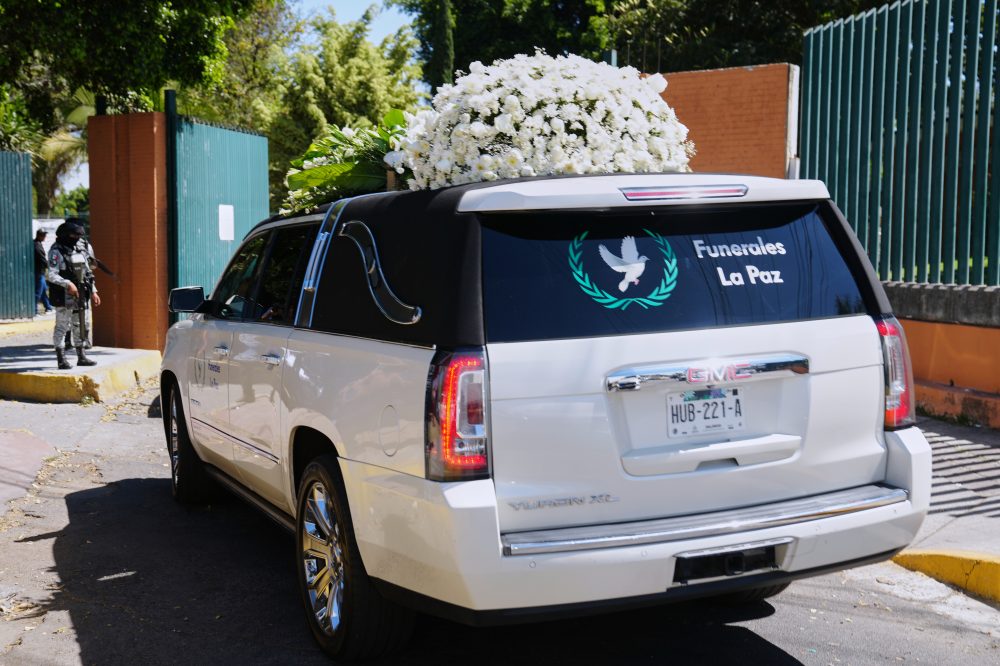

GUADALAJARA, Mexico — Mexican authorities conducted the burial of one of the country’s most notorious drug kingpins Monday, as Nemesio Oseguera Cervantes, better known as ‘El Mencho,’ was laid to rest in an elaborate gleaming gold coffin surrounded by massive floral arrangements and heavy military security.
A federal source verified that the head of the Jalisco New Generation Cartel was interred at a burial ground in Zapopan, located on the outskirts of Guadalajara, Mexico’s second most populous city. The funeral procession drew dozens of attendees, with many holding black umbrellas despite clear skies while a traditional banda ensemble performed regional Mexican music.
The source speaking about the burial site asked to remain unnamed as they lacked permission to discuss the matter publicly. Mexico’s Attorney General’s Office refused to verify where El Mencho was buried, citing safety concerns.
Enhanced security measures had been in place since Sunday at a mortuary where massive floral displays began arriving without identification. Several arrangements featured rooster imagery made from flowers, referencing Oseguera Cervantes’ nickname as the ‘Lord of the Roosters.’
Mexican military forces fatally shot Oseguera Cervantes just over a week ago during an operation to apprehend him. According to his death certificate reviewed by The Associated Press, he succumbed to numerous gunshot injuries.
His death triggered widespread violence spanning approximately 20 states. The death certificate aligns with Defense Secretary Ricardo Trevilla’s account of the capture mission, in which he stated that the cartel boss and two security personnel sustained severe injuries during a firefight with troops near a residence in Tapalpa, Jalisco. All three perished while being transported to medical facilities.
The official document detailed that Oseguera Cervantes sustained gunshot trauma to his torso, stomach, and lower extremities.
Following his death, his remains were transported to Mexico City for forensic examination before being released to relatives on Saturday, according to a brief Attorney General’s Office announcement.
The death certificate also indicates that Oseguera Cervantes was designated for burial, which is typical protocol in violent death cases to preserve potential forensic evidence for future investigations. The paperwork did not specify the intended burial site.
Law enforcement’s security worries about the burial location are justified. The cartel leader’s death prompted revenge attacks by the organization across multiple states. Over 70 individuals lost their lives between the initial military action and subsequent violence. Officials report that enforcement operations targeting other senior cartel members remain ongoing.
Mexican drug lord burials are traditionally shrouded in secrecy, which their followers exploit to build legendary status around these figures. Within hours of El Mencho’s death, songwriters had already composed ballads called narcocorridos commemorating his demise.
In Culiacan, located in adjacent Sinaloa state and headquarters of the similarly named cartel, a graveyard is famous for its opulent tombs and monuments housing former drug bosses including Ignacio Coronel — a former El Mencho partner — and Arturo Beltrán Leyva.
One drug leader, Nazario Moreno of the violent, religiously-themed Knights Templar cartel, gained notoriety for being reportedly killed twice — first in 2010, then actually eliminated in 2014.
Some remains vanish entirely, such as Heriberto Lazcano, the notorious Zetas leader whose corpse was taken in 2012. Others meet unusual ends, like Amado Carrillo Fuentes, the ‘Lord of the Skies,’ who perished during failed cosmetic surgery.