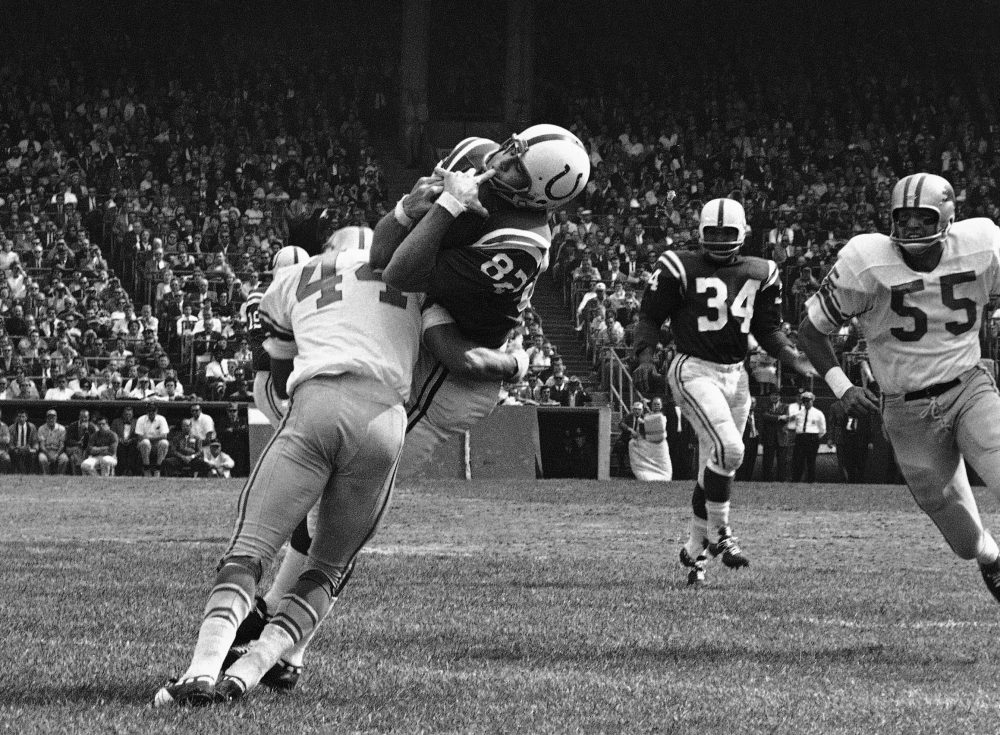

Raymond Berry, the Pro Football Hall of Fame wide receiver who formed one of the NFL’s most legendary partnerships with Baltimore quarterback Johnny Unitas and guided the Colts to victory in the famous 1958 championship game, has passed away at age 93.
The Pro Football Hall of Fame announced Monday that Berry died May 25. According to his family, Berry passed away peacefully at his Tennessee home in Murfreesboro, with loved ones by his side, including Sally, his wife of 65 years.
Indianapolis Colts owner Carlie Irsay-Gordon praised Berry’s transformative impact on the sport. “In NFL history, there are only a handful of players who we can say truly changed the sport. Raymond Berry is one of the few names on that list,” Irsay-Gordon stated. “As a player during a historic era of Colts football, Raymond redefined the standard for what a wide receiver could and should be. … Simply put, not only was Raymond Berry one the greatest players in the history of the Colts, but he was one of the most influential and foundational players of the modern NFL.”
Selected in the 20th round from SMU in 1954, this Texas-born player exemplified dedication and perseverance. Despite having modest speed, uneven leg lengths, back problems, vision issues, and large feet that earned him the high school nickname “Skis,” Berry transformed himself into a star through relentless preparation and study. His training methods included using Silly Putty for finger strengthening and recreating complete games during practice sessions.
Berry established himself as one of the most dependable pass catchers in NFL history, with an exceptional record for holding onto the ball and only two career fumbles according to Pro Football Reference. He created 88 different pass routes to find openings, displaying such intense dedication that his coach, Weeb Ewbank, sometimes had to step in.
“One of his drills was to throw nothing but bad balls to him,” Ewbank shared with the Los Angeles Times in 1986. “I used to have to run John (Unitas) off — ‘John, you’ve had enough throwing today’ — and he’d say, ‘Yeah, talk to that guy out there.’”
During his 13-year career, Berry hauled in a then-record 631 receptions (Jerry Rice now holds the all-time mark with 1,549) and scored 68 touchdowns. He topped the NFL in catches three times and earned six Pro Bowl selections. As a cornerstone of one of the league’s premier offenses alongside Unitas, running back Lenny Moore and offensive lineman Jim Parker, Berry captured championships in 1958 and 1959 and reached the finals in 1964.
The NFL inducted Berry into its Hall of Fame in 1973, and he earned spots on both the league’s 50th and 75th anniversary all-time teams. The Colts honored him by retiring his jersey number 82, while SMU retired his college number 87.
Berry delivered his finest performance during one of the NFL’s most memorable moments: the 1958 championship against the Giants at Yankee Stadium, an overtime thriller many call “The Greatest Game Ever Played.” This nationally broadcast contest is frequently mentioned as the catalyst for the league’s explosive growth in subsequent decades.
Facing the NFL’s most formidable defense, Berry hauled in 12 catches for 178 yards and a touchdown, including three straight receptions during the 86-yard march that forced a 17-17 tie in regulation, plus two key catches in the 80-yard overtime drive that secured a 23-17 victory. This first overtime championship game helped establish Unitas as a household name while showcasing Berry as his perfect receiving target.
“We worked and got to know each other and developed timing you just can’t get any other way,” Berry later explained to the Sports & Torts radio show. “He (Unitas) knew I was going to be there when I was supposed to be there and he knew I was going to catch it.”
Following his 1967 retirement as a player, Berry served as a receivers coach for the Dallas Cowboys, Cleveland Browns and New England Patriots before becoming New England’s head coach from 1984-89. His Patriots record stood at 48-39, highlighted by an 11-5 campaign in 1985 and the franchise’s first Super Bowl appearance. However, the Chicago Bears dominated that championship game 46-10.
“Raymond Berry holds a special place in Patriots history,” team owner Robert Kraft commented. “He led our franchise to its first Super Bowl appearance following a remarkable playoff run, a milestone that was the greatest achievement in team history at the time.”
Kraft noted that Berry created a lasting influence on both the Patriots organization and the entire NFL.
Following the Super Bowl loss to Chicago, the Boston Globe published revelations about drug issues affecting several New England players. Berry had cooperated with the Globe’s investigation and advocated for team drug testing, which faced strong opposition from the NFL players union.
Berry’s strong stance against substance abuse stemmed from personal experience, as this deeply religious man who avoided alcohol and tobacco had witnessed his former Colts teammate, All-Pro defensive tackle Gene “Big Daddy” Lipscomb, battle addiction.
“They didn’t help him, they just cut him,” Berry told The Patriot Ledger in 1986. “Three years later, he was dead.”
In 1960, Berry wed fellow Texan Sally Crook, and the couple raised three children together.
Born in Corpus Christi in 1933, Berry attributed part of his success to his high school coach and father, Mark Raymond Berry, who taught fundamental football skills despite limited playing time for his son. After spending one year at Schreiner College in Kerrville, he transferred to SMU, where a crucial game featuring two fumbles motivated him to eliminate such mistakes in professional football.
Berry managed just 13 receptions during his rookie season with Baltimore, but the following year brought a pivotal change when the team signed a free agent quarterback released by the Pittsburgh Steelers — Unitas. The pair quickly began working together in practice.
“I didn’t know my butt from first base about how to run pass routes,” Berry admitted to Sports & Torts. “If you saw both of us in training camp in 1956, you may have gone away sobbing. We were two pitiful football players, good grief.”